India-UK FTA takes effect: 96.8% UK tariff lines cut, 75,000 workers to gain
Synopsis
The India-UK FTA is not just a tariff deal — it is a structural reset. With the UK eliminating duties on 96.8% of tariff lines immediately and a Double Contributions Convention that could save over 75,000 Indian workers from paying double social security, this agreement reaches well beyond goods trade into the daily economics of India's skilled diaspora.
Key Takeaways
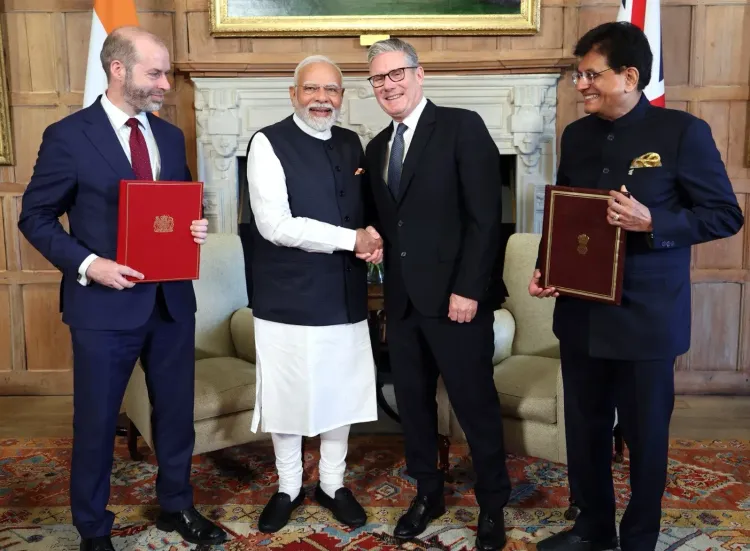
The India-UK Free Trade Agreement came into force on 14 July 2025 , described as a 'gold standard' FTA by Commerce Secretary Rajesh Agrawal .
The UK will immediately eliminate tariffs on 96.8% of tariff lines, covering 97.7% of bilateral trade value.
India will eliminate tariffs on 30.3% of trade value immediately, with 47% more phased out over time — covering 89.5% of tariff lines in total.
Sectors benefiting include textiles (duties up to 12% eliminated), seafood (full duty-free access), and farmers gaining premium UK market access.
The Double Contributions Convention (DCC) will benefit over 75,000 Indian workers and 900+ employers by ending double social security payments for five years.
Sensitive sectors including dairy, gold, smartphones, and cereals are protected under the agreement.
The India-UK Free Trade Agreement (FTA) came into force on Wednesday, 14 July, marking a landmark shift in bilateral trade ties between the world's fifth and sixth largest economies. Commerce Secretary Rajesh Agrawal described the pact as a 'gold standard' FTA, citing its sweeping sectoral coverage that spans farmers, seafood exporters, textile manufacturers, and skilled workers.
Key Provisions of the Agreement
Under the deal, the UK will immediately eliminate tariffs on 96.8 per cent of its tariff lines, covering 97.7 per cent of bilateral trade value. An additional 2 per cent of tariff lines — accounting for 1.8 per cent of trade value — will see reduced tariffs applied under quota arrangements.
India, in turn, will immediately eliminate tariffs on 30.3 per cent of trade value, with a further 47 per cent phased out over time. Quota-based reduced tariffs will apply to 12.1 per cent of trade value. In aggregate, the agreement covers 89.5 per cent of tariff lines and 89.4 per cent of India's trade value with the UK.
Sectors That Stand to Gain
Indian farmers will gain enhanced access to the premium UK agricultural market, while seafood exporters will benefit from complete duty-free access. Labour-intensive industries such as textiles stand to gain significantly, with duties of up to 12 per cent being eliminated under the pact. Agrawal called the agreement 'one of the most ambitious and aspirational FTAs' India has operationalised to date.
The Commerce Ministry confirmed that all domestic implementation processes have been completed. Symbolic flag-off ceremonies for export consignments are scheduled for 15 July from multiple locations across the country.
Non-Tariff Barriers and Sensitive Sectors
The FTA also addresses non-tariff barriers, including Sanitary and Phytosanitary Measures (SPS) and Technical Barriers to Trade (TBT), to prevent these from becoming unjustified trade restrictions, according to Agrawal. Sensitive Indian sectors — including dairy, cereals, pulses, vegetables, gold and jewellery, smartphones, and critical polymers — have been explicitly protected under the agreement.
Double Contributions Convention: A Game-Changer for Workers
A key feature of the deal is the reciprocal Double Contributions Convention (DCC), which Agrawal described as a 'game-changer' for India's services sector and skilled workforce. Currently, Indian employees and their employers contribute around 25 per cent of salary to the UK's national insurance system — contributions Agrawal characterised as 'sunk costs' since workers are unable to draw corresponding benefits.
Under the DCC, workers paying social security in India will be exempt from paying it in the UK for a period of five years. This provision is expected to benefit more than 75,000 Indian workers and over 900 employers.
With implementation now underway, industry bodies and exporters will be watching closely to see how quickly the tariff relief translates into measurable trade gains on the ground.
Point of View
But the real test lies in utilisation rates — how many Indian exporters actually claim the preferential tariffs. Past FTAs with ASEAN and South Korea saw India run persistent deficits partly because domestic exporters lacked the capacity to meet rules-of-origin requirements. The textile and seafood provisions are genuinely significant, but the Double Contributions Convention may be the deal's most underreported win: eliminating a de facto 25% tax on Indian workers in the UK is a direct income transfer that no headline tariff number captures. Whether this FTA shifts India's export trajectory or becomes another underutilised agreement depends on how aggressively the Commerce Ministry drives awareness and compliance among small and mid-sized exporters.
NationPress
14 Jul 2026
Frequently Asked Questions
What is the India-UK Free Trade Agreement?
The India-UK Free Trade Agreement (FTA) is a comprehensive bilateral trade pact that came into force on 14 July 2025. It covers goods, services, and labour mobility, with the UK eliminating tariffs on 96.8% of its tariff lines immediately and India phasing out duties on 89.5% of tariff lines over time.
Which Indian sectors benefit most from the India-UK FTA?
Textiles, seafood, and agriculture stand to gain the most. Textile exporters will see duties of up to 12% eliminated, seafood exporters gain complete duty-free access, and Indian farmers will have greater access to the UK's premium agricultural market. Sensitive sectors such as dairy, gold, smartphones, and cereals are protected.
What is the Double Contributions Convention in the India-UK FTA?
The Double Contributions Convention (DCC) ensures that Indian workers employed in the UK do not pay social security contributions in both countries simultaneously. If a worker is already contributing to social security in India, they will be exempt from UK national insurance payments for five years. This is expected to benefit over 75,000 Indian workers and more than 900 employers.
How much of UK tariff lines are eliminated under the FTA?
The UK will immediately eliminate tariffs on 96.8% of its tariff lines, covering 97.7% of bilateral trade value. An additional 2% of tariff lines will see quota-based reduced tariffs applied.
When will export consignments under the India-UK FTA begin?
The Commerce Ministry has scheduled symbolic flag-off ceremonies for export consignments on 15 July from multiple locations across India, marking the operational start of trade flows under the new preferential tariff regime.