Odisha CMO Highlights Two Years of Mining Reforms
Synopsis
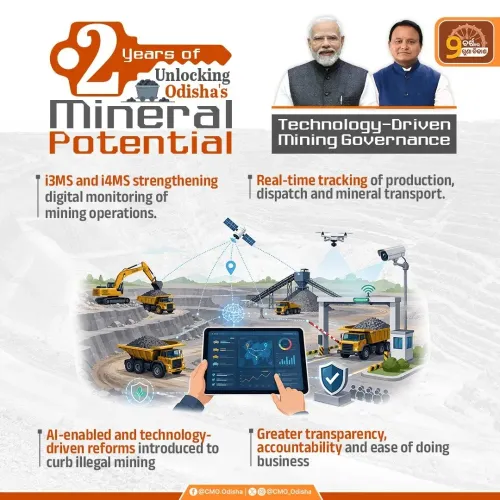
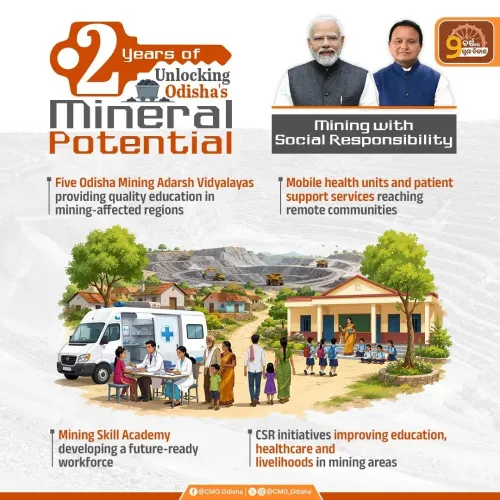
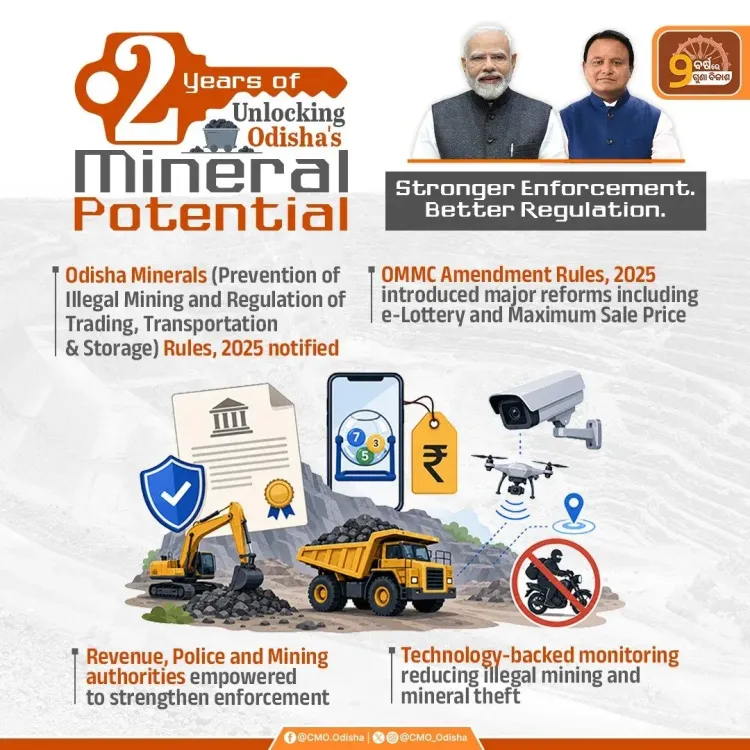
The Chief Minister's Office of Odisha marked two years of the state government on 14 July 2026 by highlighting mining sector reforms, citing transparent governance, progressive regulations, stronger enforcement and improved inter-departmental coordination as tools to promote responsible mining and curb illegal activity.
Key Takeaways
The Chief Minister's Office of Odisha posted on 14 July 2026 marking two years of the state government, with mining governance as a headline achievement.
The CMO cited 'transparent governance', 'progressive regulations', 'stronger enforcement' and 'improved inter-departmental coordination' as the pillars of its mining reforms.
Odisha is one of India's most mineral-rich states, with major deposits of iron ore , bauxite and manganese .
The reforms align with the national framework established by the MMDR Act amendment of 2015 , which mandated e-auctions for mining leases and stricter environmental safeguards.
Key stakeholders include mining lease holders , tribal communities in mineral-bearing districts, and the state revenue department .
Independent verification of reform outcomes will depend on publication of auction data , illegal mining case records, and revenue collection figures .
The Chief Minister's Office of Odisha on Tuesday, 14 July 2026 highlighted the state's mining governance overhaul, stating that transparent governance has been central to Odisha's mining reforms over the past two years, with progressive regulations, stronger enforcement and improved inter-departmental coordination driving responsible mining and curbing illegal activity.
Context
The post, shared under the hashtags #2YearsofLokankaSarakar and #BikasharaDharaOdishaSara, marks a two-year milestone of the current Odisha government. The Chief Minister's Office stated that the administration has prioritised 'transparent governance' as the cornerstone of its approach to the mining sector, a sector that is central to the state's fiscal health given Odisha's vast deposits of iron ore, bauxite and manganese.
Policy Backdrop
The reforms cited by the CMO sit within a broader national framework shaped by the Mines and Minerals (Development and Regulation) Act, amended in 2015 to replace discretionary lease grants with mandatory e-auctions and tighter environmental safeguards. Odisha, one of India's most mineral-rich states, was among those directed by the Supreme Court in the 2010s to recover dues and regularise leases following findings of large-scale illegal extraction. The state's current emphasis on inter-departmental coordination and enforcement aligns with the post-2015 national push to formalise the sector and close regulatory gaps that had accumulated over earlier decades.
Several mineral-rich states across India have adopted digital tracking mechanisms and auction-based allocations to raise revenues while addressing environmental and lease compliance issues. Odisha's stated approach follows this national trend, seeking to balance extraction activity with the compliance architecture introduced through central and state-level regulatory changes.
Stakeholders and Impact
The primary stakeholders in Odisha's mining sector include mining lease holders, tribal communities in mineral-bearing districts, and the state revenue department, which depends significantly on mining royalties for public expenditure. Stronger enforcement against illegal mining directly affects tribal and forest communities who often bear the environmental costs of unregulated extraction. Improved inter-departmental coordination — between revenue, forest, environment and mines departments — is seen as a key mechanism for reducing regulatory arbitrage that had historically enabled lease irregularities.
For lease holders operating within the law, a more predictable and transparent regulatory environment reduces compliance uncertainty. For the state exchequer, tighter oversight of extraction volumes and royalty payments has the potential to improve revenue realisation from the sector.
What's Next
The government's two-year milestone communication signals that mining governance will remain a visible part of its public narrative. Analysts and civil society groups tracking the sector will look to formal state reports on mining lease auction outcomes, illegal mining cases registered and resolved, and revenue collection figures as measurable indicators of whether the stated reforms have translated into on-ground change. The publication of such data would allow independent assessment of the claims made in the CMO's communication.
As Odisha approaches the next phase of its mining policy cycle, the balance between accelerating extraction for revenue and ensuring environmental and community safeguards will continue to define the governance challenge at the heart of the sector.
Point of View
Deploying the mining sector — historically a source of both revenue and controversy in Odisha — as proof of administrative competence. By anchoring the message in process language ('inter-departmental coordination', 'progressive regulations') rather than specific outcomes, the government signals intent while leaving room for contested interpretations of on-ground impact. This is consistent with a broader pattern among mineral-rich state governments of using reform rhetoric at political milestones ahead of the harder task of publishing auditable data. The real test of the two-year narrative will come when lease auction results and illegal mining enforcement statistics are placed in the public domain for independent scrutiny.
NationPress
14 Jul 2026
Frequently Asked Questions
What mining reforms has the Odisha government introduced in the last two years?
The Chief Minister's Office of Odisha stated on 14 July 2026 that the government has implemented progressive regulations, stronger enforcement mechanisms and improved inter-departmental coordination over the past two years to promote responsible mining and curb illegal activity. Specific regulations for this period have not been independently verified.
What is the MMDR Act and how does it relate to Odisha's mining sector?
The Mines and Minerals (Development and Regulation) Act, amended in 2015, replaced discretionary mining lease grants with mandatory e-auctions and introduced stricter environmental safeguards. Odisha, as a major mineral-producing state, operates its mining sector within this central framework.
What minerals does Odisha produce and why is mining important to the state?
Odisha holds major deposits of iron ore, bauxite and manganese, making it one of India's most mineral-rich states. Mining royalties contribute significantly to the state's revenue, which funds public expenditure across sectors.
How does illegal mining affect tribal communities in Odisha?
Tribal communities living in mineral-bearing districts often bear the direct environmental costs of unregulated extraction, including land degradation and water contamination. Stronger enforcement against illegal mining is intended to reduce these community-level impacts.
How can citizens verify Odisha's mining reform claims?
Independent verification would require the state government to publish data on mining lease auction outcomes, the number of illegal mining cases registered and resolved, and annual revenue collection from the sector. Civil society groups and policy researchers track these indicators to assess on-ground progress.