India's growth powered by agriculture and AI, experts say at Summer Davos
Synopsis
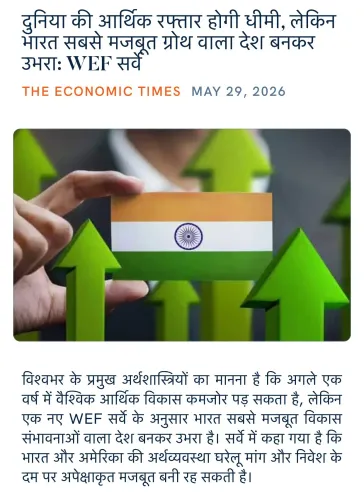
At Summer Davos in Dalian, two distinct voices — a WEF managing director and a Padma Shri soil scientist — converged on a single message: India's path to becoming the world's third-largest economy runs through its farms as much as its tech hubs. The AI-agriculture link, often overlooked in macro growth narratives, emerged as a defining theme.
Key Takeaways
Mirek Dušek , Managing Director of the World Economic Forum , called India one of the world's most important and fastest-growing economies at Summer Davos on 23 June .
Rattan Lal , Padma Shri awardee and soil scientist at The Ohio State University , said agriculture will be a key driver as India targets the world's third-largest economy rank.
AI and digital tools can make soil testing faster, more affordable, and more accessible for Indian farmers, according to Prof.
The WEF Annual Meeting of the New Champions runs from 23–25 June in Dalian, China .
Emerging technologies including artificial intelligence , advanced manufacturing, and digital platforms were highlighted as key productivity drivers for global growth.
India is poised to sustain its position as one of the world's fastest-growing major economies, with agriculture and emerging technologies identified as twin engines of future expansion, experts said on Tuesday, 23 June at the World Economic Forum's Annual Meeting of the New Champions — commonly known as Summer Davos — in Dalian, China.
WEF's Confidence in India's Trajectory
Mirek Dušek, Managing Director of the World Economic Forum, described India as one of the most consequential economies in the current global landscape. 'India is making a significant contribution to global growth, and we remain optimistic about its future. We expect the Indian economy to continue growing strongly in the years ahead,' Dušek said.
He noted that the Summer Davos gathering has convened innovators, technology leaders, policymakers, and business executives from across the world to foster collaboration and develop solutions to pressing global challenges. Dušek also underscored the transformative potential of artificial intelligence, advanced manufacturing, and digital platforms in driving productivity and sustaining global economic momentum.
Agriculture as a Pillar of India's Rise
Prof. Rattan Lal, Padma Shri awardee and distinguished university professor of soil science at The Ohio State University, argued that agriculture will be central to India's growth story as the country accelerates toward becoming the world's third-largest economy. 'India is on track to become the world's third-largest economy, and agriculture will play a key role in that growth,' Lal said.
Prof. Lal emphasised the critical importance of improving soil health and adopting sustainable land management practices to boost agricultural productivity. He stressed that without addressing soil degradation, gains in other sectors risk being undermined by food security pressures.
Technology Transforming the Farm
Beyond conventional methods, Prof. Lal highlighted how artificial intelligence and digital tools can fundamentally reshape Indian agriculture. AI-driven soil testing, he said, can make the process faster, more affordable, and more accessible for smallholder farmers — enabling data-informed decisions that improve crop yields and reduce input waste.
This comes amid a broader global push to integrate precision agriculture into developing economies, where the gap between available technology and farmer access remains wide. India, with its 140 crore-plus population and a farming community that still accounts for a significant share of the workforce, stands to gain disproportionately from such tools.
About Summer Davos 2025
The Annual Meeting of the New Champions commenced on 23 June and is scheduled to conclude on 25 June in Dalian. The forum brings together leaders from business, government, academia, and international organisations to deliberate on innovation, entrepreneurship, and economic development. India's prominence at this year's discussions reflects its growing weight in shaping the global economic conversation.
As India eyes the third-largest economy milestone, the convergence of agricultural modernisation and technology adoption will likely determine whether that growth is broad-based or concentrated — a question that experts at Dalian appear keen to answer.
Point of View
But the specific application to soil testing and smallholder decision-making is where the real policy gap lies. India has ambitious digital public infrastructure; whether it reaches the last-mile farmer before the next climate shock is the harder question that Summer Davos did not fully answer.
NationPress
23 Jun 2026
Frequently Asked Questions
What did experts say about India's economy at Summer Davos 2025?
Experts at the World Economic Forum's Annual Meeting of the New Champions in Dalian on 23 June described India as one of the world's most important and fastest-growing economies. WEF Managing Director Mirek Dušek said India is making a significant contribution to global growth and expressed confidence in its continued strong performance.
What role will agriculture play in India's economic growth?
Prof. Rattan Lal, a Padma Shri-winning soil scientist at The Ohio State University, said agriculture will be a key pillar as India moves toward becoming the world's third-largest economy. He stressed the need to improve soil health and adopt sustainable land management to sustain agricultural productivity.
How can artificial intelligence help Indian farmers?
According to Prof. Rattan Lal, AI and digital tools can make soil testing faster, more affordable, and more accessible for farmers. This enables data-driven decisions that can improve crop productivity and reduce input costs for smallholder farmers.
What is Summer Davos and when is it held?
Summer Davos is the informal name for the World Economic Forum's Annual Meeting of the New Champions, held this year in Dalian, China from 23 to 25 June. It brings together business leaders, policymakers, academics, and international organisations to discuss innovation, entrepreneurship, and global economic development.
Who is Prof. Rattan Lal and why is his view significant?
Prof. Rattan Lal is a Padma Shri awardee and distinguished university professor of soil science at The Ohio State University, recognised globally for his work on sustainable agriculture. His emphasis on soil health and AI-enabled farming at a major global forum highlights the growing intersection of climate resilience and technology in India's growth strategy.