India's PPP economy at $20 trillion, third largest globally: Piyush Goyal
Synopsis
India may be a $4 trillion economy in nominal terms, but Commerce Minister Piyush Goyal put a starkly different figure on the table at the PAFI Annual Forum 2026 — $20 trillion on a PPP basis, third largest in the world. With trade talks running across four continents and a $30 trillion long-term target, the minister's framing signals a deliberate shift in how India pitches itself at the negotiating table.
Key Takeaways
Commerce Minister Piyush Goyal said India's PPP-adjusted economy is approximately $20 trillion , the third largest globally, at the 13th PAFI Annual Forum 2026 on 25 September 2026 .
India's nominal GDP stands at around $4 trillion ; the PPP gap reflects lower domestic price levels compared to advanced economies.
India is in active trade negotiations with Canada , Chile , Peru , SACU , Mexico , Maldives , Russia , GCC , Israel , Eurasia , and Central Asia .
India's semiconductor consumption is projected to exceed $150 billion annually within five years.
India is the third country to have a rocket launched into space by the private sector, per Goyal.
The minister cited the $30 trillion economy target as the frame for all current trade and partnership negotiations.
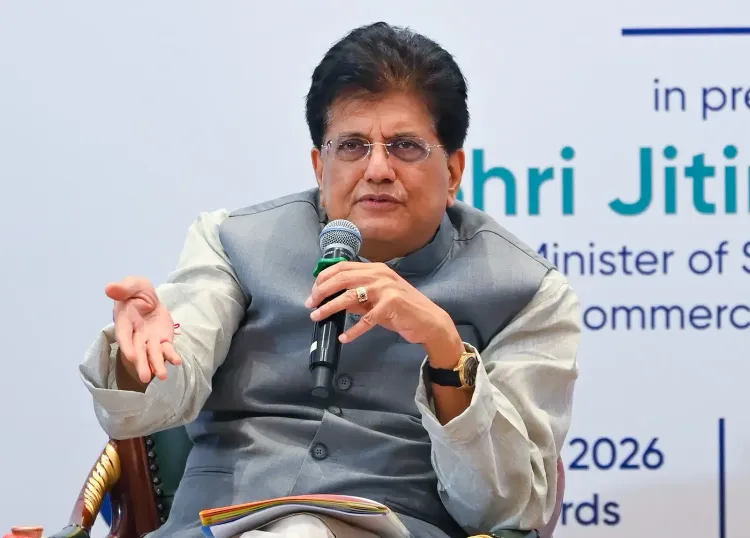
Commerce and Industry Minister Piyush Goyal on 25 September 2026 said that while India engages with the world as a $4 trillion economy in nominal terms, its economy on a purchasing power parity (PPP) basis stands at approximately $20 trillion, making it the third largest in the world by that measure. Goyal made the remarks at the 13th PAFI Annual Forum 2026 in New Delhi, framing India's trade negotiations against the backdrop of its expanding economic footprint.
Understanding the PPP Gap
Purchasing power parities are currency conversion rates designed to equalise the buying power of different currencies by stripping out price-level differences between countries. The gap between India's nominal GDP of roughly $4 trillion and its PPP-adjusted $20 trillion reflects the lower cost of goods and services within the country compared to advanced economies.
Goyal indicated that this gap would narrow as India advances toward its long-term ambition of becoming a $30 trillion economy. He said the country is already negotiating trade and economic partnerships from the vantage point of an economy on that trajectory.
Trade Negotiations in Progress
India is currently engaged in trade and partnership talks with a broad set of economies and blocs, including Canada, Chile, Peru, the Southern African Customs Union (SACU), Mexico, Maldives, Eurasia, Central Asia, Russia, the Gulf Cooperation Council (GCC), and Israel. These engagements are aimed at deepening India's integration into global value chains and supply chains and facilitating seamless movement of goods, services, tourists, educational institutions, and sports.
The minister highlighted that India's approach to trade negotiations reflects the country's shifting economic position and its objective of stronger integration with global markets — a posture that has evolved significantly over the past decade.
Semiconductors, AI, and Deep-Tech Ambitions
Goyal also flagged a set of forward-looking economic priorities. He noted that India's semiconductor consumption demand is expected to surpass $150 billion annually within the next five years. On the technology front, he underscored the need to build capabilities across the artificial intelligence (AI) ecosystem, including large language models and agentic models, with a focus on nurturing Indian startups in the deep-tech space.
Notably, the minister highlighted India's emergence as the third country to have a rocket launched into space by the private sector — a milestone that he cited as evidence of India's growing innovation credentials.
Youth and the Startup Ecosystem
Goyal expressed confidence in India's young population, describing them as increasingly informed about global developments and opportunities. He pointed to the growth of India's startup ecosystem as a key driver of the country's economic ambitions, arguing that an informed and entrepreneurial youth cohort would be central to realising the $30 trillion vision.
With trade talks spanning four continents and technology investments accelerating, India's economic diplomacy is entering a more assertive phase — one that will be closely watched by both partners and competitors in global markets.
Point of View
Not just a statistical footnote. By anchoring India's identity in the $20 trillion PPP figure rather than the $4 trillion nominal one, New Delhi is signalling to trade partners that it expects terms commensurate with its actual market weight. The risk is that PPP-adjusted figures, while analytically valid, can obscure real purchasing constraints that Indian consumers and businesses still face. More critically, the $30 trillion nominal target requires sustained 8%-plus growth for over a decade — a rate India has rarely maintained. The trade talks listed are encouraging in breadth, but several, including negotiations with Canada and GCC, have been stalled or slow-moving for years. Ambition and execution remain two different currencies.
NationPress
25 Sept 2026
Frequently Asked Questions
What is India's economy size on a purchasing power parity basis?
According to Commerce and Industry Minister Piyush Goyal, India's economy on a purchasing power parity (PPP) basis is approximately $20 trillion, making it the third largest in the world. This differs from India's nominal GDP of around $4 trillion, which is the figure typically used in international trade negotiations.
What is purchasing power parity and why does it matter?
Purchasing power parity (PPP) is a method of comparing economies by adjusting for differences in price levels between countries, aiming to equalise the real buying power of different currencies. It matters because it gives a more accurate picture of the actual size of an economy in terms of what its people can buy, rather than the raw exchange-rate-based value.
What is India's long-term economic target mentioned by Piyush Goyal?
Goyal stated that India is targeting a $30 trillion economy and is conducting trade negotiations on the premise of that future economic scale. He indicated that the gap between nominal GDP and PPP-adjusted GDP would narrow as India progresses toward this target.
Which countries is India currently negotiating trade deals with?
India is in active trade and economic partnership negotiations with Canada, Chile, Peru, the Southern African Customs Union (SACU), Mexico, Maldives, Eurasia, Central Asia, Russia, the Gulf Cooperation Council (GCC), and Israel. These talks are aimed at integrating India deeper into global value chains and supply networks.
What did Piyush Goyal say about India's semiconductor and AI ambitions?
Goyal said India's semiconductor consumption demand is expected to grow to over $150 billion annually in the next five years. He also stressed the need to build AI capabilities, including large language models and agentic models, and emphasised support for Indian deep-tech startups as a strategic priority.