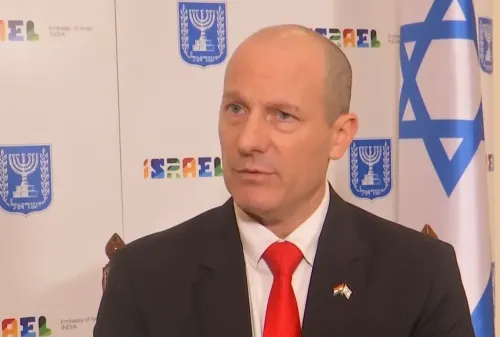
Israeli Ambassador Azar: Iran Must Comply or Face Consequences

Synopsis
In a revealing interview, Israeli Ambassador to India, Reuven Azar, discusses the consequences Iran may face for non-compliance with international demands, asserting Israel's commitment to neutralizing Iranian threats. Key insights into regional negotiations and military strategies are shared.
Key Takeaways
Iran faces severe repercussions for continuing its defiance against international demands.
Israel aims to neutralize Iranian threats through military operations.
Ongoing negotiations between the US and Iran could lead to significant regional changes.
Israel's air defense systems maintain a high success rate, despite challenges.
Saudi Arabia and UAE support US-led operations against Iran.
New Delhi, March 25 (NationPress) The Israeli Ambassador to India, Reuven Azar, has issued a stark warning that Iran will face significant repercussions if it continues its defiance and fails to comply with the demands of the United States and the international community. In an exclusive interview with IANS, Azar emphasized that Israel will persist in its efforts until the threats from Iran are effectively neutralised.
Key Insights:
IANS: What is Israel’s evaluation of the risk of an all-out war if the US targets Iranian power facilities? What strategies is Israel implementing to safeguard its interests?
Reuven Azar: Our primary focus is on degrading Iran's capabilities as they pose two existential threats to Israel: the nuclear threat and the ballistic missile threat. Additionally, Iran supports proxies that are constantly attacking Israel, necessitating a military response. If Iran chooses to persist in its defiance and not cooperate with the US and international mandates, they will face dire consequences. We are prepared. Despite Iran's attacks, particularly on civilian sites in Israel, we will continue our operations until we successfully neutralize these threats. We also provide the Iranian populace an opportunity to secure a better future by dismantling their oppressive regime, which has caused significant suffering.
Israel believes that the United States shares this determination, and we are encouraged that the Iranian regime has begun to show signs of negotiation, contrary to their initial claims. Our hope is that these negotiations will yield positive outcomes, which include removing all fissile materials from Iran, halting uranium enrichment and military nuclear activities, and curtailing Iran’s missile projects and support for regional proxies. Achieving these objectives could lead to a swift end to negotiations and stabilization in the region.
IANS: US Vice President J D Vance recently discussed negotiations with Iran during a call with Israeli PM Benjamin Netanyahu, including a potential agreement to end hostilities. Is this accurate?
Reuven Azar: Yes, negotiations are indeed underway. The President of the United States has confirmed this, and our Prime Minister has been briefed on these developments.
IANS: US President Donald Trump has mentioned that talks between the US and Iran aim for a complete resolution of hostilities in the Middle East. Is Israel optimistic about these developments?
Reuven Azar: We hold an optimistic outlook because the Iranian regime’s willingness to negotiate indicates they are under pressure, primarily due to our military operations. Observations of discord within the Iranian leadership suggest cracks in their system, highlighting their insecurity. This provides hope for successful negotiations. However, if they fail, we will continue our operations until we fulfill our objectives.
IANS: How does Israel perceive the recent support from Saudi Arabia and the UAE for US-led operations in Iran? What are the potential benefits or risks of this shift in regional alliances?
Reuven Azar: I believe there is no significant shift; Gulf states have always supported our operations, albeit discreetly. The Iranian regime’s recent aggressions have compelled them to express their stance publicly. This alignment shows that the region desires a change in Iran’s policy and seeks to eliminate the threats for regional stability.
IANS: What role does Israel see for Pakistan in facilitating indirect negotiations between the US and Iran, and what implications does this have for Israel's diplomatic initiatives?
Reuven Azar: The United States will choose its facilitators for negotiations. As long as the outcomes align with the interests of both the US and Israel, the location of negotiations is secondary.
IANS: Can Pakistan be trusted given their involvement in terrorism?
Reuven Azar: Trust is not established with a country that lacks diplomatic relations with us. We rely on our judgment and the United States' discernment.
IANS: What caused the Iron Dome's failure to intercept Iranian ballistic missiles in Dimona and Arad? How will Israel enhance its air defense systems in the future?
Reuven Azar: Israel boasts a high interception success rate exceeding 90%. Our defense systems include Arrow 3, David's Sling, Iron Beam, and Iron Dome, supported by the Israeli and US Air Forces. Although some missiles do penetrate our defenses, resulting in casualties and damage, our strategy includes educating citizens on safety protocols during missile attacks. Although we face challenges, we maintain our ability to target Iranian military assets effectively. We will continue applying pressure, as the Iranian regime has shown signs of yielding, and we remain hopeful for a diplomatic resolution.
Point of View
All framed within a broader context of regional stability.
NationPress
23 Sept 2026
Frequently Asked Questions
What actions is Israel taking against Iranian threats?
Israel is focused on degrading Iran's military capabilities, particularly regarding nuclear and ballistic missile threats, while also addressing the support Iran provides to regional proxies.
What is the significance of the US-Iran negotiations?
The US-Iran negotiations are crucial for addressing nuclear proliferation concerns and ensuring regional stability, with Israel closely monitoring the outcomes.
How is Israel responding to Iranian missile attacks?
Israel employs a range of air defense systems, including Iron Dome, and emphasizes public safety measures to minimize casualties during missile attacks.
What roles do Saudi Arabia and UAE play in the current situation?
Saudi Arabia and the UAE are supportive of US-led operations against Iran, reflecting a unified regional stance against Iranian aggression.
How does Israel view Pakistan's involvement in US-Iran negotiations?
Israel maintains that the US should decide on facilitators for negotiations, prioritizing outcomes that align with its interests, regardless of the selected country.