Israel's Ambassador: Lebanon Excluded from US-Iran Ceasefire
Synopsis
In an exclusive interview, Israeli Ambassador Reuven Azar asserts Lebanon's exclusion from the US-Iran ceasefire, emphasizing Israel's military readiness against Hezbollah's attacks. He discusses Iran's weakened state and the prospects for peace in the region.
Key Takeaways
Lebanon is excluded from the US-Iran ceasefire, according to Israel.
Israel has conducted significant military operations against Hezbollah.
Iran's military capabilities are reportedly weakened.
Israel is prepared to defend itself against further aggression.
India is seen as a reliable partner in promoting stability.
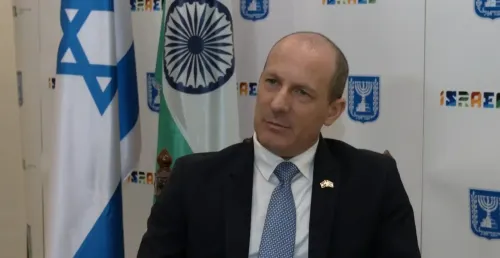
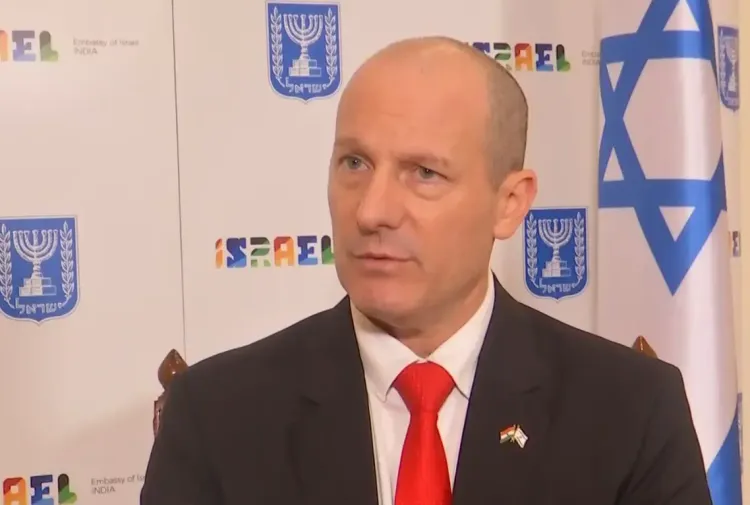
New Delhi, April 9 (NationPress) Emphasizing that Tehran is now weaker than ever with its missile production capabilities completely dismantled, Reuven Azar, the Ambassador of Israel to India, on Thursday reaffirmed Israeli Prime Minister Benjamin Netanyahu's assertion that Lebanon is excluded from the current two-week ceasefire involving the United States and Iran.
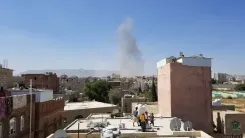
Following the announcement of the temporary truce, Israel reported a significant strike against Hezbollah, claiming to have attacked 100 targets in just 10 minutes, with Netanyahu asserting that Lebanon is not included in the ceasefire agreement.
"We have made this very clear, and the American administration has validated it. We faced a unilateral attack from Hezbollah, which has breached not only this ceasefire but also agreements signed last year. They were supposed to cease operations in southern Lebanon. The Lebanese government had committed to disarming them, but that has not transpired. As such, we are defending ourselves, particularly our border communities that have been heavily targeted by Iranian missiles and anti-tank weaponry," Azar shared in an exclusive interview with IANS.
The Israeli envoy also elaborated on the current dynamics in the volatile region, ongoing peace initiatives, Pakistan's involvement, and India's constructive advocacy for de-escalation, dialogue, and diplomacy.
Excerpts:
IANS: Are you satisfied with the US-Iran ceasefire, or was it announced prematurely?
Reuven Azar: We are quite pleased. Our military operation has reached its limits, and we are eager to see diplomacy have another opportunity. We hope that this regime finally seizes the moment and agrees to the 15-point plan proposed by President Trump. If that occurs, not only will they gain relief, but the entire region will benefit. We sincerely hope for this outcome. However, we are prepared if they choose to disregard the ceasefire or attempt to stall for time. Our forces remain ready to defend ourselves should hostilities resume.
IANS: Has Israel met its strategic aims in Iran?
Reuven Azar: Absolutely. We have consistently stated our three primary objectives. The first two pertain to eliminating existential threats, primarily concerning Iran's military nuclear program. We have targeted numerous sites across Iran, not limited to the Natanz facility but also heavy water reactors and plutonium-related infrastructure. We have struck scientists, research and development centers, and locations where they were planning to construct nuclear weapons. This has been tremendously effective. Additionally, we have severely compromised Iran's missile capabilities, having obliterated their production facilities for ballistic missiles, drones, and other weapon systems. Moreover, we have dealt a substantial blow to their military personnel, eliminating over 10,000 from the military and the IRGC, and have removed top leadership from the IRGC, including three intelligence agency chiefs. This ensures we maintain a robust understanding of circumstances inside Iran, allowing our intelligence agencies to monitor and act if the Iranian regime continues its aggressive campaign.
IANS: If provoked by Iran, does Israel reserve the right to retaliate?
Reuven Azar: Absolutely. We are prepared. Not only us, but the United States has also indicated that they are maintaining forces in the region to ensure diplomacy is effectively utilized for a satisfactory resolution. Our goal remains clear: the removal of enriched uranium from Iranian territory, curbing their ballistic missile initiatives, and ceasing all support for terrorism, including financing, training, and weapon transfers. Should these conditions be met, Iran could receive sanctions relief, paving the way for a more peaceful future in the West Asian region.
IANS: Is Lebanon included in a broader peace agreement?
Reuven Azar: Absolutely not. We have made this unequivocally clear, and the American administration has corroborated it. We were subjected to a unilateral attack by Hezbollah, which has violated not only this ceasefire but also the terms signed last year. They were not supposed to operate in southern Lebanon. The Lebanese government had pledged to disarm them, but that has not occurred. Consequently, we are defending ourselves, particularly our border communities, which have been heavily targeted by Iranian missiles and anti-tank weaponry.
IANS: Is Pakistan neutral or involved in the conflict?
Reuven Azar: We have not observed Pakistan's participation in the conflict, but they have not played a favorable role either. The United States has opted to use them as a facilitator for their own strategic reasons. We trust the United States to implement the 15-point plan.
IANS: Has Iran's nuclear enrichment capability been eliminated?
Reuven Azar: Yes, without a doubt. We have dismantled Iran's capacity to produce nuclear weapons and have significantly delayed their program by years. We will continue to monitor the situation until enriched uranium is safely extracted and enrichment activities cease. If Iran resumes its program, we will defend against that threat.
IANS: Is there any sign of regime change in Iran, as suggested by U.S. President Donald Trump?
Reuven Azar: We are witnessing fissures within the regime. There seems to be a disconnect between the IRGC and the leadership. The regime has even invited foreign militias, indicating weak internal backing. Despite internet restrictions, reports suggest public support for strikes against the regime, signaling instability. We hope for change within or of the regime in the future.
IANS: How do you view India's role in the Middle East crisis?
Reuven Azar: India is advancing its interests. We are very satisfied with our bilateral relations, especially following PM Narendra Modi's visit to Israel, which yielded numerous positive results, including agreements in defense, finance, infrastructure, technology, education, and more. We are encouraged by India's support for free maritime navigation. It is essential for nations to collaborate to uphold international law and prevent coercion in global waterways.
IANS: Has India become a trustworthy partner for Israel and Gulf nations?
Reuven Azar: Yes. Iran's actions have drawn many countries closer together. People now recognize how aggressive this regime is and understand that had Iran been allowed to carry out its threats, the situation would have deteriorated significantly. Awareness of the regime's threat has grown.
IANS: Is Iran receiving support from nations like China or Russia?
Reuven Azar: We have not witnessed direct military support. There may be assistance that remains unseen. However, we know that various raw materials necessary for Iran's ballistic missile industry have originated from places like China. Stricter sanctions are essential to prevent such support.
IANS: Will the war resume after two weeks, or could a lasting ceasefire be achieved?
Reuven Azar: We are hopeful for a lasting ceasefire. We prefer diplomacy over violence. We have witnessed sufficient bloodshed and are not keen to revert to military actions.
IANS: Regarding Israeli strikes, China has stated that Lebanon's sovereignty should not be violated. What is your perspective?
Reuven Azar: The Lebanese government must uphold its own sovereignty. Unfortunately, it has failed to do so and has permitted Hezbollah to persist in its attacks. As long as that continues, Israel will defend itself.
Point of View
It's essential to highlight that the ongoing tensions in the Middle East, particularly between Israel, Iran, and Hezbollah, reflect a complex web of geopolitical interests. The assertions made by Ambassador Azar underline Israel's defensive stance while raising questions about regional stability and international diplomatic efforts.
NationPress
19 Sept 2026
Frequently Asked Questions
Is Lebanon part of the US-Iran ceasefire?
No, according to Israeli Ambassador Reuven Azar, Lebanon is not included in the ongoing ceasefire between the US and Iran.
What has Israel's military response been to Hezbollah?
Israel claims to have struck 100 targets in a rapid military response to Hezbollah's unilateral attacks.
What are Israel's strategic objectives concerning Iran?
Israel aims to eliminate threats from Iran's nuclear program and missile capabilities, having successfully targeted numerous sites.
What role does Pakistan play in the conflict?
Pakistan has not actively participated in the conflict but has been viewed as a facilitator by the United States.
What is the current situation regarding Iran's nuclear capabilities?
Israel asserts that it has significantly diminished Iran's nuclear production capabilities.