ISRO developing 200-day lunar survival tech with DAE, says Chairman Narayanan
Synopsis
India's Chandrayaan-3 Vikram lander lasted just 14 days on the Moon — stopped cold by the lunar night. ISRO and the Department of Atomic Energy are now building artificial heating systems that could stretch that to 200 days, a 14-fold leap that would redefine what India's lunar missions can actually accomplish.
Key Takeaways
Narayanan announced on 13 June that ISRO and the Department of Atomic Energy (DAE) are jointly developing artificial heating technology for lunar landers.
The technology aims to extend lunar surface survival from 14 days to between 100 and 200 days , covering multiple lunar day-night cycles.
Chandrayaan-3's Vikram lander became inoperable after one lunar night on 23 August 2023 due to its reliance on solar power.
Extended mission durations would enable longer experiments, greater data collection, and sustained robotic operations on the Moon.
Narayanan also said India needs more than 200 satellites in the next three years , against a current base of 56 satellites , requiring private sector participation.
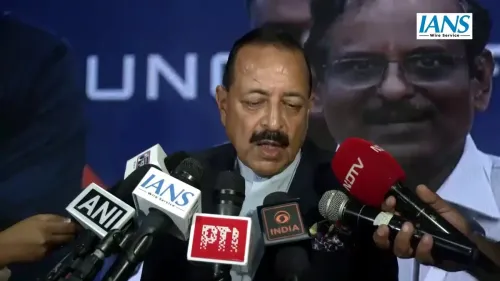
ISRO Chairman V. Narayanan on Saturday, 13 June revealed that the Indian Space Research Organisation (ISRO), in collaboration with the Department of Atomic Energy (DAE), is developing advanced heating technology that could enable future lunar landers to survive on the Moon for up to 200 days — a dramatic leap from the 14-day operational window achieved by the Chandrayaan-3 mission. The announcement was made in Bengaluru, where Narayanan outlined the ongoing research into one of lunar exploration's most formidable engineering challenges.
The Chandrayaan-3 Baseline and Its Limits
On 23 August 2023, India made history as the first country to successfully land a spacecraft near the Moon's south pole. The Vikram lander, however, operated for only one lunar day — approximately 14 Earth days — because it depended entirely on solar energy. When the lunar night descended, temperatures plunged to extreme lows, rendering the spacecraft's electronic systems inoperable. The absence of sunlight effectively ended the mission's active phase.
What ISRO and DAE Are Building
Narayanan said the two agencies are jointly working on artificial heating systems capable of protecting spacecraft components through the prolonged lunar night. If successful, these systems could extend a lander's functional lifespan to between 100 and 200 days, allowing it to endure multiple lunar day-night cycles. The technology represents a structural shift in India's approach to deep-space hardware design — moving from solar-dependent systems to thermally resilient architectures.
Why Extended Lunar Missions Matter
Longer surface durations would allow scientists to conduct more extensive experiments, accumulate larger volumes of scientific data, and sustain robotic operations across multiple lunar cycles. Notably, the ability to survive the lunar night is considered a prerequisite for any credible long-term human presence on the Moon. This development could therefore serve as a foundational capability for India's broader lunar ambitions, including potential crewed missions in the coming decades.
India's Satellite Demand and the Private Sector Push
Separately, Narayanan underscored the scale of India's near-term space infrastructure needs. Speaking at the 10th Industry Connect event organised by IN-SPACe in Ahmedabad, he said India currently has 56 satellites in orbit but will require more than 200 satellites over the next three years to meet growing national and commercial demand. He stressed that ISRO alone cannot fulfil this requirement and called for deeper participation from private industry, start-ups, and academia across the space ecosystem.
What Comes Next
The artificial heating programme with DAE is ongoing, and no specific timeline for a demonstration mission has been publicly announced. Should the technology mature, it is expected to be integrated into future lunar lander designs, potentially positioning India as a leader in long-duration surface exploration — a capability currently held by only a handful of spacefaring nations.
Point of View
Requiring a fundamental rethink of power and thermal architecture. The ISRO-DAE collaboration is significant: it signals that India is looking at radioisotope-style heating solutions, a technology the US and Russia have used for decades in deep-space probes. What mainstream coverage underplays is that without this capability, India's lunar ambitions — including any crewed surface mission — remain structurally limited to a two-week window. Solving the lunar night problem does not just extend a mission; it changes the category of mission India can attempt.
NationPress
13 Sept 2026
Frequently Asked Questions
What is the 200-day lunar lander technology ISRO is developing?
ISRO, in collaboration with the Department of Atomic Energy, is developing advanced artificial heating systems to keep lunar landers operational through the extreme cold of the lunar night. If successful, the technology could extend a lander's active lifespan from the current 14 days to between 100 and 200 days.
Why did Chandrayaan-3's Vikram lander stop working after 14 days?
The Vikram lander relied entirely on solar energy for power. When the lunar night began after approximately 14 Earth days, sunlight disappeared and temperatures dropped to extreme lows, making it impossible for the spacecraft's electronic systems to continue functioning.
Why does surviving the lunar night matter for future missions?
Surviving the lunar night allows spacecraft to conduct experiments and collect data across multiple lunar cycles rather than just one. It is also considered a prerequisite for sustained robotic operations and, eventually, long-term human presence on the Moon.
How many satellites does India need in the next three years?
ISRO Chairman V. Narayanan said India currently has 56 satellites in orbit but requires more than 200 satellites over the next three years to meet national and commercial demand. He called for greater involvement from private industry, start-ups, and academia to meet this target.
Which agencies are collaborating on the lunar heating technology?
The Indian Space Research Organisation (ISRO) and the Department of Atomic Energy (DAE) are jointly working on the artificial heating systems. No specific timeline for a demonstration mission has been publicly announced.