Jaishankar visits Adwa Victory Museum in Ethiopia
Synopsis
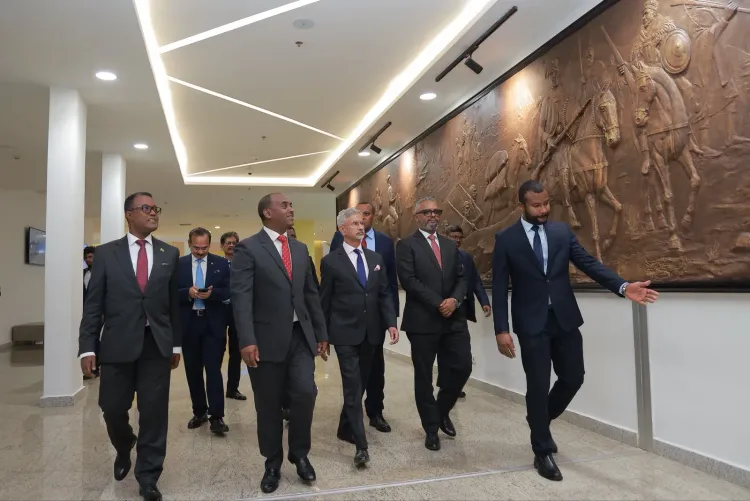
External Affairs Minister Dr. S. Jaishankar visited the Adwa Victory Memorial Museum in Addis Ababa with Ethiopian Defence Minister Mohamed Idris, framing the 1896 Ethiopian victory over Italian colonialism as a defining symbol of the Global South's sovereign capacity.
Key Takeaways
Jaishankar visited the Adwa Victory Memorial Museum in Addis Ababa, Ethiopia on October 10, 2026 .
Ethiopian Minister of Defence Mohamed Idris hosted and accompanied the Indian External Affairs Minister at the museum.
The Battle of Adwa (1896) saw Ethiopia defeat Italy, becoming a foundational symbol of anti-colonial resistance across Africa and beyond.
Jaishankar explicitly linked the Adwa legacy to the Global South's right and capacity to determine its own destiny.
The visit reinforces India's sustained diplomatic outreach to Africa framed through a shared anti-colonial historical narrative.
Both the Indian 🇮🇳 and Ethiopian 🇪🇹 flags featured in Jaishankar's post, underscoring the bilateral warmth of the engagement.
At a museum that marks one of history's most defiant acts of resistance, Union External Affairs Minister Dr. S. Jaishankar stood alongside Ethiopian Minister of Defence Mohamed Idris on Saturday, October 10, 2026, to pay his respects at the Adwa Victory Memorial Museum in Addis Ababa, Ethiopia — and turned that visit into a pointed statement about the Global South's sovereign will.
Why Adwa still reverberates across the Global South
The Battle of Adwa in 1896 was a watershed: Ethiopian forces under Emperor Menelik II decisively defeated an invading Italian army, making Ethiopia the only African nation to repel a European colonial power in the 19th century. The victory reverberated far beyond the Horn of Africa — it became a rallying symbol for anti-colonial movements across Africa, the Caribbean, and Asia, lighting a torch that burned through decades of independence struggles.
Dr. Jaishankar underscored precisely that legacy. 'Adwa inspired the struggle against colonialism and racial domination in Africa and beyond,' he wrote, adding that the memorial museum 'is a reminder that the members of the Global South have the right and capacity to determine their own destiny.'
India-Ethiopia ties and the Global South signal
India and Ethiopia share historically warm bilateral relations, anchored in shared experiences of anti-colonial struggle and non-alignment. The presence of Defence Minister Mohamed Idris at the visit elevates the visit beyond a cultural stopover — a Cabinet-level host for a Cabinet-level guest signals the weight both sides place on the engagement.
The framing Dr. Jaishankar chose is deliberate and consequential. Invoking the Global South at the Adwa museum connects India's own foreign-policy posture — championing developing-world agency in multilateral forums, from the G20 to the UN Security Council reform debate — to a living historical symbol. It is a reminder that New Delhi's Global South diplomacy is not merely rhetorical; it is rooted in a shared civilisational memory of resistance.
A flag-pin moment that carries diplomatic weight
The post concludes with the Indian 🇮🇳 and Ethiopian 🇪🇹 flags side by side — a small but pointed visual. Two nations, two continents, one shared story of self-determination. For India, the image of its External Affairs Minister at a shrine to African sovereignty speaks directly to the narrative New Delhi has been carefully constructing: that it stands with the Global South not as a patron but as a partner with its own history of resistance.
The Adwa museum does not let its message fade quietly. Neither, it seems, does India's foreign minister.
Point of View
Not a tourist footnote. By anchoring India's Global South identity to one of Africa's most potent symbols of self-determination, he reinforces New Delhi's bid to be seen as a peer — not a patron — within the developing world. This visit fits a deliberate arc: India has consistently used historical memory and civilisational solidarity as soft-power tools in its Africa outreach, especially as competition with China for influence on the continent intensifies. The joint appearance with Defence Minister Mohamed Idris also hints at a defence and strategic dimension to India-Ethiopia ties that extends well beyond the ceremonial.
NationPress
10 Oct 2026
Frequently Asked Questions
What is the Adwa Victory Memorial Museum?
The Adwa Victory Memorial Museum in Addis Ababa, Ethiopia, commemorates the Battle of Adwa in 1896 , in which Ethiopian forces defeated an invading Italian army — a landmark moment that made Ethiopia the only African country to successfully repel a European colonial power in the 19th century.
Why did Jaishankar visit Ethiopia in October 2026?
Dr. S. Jaishankar visited Ethiopia as part of India's diplomatic engagement with Africa, stopping at the Adwa Victory Memorial Museum to underscore the shared anti-colonial heritage between India and African nations and to meet Ethiopian Defence Minister Mohamed Idris .
What is the significance of Adwa for the Global South?
The Battle of Adwa is widely regarded as a foundational inspiration for anti-colonial and independence movements across Africa, the Caribbean, and Asia, demonstrating that a non-European nation could militarily defeat a colonial power — a message that resonated deeply in the Global South.
What did Jaishankar say about the Global South at the Adwa museum?
Jaishankar stated that the Adwa memorial 'is a reminder that the members of the Global South have the right and capacity to determine their own destiny,' connecting the 1896 Ethiopian victory to India's broader foreign-policy advocacy for developing nations.
Who is Mohamed Idris of Ethiopia?
Mohamed Idris is the Minister of Defence of Ethiopia , who received and accompanied Dr. Jaishankar during his visit to the Adwa Victory Memorial Museum in Addis Ababa in October 2026.