Jaishankar on Rubio Mumbai meet: 'Indira Gandhi went to Shimla to meet Bhutto'
Synopsis
Jaishankar did not just defend hosting Rubio in Mumbai — he reached back to 1972, invoking Indira Gandhi's Shimla summit with Bhutto to turn a Congress critique into a Congress liability. The exchange at the NDTV World Summit laid bare how India's foreign policy conduct has become a live front in domestic political combat.
Key Takeaways
EAM S Jaishankar on 22 October dismissed opposition criticism of hosting US Secretary of State Marco Rubio in Mumbai on 19–20 October .
Jaishankar invoked Indira Gandhi's 1972 trip to Shimla to meet Zulfikar Ali Bhutto as a Congress-era precedent for out-of-Delhi diplomatic meetings.
Rahul Gandhi had described the Mumbai meeting as India being 'summoned' by a foreign counterpart.
MEA spokesperson Randhir Jaiswal cited multiple recent examples of foreign dignitaries hosted outside Delhi, including in Baroda , Ahmedabad , Varanasi , Goa , and Amritsar .
Jaishankar also hosted the UAE counterpart in Mumbai and attended US 250th independence anniversary celebrations as Guest of Honour.
External Affairs Minister S Jaishankar on Thursday, 22 October said he had 'failed' to understand the reasoning behind opposition criticism of India hosting US Secretary of State Marco Rubio in Mumbai, pushing back sharply against Congress leader Rahul Gandhi's characterisation of the meeting as a 'summoning.'
Jaishankar's Sharp Rebuttal
Speaking at the NDTV World Summit, Jaishankar deflected the criticism with pointed sarcasm. 'I didn't get that. They don't like Mumbai? I mean, they have something against Mumbai? I think it is a great city, it is our financial capital. It is our Bollywood capital. It has got so much going for it. Maybe Mumbai doesn't like them... I have no idea why they have this reservation,' he said, drawing applause from the audience.
The minister's remarks came days after Rahul Gandhi took a swipe at the Narendra Modi-led government over the choice of venue for the bilateral engagement with Rubio, framing it as India being 'summoned' to meet a foreign counterpart outside the national capital.
Historical Precedents Cited
Jaishankar was direct in invoking historical precedents to counter the criticism. 'If going out of Delhi to meet a foreign leader or a foreign counterpart is summoning, I can give you a lot of examples. Mrs (Indira) Gandhi went to Shimla to meet Bhutto. Was she summoned? Salman Khurshid went to Jaipur to meet a Pakistan PM. Was he summoned?' he said.
'We are adults, let's have an adult conversation,' he added, before the gathering responded with another round of applause. The reference to the Shimla Agreement of 1972 — a landmark diplomatic summit between then Prime Minister Indira Gandhi and Pakistani leader Zulfikar Ali Bhutto — was a deliberate invocation of Congress-era diplomacy to blunt the opposition's argument.
The Mumbai Bilateral Meetings
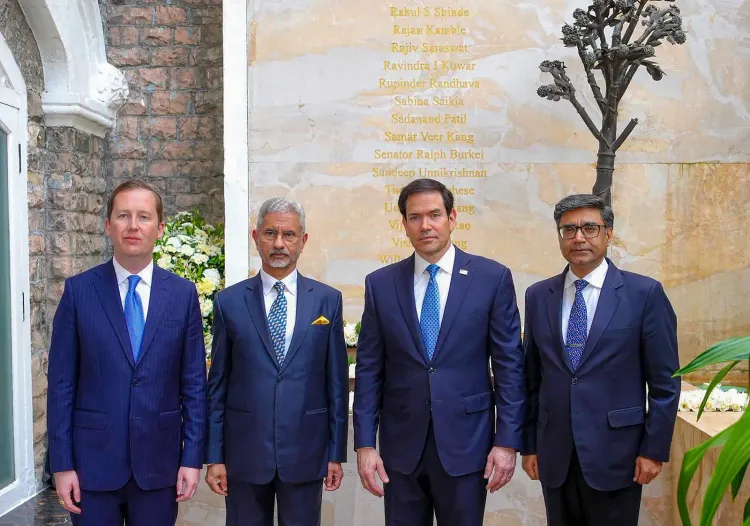
Jaishankar had hosted counterparts from the United Arab Emirates (UAE) and the United States in Mumbai on 19–20 October. He also attended celebrations marking the 250th anniversary of US independence as Guest of Honour during that visit.
Notably, the Ministry of External Affairs (MEA) had already addressed the controversy the previous week. Spokesperson Randhir Jaiswal, at a bi-weekly media briefing in New Delhi, stated: 'It has been the practice for the last decade or so that we have hosted foreign dignitaries outside Delhi.' Jaiswal cited multiple examples, including Prime Minister Modi hosting the Prime Minister of Spain in Baroda, Chancellor Merz in Ahmedabad, and the Prime Minister of Mauritius in Varanasi. He also noted that the SCO Foreign Ministers Meeting was hosted in Goa, and the Heart of Asia Conference was held in Amritsar.
The Broader Context
The exchange reflects a broader pattern of political contestation over India's foreign policy conduct. The opposition's 'summoning' framing taps into a nationalist anxiety around diplomatic optics, while the government's counter-narrative positions India's decentralised diplomatic hosting as a mark of confidence rather than deference. This is not the first time Jaishankar has been drawn into a direct public rebuttal of Congress foreign policy critiques — the minister has repeatedly used media forums to defend India's diplomatic posture.
With India-US ties entering a consequential phase on trade and security, the optics of where senior officials meet is unlikely to remain a sustained point of controversy, but Thursday's exchange underscores how foreign policy has become an arena of domestic political competition.
Point of View
Not just on the current government. The 'summoning' charge was always a weak one, given India's documented practice of hosting diplomacy outside Delhi, and the minister knew it. What is more significant is that India-US bilateral mechanics are now a subject of domestic political theatre. That itself is a shift — for most of the last decade, the broad arc of India-US relations enjoyed bipartisan cover. If opposition parties are willing to score points off Rubio meetings, the Modi government will need to be more deliberate, not less, in managing the optics of high-profile foreign engagements.
NationPress
22 Oct 2026
Frequently Asked Questions
Why did Jaishankar mention Indira Gandhi and the Shimla meeting?
Jaishankar cited Indira Gandhi's 1972 trip to Shimla to meet Pakistani leader Zulfikar Ali Bhutto as a historical precedent for Indian leaders conducting significant diplomacy outside New Delhi. The reference was made to counter Congress's criticism that hosting US Secretary of State Rubio in Mumbai was inappropriate or a sign of diplomatic weakness.
What did Rahul Gandhi say about the Rubio-Jaishankar meeting in Mumbai?
Congress leader Rahul Gandhi described the meeting between EAM Jaishankar and US Secretary of State Marco Rubio in Mumbai as 'summoning,' implying India was at a disadvantage in the diplomatic exchange. The remark drew a sharp public rebuttal from Jaishankar at the NDTV World Summit on 22 October.
Where did Jaishankar meet Marco Rubio and what was the occasion?
Jaishankar hosted Rubio in Mumbai on 19–20 October for bilateral meetings. He also attended celebrations of the 250th anniversary of US independence as Guest of Honour during the same visit.
Has India hosted foreign dignitaries outside Delhi before?
Yes, extensively. MEA spokesperson Randhir Jaiswal cited examples including PM Modi hosting Spain's PM in Baroda, Chancellor Merz in Ahmedabad, and Mauritius's PM in Varanasi. Jaishankar himself hosted the SCO Foreign Ministers Meeting in Goa and the Heart of Asia Conference in Amritsar.
What is the political significance of the Jaishankar-Congress exchange?
The exchange reflects a broader trend of foreign policy becoming a domestic political battleground in India. The opposition's 'summoning' framing challenges the government's narrative of an assertive Indian diplomacy, while the BJP-led government has used historical Congress-era examples to deflect the criticism and put the opposition on the defensive.