How is EAM Jaishankar Strengthening India’s Foreign Policy? PM Modi Celebrates His Birthday
Synopsis
On January 9, Prime Minister Modi wishes External Affairs Minister S. Jaishankar a happy birthday while highlighting his invaluable contributions to India's foreign policy. With a career steeped in diplomacy and strategic insight, Jaishankar’s leadership has been pivotal in navigating India through complex global challenges.
Key Takeaways
Jaishankar’s diplomatic career spans over four decades.
He played a vital role in the Indo-US civil nuclear deal.
His leadership was crucial during the Covid-19 pandemic.
Jaishankar emphasizes India’s growing role as a global power.
He continues to shape India’s foreign policy in complex geopolitical landscapes.
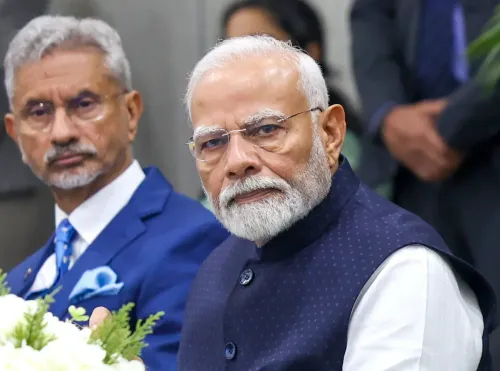
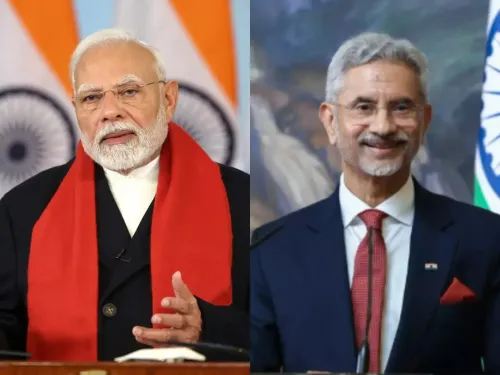
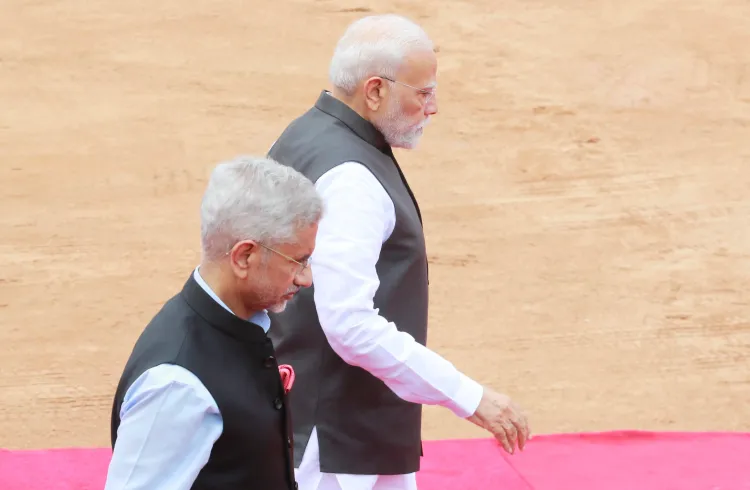
New Delhi, Jan 9 (NationPress) Prime Minister Narendra Modi took to social media on Friday to convey heartfelt birthday greetings to External Affairs Minister S. Jaishankar, recognizing his remarkable contributions to the nation and his crucial role in fortifying India’s foreign policy and international relations.
In his message on the platform ‘X’, Prime Minister Modi stated, “Best wishes to Dr. S. Jaishankar Ji on his birthday. He has served the nation as a distinguished diplomat and is now playing a key role in strengthening India’s foreign policy and ties with the world. Praying for his long and healthy life.”
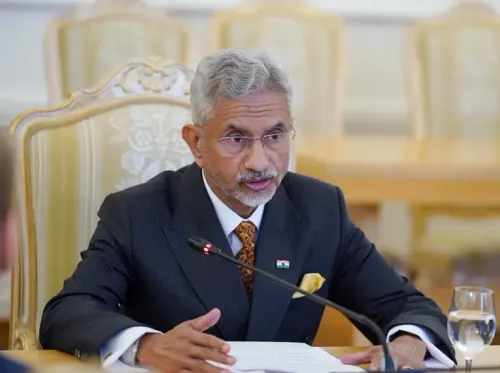
Subrahmanyam Jaishankar, who was born on January 9, 1955, in New Delhi, is a prominent Indian politician and senior BJP leader. He has been serving as India’s External Affairs Minister since 2019 and is recognized as one of the most seasoned diplomats to transition into active politics. Notably, he is the first Indian career diplomat and former foreign secretary to hold the position of external affairs minister.
Before entering politics, Jaishankar had an extensive and illustrious diplomatic career lasting over four decades. He was India’s Foreign Secretary, the highest bureaucratic role in the Ministry of External Affairs (MEA), from 2015 to 2018. Previously, he held several key diplomatic roles, including serving as India’s Ambassador to China from 2009 to 2013 and to the United States from 2013 to 2015.
Jaishankar was born into a Tamil family renowned for its rich intellectual and strategic heritage. His father, Krishnaswamy Subrahmanyam, was a highly esteemed bureaucrat, strategic affairs analyst, and commentator who significantly influenced India’s defense and nuclear policies. Growing up in such an environment, Jaishankar cultivated an early interest in international relations and strategic matters.
He completed his education in New Delhi and Bengaluru before graduating from St. Stephen’s College, University of Delhi. He later obtained a Master’s degree in Political Science, followed by an M.Phil. and a PhD in International Relations from Jawaharlal Nehru University (JNU), New Delhi. His academic focus was on nuclear diplomacy, a field that would later shape much of his professional endeavors. He joined the Indian Foreign Service (IFS) in 1977.
Jaishankar commenced his diplomatic career in Moscow in 1978, where he became fluent in Russian—a skill that has greatly aided in enhancing India-Russia relations over the years. From 1979 to 2006, he held various significant postings both abroad and within the MEA, gaining comprehensive knowledge of India’s diplomatic framework and global interactions. His international assignments included roles in Moscow, Washington, DC, Colombo, Budapest, and Tokyo.
In addition to his diplomatic roles, Jaishankar also acted as press secretary and speechwriter to former President of India Shankar Dayal Sharma, further deepening his understanding of governance, public communication, and statecraft.
Jaishankar returned to India in 2004 and was appointed head of the Americas Division in the MEA. During this time, he played a vital role in negotiations leading to the announcement of the landmark Indo-US civil nuclear deal in 2005, which significantly elevated India’s global status by enabling civil nuclear cooperation with the international community.
From 2007 to 2009, he was India’s High Commissioner to Singapore, where he strengthened bilateral relations and expanded cooperation in trade, education, and regional security. In 2009, he became India’s Ambassador to China, a role he held until 2013, marking him as the longest-serving Indian envoy to Beijing. His tenure coincided with a crucial period in India-China relations, characterized by efforts to stabilize ties amidst ongoing border tensions.
In 2012, when China issued passports depicting Arunachal Pradesh and Aksai Chin as Chinese territory, the Indian Embassy in Beijing, under Jaishankar’s guidance, firmly responded by issuing visas to Chinese nationals that featured maps showing the regions as part of India. This action was widely perceived as a strong diplomatic affirmation of India’s territorial claims.
In 2013, Jaishankar was appointed as India’s Ambassador to the United States at a time when bilateral relations were tense due to the arrest of a senior Indian diplomat in New York on charges of visa fraud. He engaged with senior American officials and played a pivotal role in resolving the issue, thereby helping to restore trust between the two nations. Jaishankar has often remarked that while India-US relations are amicable, they necessitate continuous engagement and careful management.
On January 28, 2015, after a meeting of the Appointments Committee of the Cabinet chaired by Prime Minister Modi, Jaishankar was appointed as India’s Foreign Secretary. He succeeded Sujatha Singh, whose tenure was shortened by nearly eight months. As foreign secretary, Jaishankar focused on bolstering relations with neighboring countries and enhancing engagement with East and Southeast Asia. He also coordinated India’s rapid humanitarian response to the catastrophic Nepal earthquake in April 2015, which resulted in nearly 9,000 fatalities.
After retiring from the IFS in 2018, Jaishankar briefly ventured into the private sector. Although he had not initially intended to pursue a political career, he was invited by Prime Minister Modi to join the Union Cabinet. In May 2019, he became External Affairs Minister in the Modi government’s second term and was elected to the Rajya Sabha from Gujarat as a BJP candidate in July 2019.
As external affairs minister, Jaishankar adeptly navigated India’s diplomacy through a period marked by unprecedented global challenges. During the Covid-19 pandemic, he spearheaded India’s 'Vaccine Maitri' initiative, which saw India provide domestically produced vaccines to over 75 countries. He also managed the 'Vande Bharat Mission', one of the largest repatriation efforts globally, facilitating the return of countless stranded Indian citizens from around the world.
Jaishankar has been instrumental in fortifying India’s strategic partnerships with countries such as the United States, Russia, and Japan, along with multilateral groupings like the European Union and the Association of Southeast Asian Nations (ASEAN). His approach has underscored India’s rising role as a responsible global power.
Reappointed as the EAM in June 2024 in Prime Minister Modi’s third cabinet, Jaishankar continues to play a vital role in shaping India’s foreign policy. Following the terror attack in Pahalgam, Jammu and Kashmir, which resulted in 26 casualties, India reiterated its accusations against Pakistan regarding cross-border terrorism, leading to a further decline in bilateral relations.
With over three decades of diplomatic experience, fluency in multiple languages, and profound expertise in global affairs, S. Jaishankar remains a key architect of India’s contemporary foreign policy and an influential voice on the international stage.
Point of View
It is paramount to recognize the significance of S. Jaishankar's role in India's foreign policy landscape. His extensive diplomatic experience and strategic acumen have positioned India favorably on the global stage. The nation stands to benefit from his leadership as he continues to navigate complex international relations while fostering critical partnerships.
NationPress
3 Oct 2026
Frequently Asked Questions
What is the significance of S. Jaishankar's birthday?
S. Jaishankar's birthday is significant as it marks the celebration of a key figure in India's foreign policy, whose contributions have been vital in shaping international relations and enhancing India's global standing.
What are Jaishankar's notable achievements?
Jaishankar has played a crucial role in the Indo-US civil nuclear deal, led humanitarian efforts during the Covid-19 pandemic, and strengthened India’s ties with major global powers.
How has Jaishankar influenced India's foreign policy?
Jaishankar has influenced India's foreign policy through strategic partnerships, adept management of crises, and initiatives that position India as a responsible global power.
What roles has Jaishankar held in the government?
Jaishankar has served as India’s Foreign Secretary, Ambassador to the United States and China, and is currently serving as the External Affairs Minister.
What is Jaishankar's educational background?
Jaishankar holds degrees from St. Stephen's College, University of Delhi, and a PhD in International Relations from Jawaharlal Nehru University.