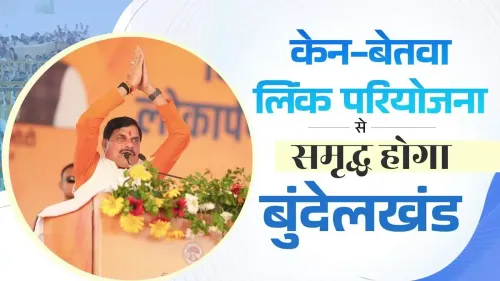
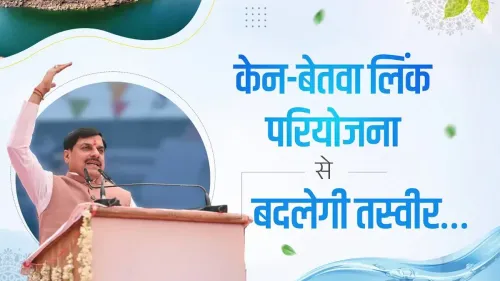
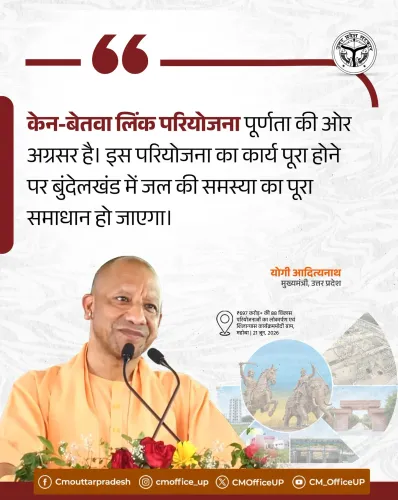
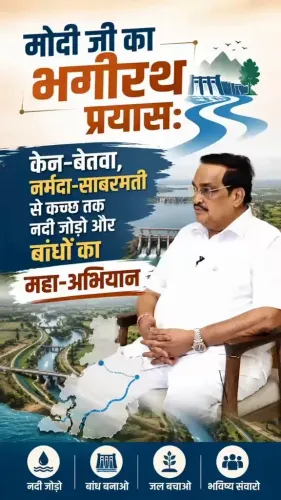
Jal Shakti Minister Paatil champions Ken-Betwa project for Bundelkhand
Synopsis
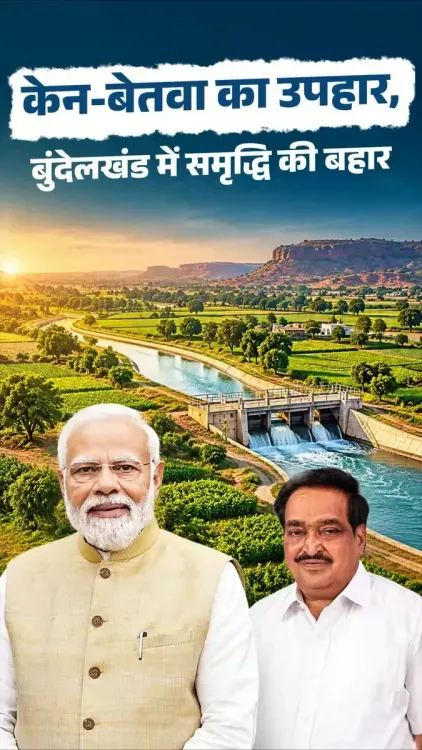
Union Jal Shakti Minister C. R. Paatil has highlighted the Ken-Betwa Link Project — India's first major inter-basin river transfer — as a transformative initiative for irrigation, drinking water, and clean energy in drought-prone Bundelkhand across Madhya Pradesh and Uttar Pradesh.
Key Takeaways
Union Jal Shakti Minister C.
Paatil publicly championed the Ken-Betwa Link Project on 29 October 2026 , tagging PM Modi directly.
The project transfers surplus water from the Ken river to the deficit Betwa river basin, serving Bundelkhand across Madhya Pradesh and Uttar Pradesh.
The Union Cabinet approved the project in December 2021 after a tripartite agreement between the Centre, Madhya Pradesh, and Uttar Pradesh.
It is India's first operational project under the National Perspective Plan for Interlinking of Rivers , conceived in 2002 .
The project's three stated benefits are irrigation, drinking water, and clean energy — targeting chronic agricultural distress in the region.
Key implementation challenges include land acquisition, environmental clearances near Panna Tiger Reserve, and phased infrastructure rollout.
Water has been Bundelkhand's most stubborn deficit for decades — and Union Jal Shakti Minister C. R. Paatil wants the nation to know that is about to change. On Thursday, 29 October 2026, Paatil took to X to champion the Ken-Betwa Link Project as a historic turning point for the drought-scarred heartland straddling Madhya Pradesh and Uttar Pradesh.
In his post, Paatil framed the project as a triple promise: 'Bundelkhand ke kheton tak paani, har ghar tak peyajal aur vikas ko nayi gati' — 'water reaching Bundelkhand's fields, drinking water to every home, and a new momentum for development.' He credited Prime Minister Narendra Modi's 'visionary leadership' as the driving force, calling the initiative 'a historic step towards water security' for the region.
What the Ken-Betwa project actually does
The Ken-Betwa Link Project is India's first major inter-basin river transfer under the National Perspective Plan for Interlinking of Rivers, a blueprint first formulated in 2002. The concept is straightforward but the engineering is vast: surplus water from the Ken river — which flows through Madhya Pradesh — will be transferred to the water-deficit Betwa river basin, irrigating farmland and filling taps across Bundelkhand.
The Union Cabinet cleared the project in December 2021 after a tripartite agreement was signed between the Centre, Madhya Pradesh, and Uttar Pradesh. That agreement resolved a long-standing inter-state negotiation that had stalled the project for years. The three pillars Paatil invokes — irrigation, drinking water, and clean energy — reflect the project's design, which includes a hydropower component alongside the water transfer infrastructure.
Why Bundelkhand's water crisis is a national conversation
Bundelkhand is not simply a region with low rainfall. It is a zone of chronic agricultural distress, outmigration, and groundwater depletion that has stubbornly resisted policy fixes for two decades. Farmers across the region's districts in both states have faced repeated crop failures as erratic monsoons and depleted tanks collide. Every promise of water infrastructure here carries outsized political and human weight.
That is precisely why the Ken-Betwa project sits at the intersection of infrastructure policy and electoral geography. Bundelkhand spans several Lok Sabha and assembly constituencies in both Madhya Pradesh and Uttar Pradesh — two of India's most electorally consequential states. Paatil's post, tagging PM Modi directly, is as much a signal of the government's ownership of the project as it is an update on its progress.
What to watch as implementation unfolds
Cabinet approval and a tripartite agreement are the beginning, not the finish line. The real test of the Ken-Betwa project lies in the pace of land acquisition, environmental clearances, funding disbursements, and the phased rollout of irrigation channels and drinking water pipelines. Bundelkhand's terrain and the ecological sensitivities around the Panna Tiger Reserve — which the Ken river flows through — have made this one of the more complex infrastructure corridors in central India.
For a minister whose entire portfolio is water security, amplifying the project's ambitions keeps the spotlight firmly on delivery. The fields of Bundelkhand, and the farmers waiting on them, will be the ultimate scorecard.
Point of View
And amplifying it through the Jal Shakti minister signals that the Centre wants the project's progress perceived as a governance milestone, not a bureaucratic exercise. The framing around farmers and drinking water is astute: Bundelkhand's distress narrative has long been a vulnerability for governments of all stripes, and converting it into a delivery story is both policy substance and political strategy. Whether the on-ground pace of implementation matches the rhetorical ambition will define how durable that narrative proves.
NationPress
29 Oct 2026
Frequently Asked Questions
What is the Ken-Betwa Link Project?
The Ken-Betwa Link Project is India's first inter-basin river transfer scheme, designed to carry surplus water from the Ken river in Madhya Pradesh to the water-deficit Betwa river basin, providing irrigation, drinking water, and hydropower to the Bundelkhand region across Madhya Pradesh and Uttar Pradesh.
When did the Ken-Betwa Link Project get government approval?
The Union Cabinet approved the Ken-Betwa Link Project in December 2021 , following a tripartite agreement signed by the Centre, Madhya Pradesh, and Uttar Pradesh.
Which states benefit from the Ken-Betwa project?
Madhya Pradesh and Uttar Pradesh are the two beneficiary states, specifically the Bundelkhand districts of both states that have historically faced drought and water scarcity.
Why is Bundelkhand water-scarce?
Bundelkhand suffers from erratic monsoons, depleted groundwater, and degraded water-harvesting infrastructure, leading to chronic agricultural distress and large-scale outmigration over the past two decades.
What did Jal Shakti Minister C. R. Paatil say about the Ken-Betwa project?
On 29 October 2026, Minister Paatil called the Ken-Betwa Link Project 'a historic initiative towards water security' for Bundelkhand, promising water for farms, drinking water for every home, and new momentum for development — crediting Prime Minister Modi's 'visionary leadership.'