Har Ghar Tiranga a festival of national love, says J&K L-G Manoj Sinha
Synopsis
J&K Lt Governor Manoj Sinha used the Tiranga Mahotsav in Srinagar to make a pointed claim: that Jammu and Kashmir is now the top-performing region in the Har Ghar Tiranga campaign — a signal, he argued, of an unbreakable national consciousness in a region long defined by conflict. Paired with the 150th year of Vande Mataram, the event was as much political messaging as patriotic celebration.
Key Takeaways
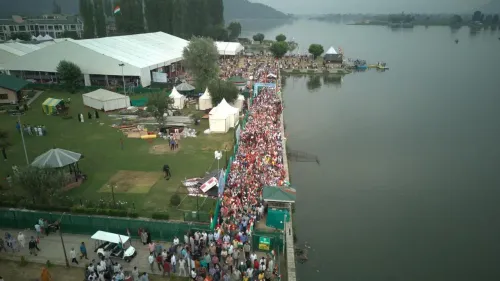
J&K Lt Governor Manoj Sinha addressed the Tiranga Mahotsav at the Botanical Garden, Srinagar on 12 August .
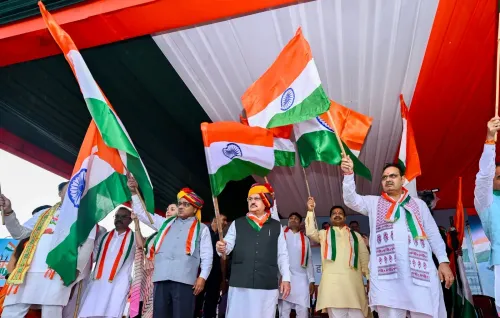
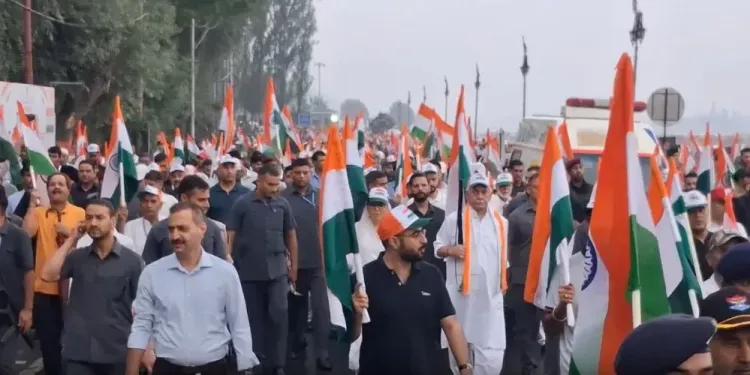
He flagged off the Tiranga Yatra from Sher-e-Kashmir International Convention Centre (SKICC) .
The 'Har Ghar Tiranga' campaign, launched in 2022 , aims to deepen every Indian's emotional bond with the Tricolour.
This year's celebrations also mark 150 years of Bankim Chandra Chatterjee's Vande Mataram .
Sinha said Jammu and Kashmir ranked as the best-performing region in the country in the campaign and urged it to retain the top spot.
He called on citizens to honour the Tricolour not just on rooftops but through 'character, honesty, dedication, unity, and service.'
Jammu and Kashmir Lieutenant Governor Manoj Sinha on Wednesday, 12 August declared that the 'Har Ghar Tiranga' campaign has grown into far more than a flag-hoisting exercise — calling it a festival of people's consciousness and a living tradition of national love. Sinha made the remarks while addressing the Tiranga Mahotsav celebrations at the Botanical Garden in Srinagar.
Key Developments
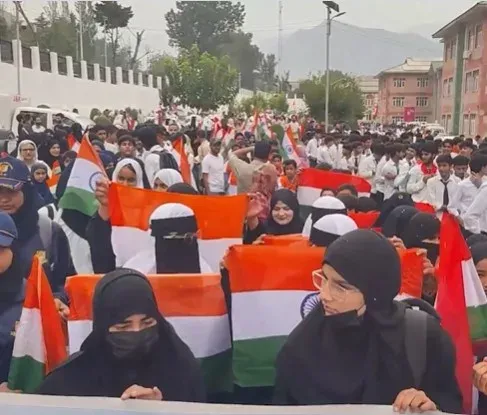
The L-G flagged off the Tiranga Yatra from the Sher-e-Kashmir International Convention Centre (SKICC) in Srinagar. He recalled that the 'Har Ghar Tiranga' campaign, first launched in 2022, was conceived to revive every Indian's emotional bond with the Tricolour.
'When the Tiranga waves across millions of homes, it is not just the flag that waves, but the hearts of 140 crore Indians are united by the same feeling, the same faith and the same resolve,' Sinha said. He added that this year's celebrations carried an additional dimension — the commemoration of 150 years of Bankim Chandra Chatterjee's Vande Mataram. 'If the Tiranga is the soul of our nation, then Vande Mataram is the immortal voice of that soul,' he said.
J&K Leads the Nation in Participation
Sinha expressed pride that the youth and citizens of Jammu and Kashmir had helped make the Union Territory the best-performing region in the country in the campaign. He called on J&K to retain that position in the next phase, describing the achievement as 'not merely a number, but an expression of the unbreakable national consciousness' flowing through the region.
'When Bandipora, Baramulla, Pulwama, Poonch, Rajouri, Kishtwar, Jammu and Srinagar march together in support of Vande Mataram, India's spirit rises,' he said. The L-G noted that J&K's participation had sent a message to the world that the region is 'a land of courage, determination, and devotion towards the motherland.'
The Significance of Vande Mataram at 150
Sinha said the commemoration of 150 years of Vande Mataram was not merely about honouring a song, but about paying homage to the awakening of national consciousness and the spirit of self-confidence, courage, and self-respect. He described the song as 'the immortal voice of our culture' and 'the embodiment of our unity,' noting its historical role in sustaining patriots when colonial rule sought to suppress national identity.
The L-G's Call to Action
Beyond the symbolism, Sinha urged citizens to use both campaigns as a prompt for introspection — asking whether each individual was actively contributing to building the India that freedom fighters and soldiers had sacrificed for. 'If our ancestors protected the nation with their blood, sweat and tears, then it is our responsibility to protect it with our character, honesty, dedication, unity, and service,' he said.
He called for collective effort to realise the vision of a Jammu and Kashmir that is economically powerful and rooted in Indian cultural and spiritual values. The L-G described the Union Territory as a symbol of a 'new Jammu and Kashmir' — one moving forward with self-confidence and national devotion. With Independence Day approaching, the campaign is expected to intensify across all districts of J&K.
Point of View
But the real story is the Centre's ongoing effort to recast J&K's public identity through visible, measurable patriotic participation. Whether that participation reflects a genuine shift in sentiment or is shaped by administrative mobilisation is a question the event's optics alone cannot answer.
NationPress
26 Sept 2026
Frequently Asked Questions
What is the Har Ghar Tiranga campaign?
The Har Ghar Tiranga campaign, launched in 2022, is a national initiative to encourage every Indian household to hoist the Tricolour, aiming to deepen the emotional and civic connection between citizens and the national flag. It is organised annually around Independence Day on 15 August.
What did J&K Lt Governor Manoj Sinha say at the Tiranga Mahotsav?
Lt Governor Manoj Sinha said the Har Ghar Tiranga campaign has evolved into a festival of people's consciousness and a tradition of national love. He also described J&K as the best-performing region in the country in the campaign and urged citizens to keep the spirit of the Tricolour alive in their thoughts, character, and actions.
Why is Vande Mataram being specially commemorated this year?
This year marks 150 years since Bankim Chandra Chatterjee composed Vande Mataram, making it a milestone year for the song. Lt Governor Sinha described Vande Mataram as the 'immortal voice' of India's national soul and said its commemoration was about honouring the awakening of national consciousness, not merely the song itself.
How did Jammu and Kashmir perform in the Har Ghar Tiranga campaign?
According to Lt Governor Manoj Sinha, Jammu and Kashmir ranked as the best-performing Union Territory or state in the country in the Har Ghar Tiranga campaign. Sinha credited the youth and citizens of J&K and urged the region to retain the top position in the campaign's next phase.
Where was the Tiranga Yatra flagged off in Srinagar?
The Tiranga Yatra was flagged off by Lt Governor Manoj Sinha from the Sher-e-Kashmir International Convention Centre (SKICC) in Srinagar on 12 August. The main Tiranga Mahotsav event was held at the Botanical Garden in the city.