Empowering Women: JGU's Second National Convention from March 8-10
Synopsis
Join O.P. Jindal Global University for its Second National Convention on Women, where discussions on gender justice will take center stage. This year's event, in line with the theme 'Give to Gain,' emphasizes the transformative power of investing in women.
Key Takeaways
Second National Convention on Women from March 8-10 at JGU.
Theme: Give to Gain , focusing on investing in women's potential.
Involvement of key stakeholders in discussions on gender justice.
Inaugural Jindal Interdisciplinary Arts and Literature Festival to accompany the Convention.
Panels addressing diverse themes related to women's empowerment.
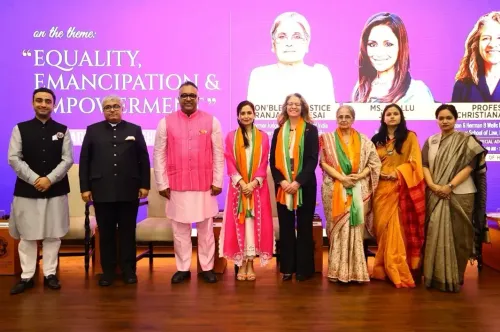
Sonipat, Feb 27 (NationPress) Following the success of its inaugural National Convention on Women, O.P. Jindal Global University is set to host its Second National Convention from March 8-10 on its Sonipat campus in Haryana. This Convention aims to promote deep, inclusive, and action-driven discussions surrounding gender justice.
Aligned with the theme for International Women’s Day 2026, “Give to Gain,” the Second Women’s Convention at JGU emphasizes that investing in women's knowledge, creativity, leadership, and labor yields substantial long-term social, cultural, and democratic benefits.
Despite advancements from decades of advocacy and reform, gender-based discrimination continues to affect women in various settings across India, including homes, workplaces, and educational institutions. The Convention will unite academics, scholars, practitioners, advocates, policymakers, and grassroots workers to foster a collaborative space for reflection and dialogue, aiming to identify actionable pathways for social and institutional transformation while addressing emerging inequalities in a swiftly evolving social and economic landscape.
This year, the Convention will be further enhanced by the inaugural Jindal Interdisciplinary Art and Literature Festival 2026. This festival aims to broaden the engagement initiated by the Convention by integrating feminist perspectives with literature, art, cinema, and other cultural expressions. It acknowledges that the quest for gender justice transcends policy and institutional reforms; it is equally influenced by narratives, visuals, and imaginative worlds. Creative expressions serve as vital spaces for resistance, critique, healing, and re-imagination, where silenced voices are amplified, alternative futures envisioned, and lived experiences articulated.
Prof (Dr) C. Raj Kumar, the Founding Vice Chancellor of O.P. Jindal Global University, remarked, “Women form the bedrock of JGU's academic and institutional ethos. Empowering women through choices, opportunities, and participation in both academic and administrative roles is integral to our culture. With over 55% of our workforce being women, we proudly identify as a women-centric organization, committed to enhancing their involvement in all our activities. This commitment is further demonstrated through the inaugural Jindal Interdisciplinary Arts and Literature Festival, which fosters dialogues between feminist visions and the arts, underscoring the importance of inclusive cultural spaces in advancing equality.”
Prof (Dr) Upasana Mahanta, Dean of Admissions and Outreach and a member of the organizing committee, noted: “The Convention brings us together with a shared purpose; it ignites ideas and inspires determination. However, its true importance and our actual commitment will be measured by the actions we take daily—through consistent institutional support, thoughtful teaching practices, mentorship, everyday solidarity, and by creating spaces that shape our lived experiences.”
The Convention will feature multiple panels over three days, commencing with an inaugural session and a keynote address focusing on feminist legacies in India. Various panel discussions will cover diverse themes, including Women’s Perspectives: Seeing, Feeling, Knowing; Women and Translation: Who Speaks for Women?; The Feminization of Aging; Gender Diversity and Public Health Justice; Pathways to Enhanced Economic and Social Outcomes; Female Voices in Humanities and Truth Preservation; Women in the Workforce: Overcoming Barriers to Equality; Media and Publishing Ecosystems; Women Shaping the Digital Future; Women’s Influence in Policy-Making; and Women in Leadership within Media, among others.
By juxtaposing artistic and literary dialogues with scholarly and policy discussions, the Festival reinforces the notion that struggles for equality and liberation should be envisioned, articulated, and sustained across various disciplines and forms. It invites writers, artists, filmmakers, poets, performers, and thinkers to engage with themes of identity, labor, care, embodiment, memory, and power, illustrating how cultural production both mirrors and reshapes social realities. This creative event complements the Convention’s deliberative focus, encouraging participants to view feminist engagement not solely as a reformative endeavor but as an ongoing intellectual and cultural journey.
Prof Dr Gargi Bharadwaj, Director of the Office of Student Life and Cultural Engagement (SLCE), emphasized, “The Jindal Interdisciplinary Arts and Literature Festival (JIALF) is envisioned as a premier cultural-academic platform to spark meaningful conversations about the arts from an interdisciplinary university perspective. The festival aims to engage a vibrant student community by showcasing a diverse array of genres, voices, and ideas that enrich contemporary cultural and literary discourse.”
Point of View
I see the Second National Convention on Women hosted by JGU as a significant step toward addressing gender disparities in India. This event not only aims to foster dialogue among various stakeholders but also seeks to identify concrete actions for social change, which is crucial in today's rapidly evolving landscape.
NationPress
3 Oct 2026
Frequently Asked Questions
When is the Second National Convention on Women taking place?
The Convention will be held from March 8 to 10, 2026.
What is the theme of this year's Convention?
The theme for this year's Convention is 'Give to Gain', emphasizing the importance of investing in women's potential.
Who will be participating in the Convention?
The Convention will bring together academics, scholars, practitioners, advocates, policymakers, and grassroots workers.
What additional event is being held alongside the Convention?
The inaugural Jindal Interdisciplinary Art and Literature Festival 2026 will take place alongside the Convention.
What topics will be discussed at the Convention?
Panel discussions will cover various themes related to women's issues, including gender diversity, economic outcomes, and women's leadership.