RJD's Manoj Jha invokes Gandhi against RSS chief Bhagwat's 'dismantle' India remarks
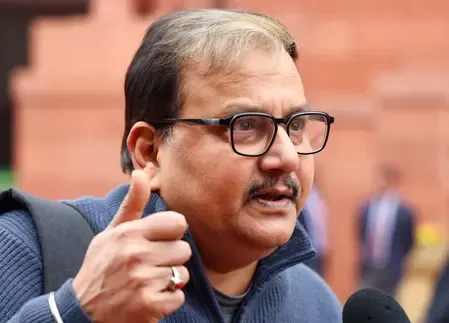
Synopsis
RJD's Manoj Jha used Gandhi's three mass movements — Non-Cooperation, Civil Disobedience, Quit India — as a direct ideological riposte to RSS chief Mohan Bhagwat's Dussehra warning about forces seeking to 'dismantle' India. With Shiv Sena (UBT)'s Arvind Sawant piling on over unemployment and privatisation, the exchange reveals how the Opposition is trying to fuse Gandhian symbolism with economic grievance into a single counter-narrative.
Key Takeaways
RJD MP Manoj Kumar Jha invoked Mahatma Gandhi's Non-Cooperation, Civil Disobedience, and Quit India movements in response to RSS chief Mohan Bhagwat's warnings on 20 October 2026 .
Bhagwat had asserted that attempts to 'dismantle' India would not succeed, citing cultural threats from a 'storm from the West' and referencing unrest in France , Albania , Bangladesh , and Nepal .
Jha accused the RSS of standing ideologically 'against Gandhi ji' and vowed continued opposition to 'authoritarianism of those in power.' Shiv Sena (UBT) MP Arvind Sawant broadened the attack, questioning rising unemployment and the privatisation of public sector enterprises.
The exchange unfolded on the occasion of Dussehra (Vijayadashami) , when the RSS chief traditionally delivers his annual address.
Rashtriya Janata Dal (RJD) Rajya Sabha MP Manoj Kumar Jha on Tuesday, 20 October 2026, fired back at Rashtriya Swayamsevak Sangh (RSS) chief Mohan Bhagwat's warnings about forces seeking to 'dismantle' India, invoking Mahatma Gandhi's legacy of non-violent resistance as the Opposition's ideological anchor. The exchange sharpened the political fault lines between the ruling establishment and the INDIA bloc ahead of a volatile political season.
Jha's Response: Gandhi as the Counter-Argument
'Mohan Bhagwat should not be worried at all. This is Mahatma Gandhi's country. Perhaps you people do not believe that, but I know it, because your ideology stands against Gandhi ji,' Jha said in remarks to reporters.
Jha drew directly on the three pillars of the freedom struggle — the Non-Cooperation Movement, the Civil Disobedience Movement, and the Quit India Movement — as templates for democratic resistance. 'France does not have Gandhi ji, Albania does not have Gandhi ji, but we have Bapu,' he said, pointedly referencing countries Bhagwat had cited as examples of societies under siege. He added that the Opposition would 'continue to challenge the authoritarianism of those in power on the basis of our ideals.'
What Bhagwat Said
Mohan Bhagwat had earlier asserted that attempts to 'dismantle' India would not succeed, warning of forces opposed to established institutions, cultural values, and social order. Referencing developments in France, Albania, Bangladesh, and Nepal, the RSS chief said a 'storm has blown in from the West that opposes every form of order, propriety, auspiciousness, culture and human values, seeking to destroy, corrupt and ruin them. Even developed nations are affected by it.'
Bhagwat also cautioned that a change in government alone would not resolve the country's challenges, and urged that the conduct of protesters, law enforcement, and political leaders should not sow hatred or deepen social divisions.
Shiv Sena (UBT) Joins the Pushback
Arvind Sawant, MP of Shiv Sena (UBT), also weighed in, extending Dussehra greetings before pivoting to a sharp critique of economic governance. He urged Bhagwat to 'reflect deeply within himself' and look at 'those sitting on the stage.'
'The nation is being sold out, isn't that a fact? Public sector enterprises are being privatised, isn't that true? The number of unemployed people is constantly rising,' Sawant said. His remarks broadened the Opposition's response from ideological symbolism to concrete policy grievances — unemployment, privatisation of public sector enterprises — that have currency with a wider electorate.
Why This Exchange Matters
The back-and-forth is notable for what each side chooses as its rhetorical terrain. The RSS chief's framing — civilisational threat, Western cultural erosion — is consistent with a long-running Hindutva intellectual project. The Opposition's counter — Gandhian constitutionalism and economic accountability — signals a strategic attempt to reclaim both the moral high ground and bread-and-butter voter concerns. Notably, the RJD's invocation of Gandhi carries particular weight in Bihar, where the Mahatma's Champaran Satyagraha of 1917 remains a foundational political memory. The timing, on the occasion of Dussehra, adds a symbolic layer to remarks that are being watched closely ahead of upcoming assembly polls.
What to Watch Next
The exchange is unlikely to be a one-off. With the RSS's annual Vijayadashami address traditionally setting ideological coordinates for the Sangh Parivar, Opposition responses in the days ahead will signal how the INDIA bloc intends to frame its political narrative through the winter session of Parliament and into the electoral calendar.
Point of View
And the 'dismantle India' framing is a deliberate escalation — one that positions the Sangh as the last line of civilisational defence. The Opposition's instinct to reach for Gandhi is both politically logical and historically resonant, but it risks being a rhetorical reflex rather than a strategic programme. Jha's invocation is stirring; what is missing is a concrete alternative framework for the challenges Bhagwat raised — unemployment, institutional credibility, social cohesion — where Sawant's economic critique is sharper and more voter-legible. The more interesting question mainstream coverage sidesteps is why Bhagwat felt it necessary to add that a 'change in government' alone would not fix things: that caveat complicates any simple reading of his remarks as partisan endorsement, and deserves more scrutiny than it received.
NationPress
20 Oct 2026
Frequently Asked Questions
What did RJD MP Manoj Jha say in response to Mohan Bhagwat?
Manoj Jha said 'This is Mahatma Gandhi's country' and cited Gandhi's Non-Cooperation Movement, Civil Disobedience Movement, and Quit India Movement as the Opposition's models for resisting authoritarianism. He also accused the RSS of standing ideologically against Gandhi, saying the Opposition would 'continue to challenge the authoritarianism of those in power.'
What did RSS chief Mohan Bhagwat say about 'dismantling' India?
Bhagwat said attempts to 'dismantle' India would not succeed and warned of a 'storm from the West' undermining order, culture, and human values — a challenge he said was affecting even developed nations. He referenced unrest in France, Albania, Bangladesh, and Nepal, and cautioned that a change in government alone would not resolve the country's problems.
What did Shiv Sena (UBT) MP Arvind Sawant say about Bhagwat's remarks?
Arvind Sawant urged Bhagwat to 'reflect deeply within himself' and look at those sharing the stage with him. He pointed to rising unemployment and the privatisation of public sector enterprises as evidence of governance failures, framing his response around economic accountability rather than ideological symbolism.
When and on what occasion were Bhagwat's original remarks made?
Bhagwat's remarks were made on Dussehra (Vijayadashami), when the RSS chief traditionally delivers an annual address setting ideological coordinates for the Sangh Parivar. The occasion, on 20 October 2026, drew responses from multiple Opposition leaders the same day.
Why is the Gandhi invocation politically significant in this context?
By framing the Opposition's resistance through Gandhi's three mass movements, Jha is positioning the INDIA bloc as heirs to constitutional, non-violent democratic tradition — a direct contrast to the RSS's cultural-nationalist framing. The argument carries particular resonance in Bihar, given the Mahatma's historic Champaran Satyagraha connection, and signals how the Opposition may frame its narrative into the upcoming election cycle.