Jharkhand CMO: Mines to Minds, Resources to Prosperity

Synopsis
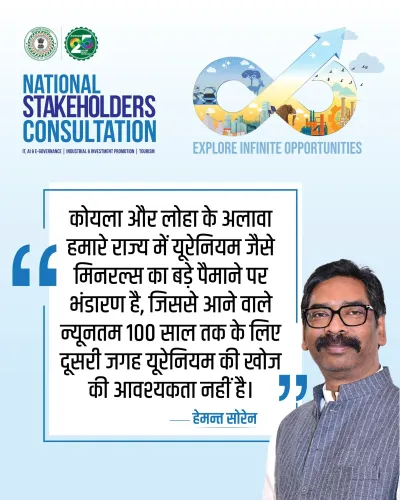
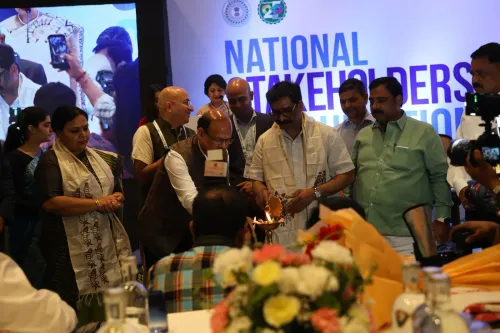
The Chief Minister's Office of Jharkhand on July 10, 2026 announced a national stakeholders consultation under the 'Mines to Minds' theme, signalling the state's intent to convert its vast mineral wealth into human capital, skill development and broad-based economic prosperity for tribal communities and local youth.
Key Takeaways
The Chief Minister's Office of Jharkhand announced a national stakeholders consultation on July 10, 2026 under the theme 'Mines to Minds.' The initiative frames Jharkhand's mineral wealth — including coal, iron ore and bauxite — as a foundation for human capital investment, not just extraction revenue.
The post tags Chief Minister Hemant Soren and the Jharkhand Department of Industries as key stakeholders in the policy push.
The 2015 MMDR Act amendment created District Mineral Foundations that channel royalties into local development in mining districts, forming the existing policy base.
Tribal communities and local youth are the primary intended beneficiaries of the resource-to-prosperity framework.
Similar 'mines to development' models are being pursued by Odisha and Chhattisgarh , reflecting a broader national pattern among mineral-rich states.
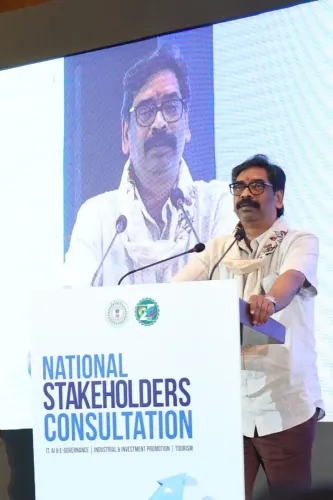
The Chief Minister's Office of Jharkhand on Friday, July 10, 2026 shared a message signalling the state's strategic pivot from raw mineral extraction toward human capital development, framing the initiative under the phrase 'Mines se Mind tak' — 'From Mines to Minds' — and announcing a national stakeholders consultation on converting the state's vast natural resources into broad-based prosperity.
Context
The post, tagged to Chief Minister Hemant Soren and the Jharkhand Department of Industries, declares that Jharkhand is moving forward in the direction of transforming its resources into prosperity. The phrase 'Mines to Minds' encapsulates a policy philosophy that has gained currency across mineral-rich Indian states: that the true return on natural wealth lies not merely in royalties and extraction volumes, but in education, skill development and diversified economic opportunity for local communities.
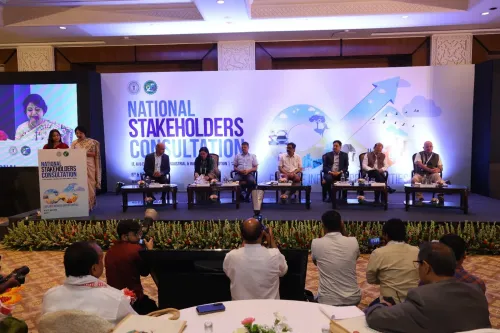
The accompanying hashtags — #JharkhandSeJohar, #National, #Stakeholders, #Consultation — indicate that a formal national-level stakeholders consultation is either underway or imminent, bringing together industry, government and civil society to deliberate on the resource-to-prosperity agenda.
Policy Backdrop
Jharkhand, carved out of Bihar in November 2000, sits atop some of India's richest mineral deposits — including coal, iron ore, bauxite, copper and mica — yet ranks among the lower-income states on human development indices. This paradox of resource wealth and developmental lag has long driven demands for a more equitable sharing of mining revenues.
The 2015 amendment to the Mines and Minerals (Development and Regulation) Act mandated the creation of District Mineral Foundations (DMFs), which channel a portion of mining royalties directly into local area development in resource-affected districts. Jharkhand has been one of the larger beneficiaries of DMF inflows, with funds earmarked for health, education and infrastructure in mining belts. Chief Minister Hemant Soren and his Jharkhand Mukti Morcha (JMM) administration have consistently pushed for greater state control over mineral revenues and stronger welfare linkages from extraction activity.
Across the region, states such as Odisha and Chhattisgarh have pursued similar frameworks — investing mining surpluses in downstream industries, vocational training and value-addition clusters — reflecting a national consensus that resource-dependent economies must diversify to achieve sustainable growth.
Stakeholders and Impact
The consultation process is expected to draw participation from mining companies, tribal community representatives, industry bodies and central government officials. Tribal communities constitute a significant share of Jharkhand's population and have historically borne the social and environmental costs of large-scale extraction while receiving limited economic benefit.
For local youth, the 'Mines to Minds' framing points toward skill-development programmes and employment pipelines tied to downstream industries — processing, manufacturing and services — rather than dependence on primary extraction jobs, which are capital-intensive and generate limited direct employment. The Jharkhand Department of Industries, tagged in the post, is likely a key implementing agency for any new policy measures emerging from the consultation.
What's Next
The outcome of the national stakeholders consultation will be closely watched for concrete policy announcements — whether new schemes linking DMF revenues to skill development, fresh investment incentives for value-added manufacturing in mineral corridors, or updated royalty-sharing frameworks. Any follow-up announcement from the Chief Minister's Office or the Jharkhand Department of Industries will indicate how the state intends to operationalise the 'Mines to Minds' vision beyond the consultative stage. The broader implication is clear: if Jharkhand succeeds in building a replicable model for converting mineral wealth into human capital, it could reshape the policy template for resource-rich states across India.
Point of View
But as an active architect of its own industrial and human capital future. The national stakeholders consultation format elevates the initiative beyond a state-level announcement, suggesting the JMM government is seeking both central government alignment and private sector buy-in for what could become a model resource-governance framework. This fits a broader arc in Indian federalism where mineral-rich states are asserting greater agency over how extraction revenues are deployed, pushing back against the historical pattern of resource outflows with minimal local developmental return. The success of this consultation in producing actionable policy — rather than remaining a rhetorical pivot — will be the true test of the administration's intent.
NationPress
10 Jul 2026
Frequently Asked Questions
What is Jharkhand's 'Mines to Minds' initiative?
'Mines to Minds' is a policy theme announced by the Jharkhand Chief Minister's Office on July 10, 2026, aimed at converting the state's mineral resource revenues into investments in human capital, skill development and diversified economic opportunities for local communities.
What is the national stakeholders consultation announced by the Jharkhand CMO?
The Jharkhand CMO announced a national-level consultation bringing together mining companies, tribal community representatives, industry bodies and government officials to deliberate on how the state's mineral wealth can be translated into broad-based prosperity.
What is the District Mineral Foundation and how does it relate to Jharkhand?
The District Mineral Foundation (DMF) was created under the 2015 amendment to the Mines and Minerals (Development and Regulation) Act, requiring mining companies to contribute a portion of royalties to local development funds. Jharkhand, as one of India's most mineral-rich states, receives significant DMF inflows directed at health, education and infrastructure in mining districts.
Who is Hemant Soren and what is his role in Jharkhand's mining policy?
Hemant Soren is the Chief Minister of Jharkhand and leader of the Jharkhand Mukti Morcha (JMM). His administration has prioritised state control over mineral revenues and stronger welfare linkages from mining activity, with tribal community welfare as a central policy plank.
Which other Indian states are pursuing similar mines-to-development policies?
Odisha and Chhattisgarh are among the mineral-rich states pursuing similar frameworks that invest mining surpluses in downstream industries, vocational training and value-addition clusters, reflecting a national trend toward sustainable and equitable resource governance.