Rajnath Singh meets Indian Navy at Visakhapatnam Barakhana
Synopsis
Defence Minister Rajnath Singh joined Indian Navy personnel at a Barakhana in Visakhapatnam on 11 July 2026, declaring India the 'largest and most responsible stakeholder' in the Indian Ocean Region and affirming that securing the region — India's 'courtyard' — is the nation's responsibility.
Key Takeaways
Rajnath Singh attended a Barakhana with Indian Navy personnel at Visakhapatnam on 11 July 2026 .
He described India as 'the largest and most responsible stakeholder in the Indian Ocean Region '.
The Minister used the 'courtyard' metaphor to assert that securing the IOR is India's primary maritime responsibility.
Visakhapatnam hosts the Eastern Naval Command , one of India's most critical naval installations.
The remarks align with India's SAGAR doctrine, first outlined by PM Modi in Mauritius in 2015 .
The visit signals continued political focus on naval modernisation ahead of the 2026-27 defence budget cycle.
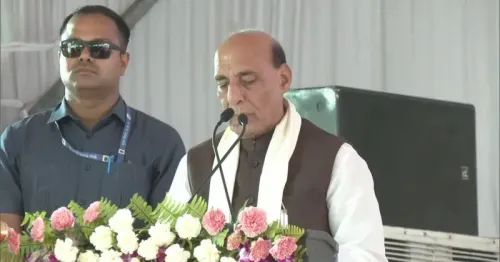
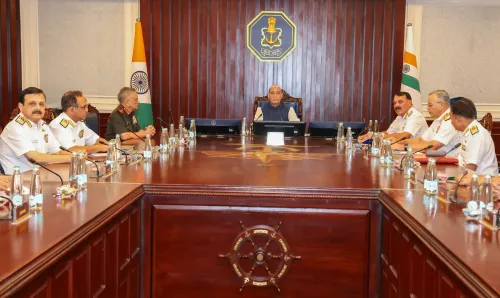
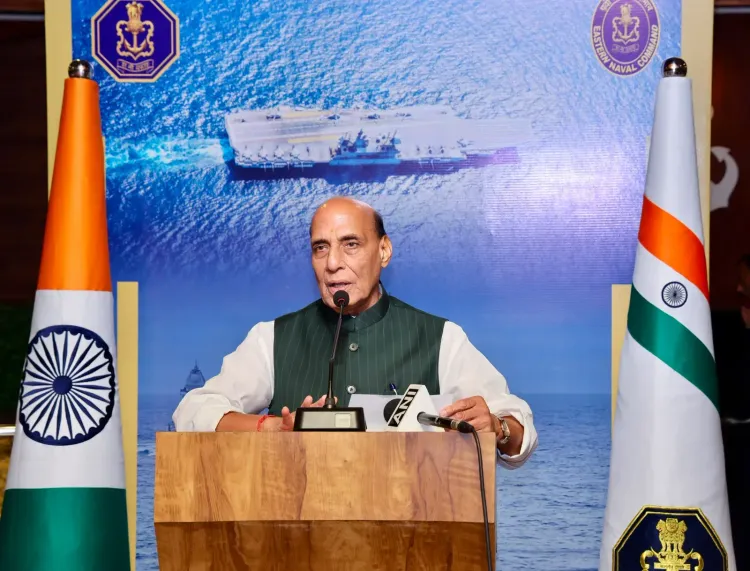
Union Defence Minister Rajnath Singh on Friday, 11 July 2026, interacted with Indian Navy personnel at a 'Barakhana' — a traditional military community meal — held at Visakhapatnam, home to the Navy's Eastern Naval Command. The Minister reaffirmed India's claim as the foremost maritime power in the Indian Ocean Region, describing it as the country's 'courtyard'.
Context
Posting on X, Rajnath Singh wrote: 'The region is our courtyard, and securing the courtyard is our responsibility.' The remark encapsulates a long-standing Indian strategic posture — that the Indian Ocean Region (IOR) is not a peripheral theatre but a primary sphere of national interest. The Minister described India as 'the largest and most responsible stakeholder' in the region, language that mirrors official doctrine used at multilateral forums.
A Barakhana is a traditional armed-forces gathering where senior leadership dines with troops, reinforcing unit cohesion and morale. Visakhapatnam, on the Andhra Pradesh coast, hosts the Eastern Naval Command and is one of India's most strategically significant naval installations.
Policy Backdrop
The Minister's remarks sit squarely within India's SAGAR — Security and Growth for All in the Region — doctrine, first articulated by Prime Minister Narendra Modi in Mauritius in 2015. The framework positions India as a net security provider across the Indian Ocean, responsible for safeguarding sea lanes, supporting littoral states, and countering extra-regional influence.
The Eastern Naval Command at Visakhapatnam has been progressively strengthened over the past two decades with expanded basing, surveillance assets, and submarine infrastructure. The IOR carries an estimated 80 per cent of global oil trade and is a critical corridor for India's energy imports and export-led growth, making naval dominance a core economic as well as security priority.
Successive governments have deepened naval diplomacy through multilateral exercises such as Malabar and Milan, and through bilateral capacity-building with Indian Ocean island nations. Rajnath Singh's visit underlines continuity in this approach regardless of which party holds office.
Stakeholders and Impact
For Indian Navy personnel stationed at Visakhapatnam, the ministerial visit and Barakhana signal political attention to the eastern seaboard at a time of heightened maritime competition in the Indo-Pacific. Coastal states along the Bay of Bengal and the broader IOR watch India's posture closely as a counterweight to expanding Chinese naval presence.
India's maritime neighbours — from Sri Lanka and the Maldives to Mauritius and Seychelles — are direct beneficiaries of Indian naval patrols, hydrographic surveys, and disaster-response missions. The Minister's framing of the IOR as India's 'courtyard' is likely to resonate with these partners even as it signals resolve to any adversarial actor.
What's Next
Attention will now turn to the next editions of the Malabar and Milan naval exercises, which serve as practical demonstrations of the doctrine Rajnath Singh articulated on Friday. Parliamentary discussions on the 2026-27 naval modernisation budget will also be a key indicator of how the government intends to resource its Indian Ocean ambitions.
With India's maritime footprint expanding and great-power competition intensifying in the IOR, the Defence Minister's Visakhapatnam visit is a reminder that the 'courtyard' metaphor is increasingly backed by hardware, deployments, and diplomatic bandwidth.
Point of View
The Defence Minister is reinforcing the SAGAR consensus that spans multiple governments — signalling to both domestic audiences and regional actors that India's maritime ambitions are bipartisan and durable. The choice of Visakhapatnam, seat of the Eastern Naval Command, is deliberate: it directs attention to the Bay of Bengal and the eastern IOR, precisely where Chinese naval activity has drawn the sharpest strategic concern. The visit also pre-positions the government ahead of parliamentary scrutiny of the naval modernisation budget, lending political weight to funding demands from the Navy.
NationPress
11 Jul 2026
Frequently Asked Questions
Why did Rajnath Singh visit Visakhapatnam in July 2026?
Rajnath Singh visited Visakhapatnam to interact with Indian Navy personnel at a Barakhana, a traditional military community meal, and to reaffirm India's commitment to securing the Indian Ocean Region .
What is a Barakhana in the Indian military?
A Barakhana is a traditional armed-forces gathering where senior officers and officials dine together with troops, fostering unit cohesion and morale. It is a common practice across all three services of the Indian Armed Forces .
What is India's SAGAR doctrine?
SAGAR — Security and Growth for All in the Region — is India's Indian Ocean policy framework announced by Prime Minister Modi in Mauritius in 2015 . It positions India as a net security provider in the Indian Ocean Region , responsible for safeguarding sea lanes and supporting littoral states.
What is the Eastern Naval Command in Visakhapatnam?
The Eastern Naval Command , headquartered at Visakhapatnam in Andhra Pradesh , is one of three commands of the Indian Navy and oversees operations in the Bay of Bengal and the eastern Indian Ocean .
What did Rajnath Singh say about the Indian Ocean Region?
Rajnath Singh stated that India is 'the largest and most responsible stakeholder in the Indian Ocean Region ' and described the region as India's 'courtyard,' asserting that securing it is the country's responsibility.