PM Modi Highlights Maritime Power as India's Strategic Priority
Synopsis
Prime Minister Narendra Modi on June 21, 2026 declared that a nation's maritime strength determines its economic and strategic influence, affirming India is actively preparing to expand its naval and maritime capabilities in the Indian Ocean Region.
Key Takeaways
PM Modi on June 21, 2026 linked maritime capability directly to economic and strategic power in an X post accompanied by a video.
He stated: 'The stronger a nation's maritime capability, the more powerful its economic and strategic influence will be.
India is preparing itself for this.' The Sagarmala Project (launched 2015 ) and the SAGAR doctrine (articulated 2015 ) are the twin policy pillars underpinning India's maritime ambitions.
The Indian Navy is pursuing indigenous carrier and submarine programmes as part of a broader modernisation drive.
India's maritime strategy is embedded in a wider Indo-Pacific orientation that includes multilateral exercises with Quad partners.
Upcoming naval budget allocations and new maritime cooperation agreements will be key indicators of policy momentum.
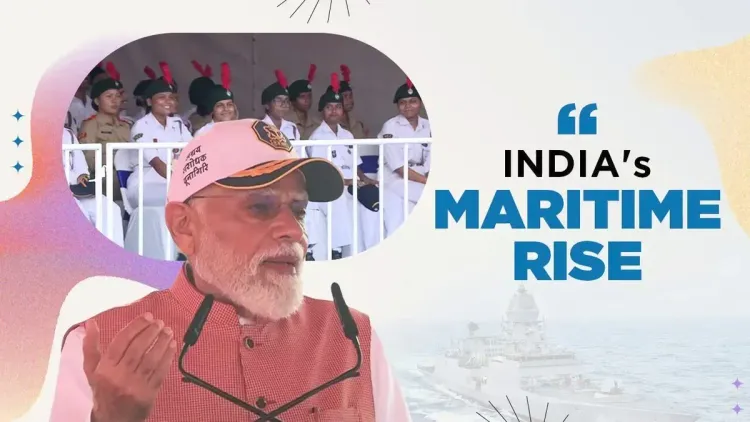
Prime Minister Narendra Modi on Sunday, June 21, 2026, underscored India's commitment to building maritime strength, asserting that a nation's economic and strategic influence is directly proportional to its naval capabilities. The statement, posted on his official X account, was accompanied by a video and signals a continued push to position India as a leading maritime power in the Indian Ocean Region.
In his post, PM Modi wrote in Hindi: 'Jis desh ka samudri saamarthya jitna mazboot hoga, uska aarthik aur raananeetik prabhav bhi utna hi sashakt hoga.' ('The stronger a nation's maritime capability, the more powerful its economic and strategic influence will be. India is preparing itself for this.')
Context
The post reflects a long-standing emphasis in PM Modi's governance on maritime security and sea-based economic growth. Since 2015, the government has articulated two major frameworks — the Sagarmala Project and the SAGAR doctrine — to translate India's geographic position in the Indian Ocean into tangible economic and diplomatic leverage.
The SAGAR (Security and Growth for All in the Region) vision, first outlined by PM Modi in Mauritius in 2015, set the tone for India's cooperative yet assertive approach to the Indian Ocean Region, emphasising trade security and capacity-building with littoral states.
Policy Backdrop
The Sagarmala Project, approved in 2015, remains the flagship port-led development programme aimed at modernising India's ports, improving coastal connectivity, and spurring coastal economic growth. Alongside, the Indian Navy has pursued an ambitious modernisation roadmap that includes indigenous aircraft carrier programmes and advanced submarine projects.
India has simultaneously deepened multilateral maritime engagements — including exercises under the Quad framework with the United States, Japan, and Australia — to reinforce its presence across key sea lanes without direct confrontation. The broader Indo-Pacific orientation has made maritime capability a central pillar of national security planning.
Stakeholders and Impact
The Indian Navy, port authorities, the domestic shipping industry, and coastal states stand as the primary stakeholders in this strategic vision. For coastal communities, investments in port infrastructure translate into employment and improved logistics. For the broader economy, secure sea lanes underpin the movement of energy imports and export cargo, making maritime strength an economic imperative, not just a defence one.
India's strategic competitors and partners in the Indian Ocean Region — from Sri Lanka and Maldives to Oman and Indonesia — are also watching closely, as India's maritime posture shapes regional security architecture and bilateral cooperation agreements.
What's Next
Analysts will watch upcoming naval budget allocations for signals on the pace of indigenisation and fleet expansion. Progress on the indigenous aircraft carrier and advanced submarine programmes will be key indicators of how swiftly India converts its maritime ambitions into operational capability.
New maritime cooperation agreements at bilateral or multilateral forums — including any Quad-level announcements — could further define the contours of India's evolving Indo-Pacific strategy. PM Modi's post, coming alongside an attached video, suggests a broader communication push around maritime readiness that may precede a formal policy announcement or event.
Point of View
The government signals that port development, shipbuilding, and sea-lane security are not siloed defence concerns but integrated pillars of national growth. The timing alongside a video suggests a coordinated outreach effort, possibly preceding a naval event, budget announcement, or bilateral summit with an Indian Ocean partner. This framing also serves a geopolitical purpose: positioning India as the preferred security provider in the Indian Ocean Region at a moment of intensifying great-power competition.
NationPress
20 Sept 2026
Frequently Asked Questions
What did PM Modi say about India's maritime power on June 21 2026?
PM Modi stated that the stronger a nation's maritime capability, the more powerful its economic and strategic influence, and affirmed that India is actively preparing to build that strength.
What is the SAGAR doctrine and how does it relate to India's maritime policy?
SAGAR stands for Security and Growth for All in the Region. PM Modi outlined this maritime vision in Mauritius in 2015 to guide India's cooperative and assertive approach to the Indian Ocean, emphasising trade security and partnerships with littoral states.
What is the Sagarmala Project?
The Sagarmala Project is a port-led development programme approved in 2015 to modernise India's ports, improve coastal connectivity, and promote coastal economic growth as part of a broader maritime strategy.
How is the Indian Navy modernising under India's maritime strategy?
The Indian Navy is pursuing indigenous aircraft carrier and advanced submarine programmes, conducting multilateral exercises with Quad partners, and expanding its maritime domain awareness to secure key sea lanes in the Indian Ocean Region.
Why is maritime strength important for India's economy?
India relies on sea lanes for the bulk of its energy imports and export cargo. Securing these routes and building port infrastructure directly supports economic growth, making naval capability an economic priority alongside its strategic dimension.