Dr. Jitendra Singh at IIT Gandhinagar Backs ANRF, Quantum Mission
Synopsis
Union Science Minister Dr. Jitendra Singh, addressing IIT Gandhinagar on 11 June 2026, called for democratising research funding via ANRF, highlighted the National Quantum Mission and India AI Mission, and urged early industry collaboration in publicly funded research to accelerate technology transfer.
Key Takeaways
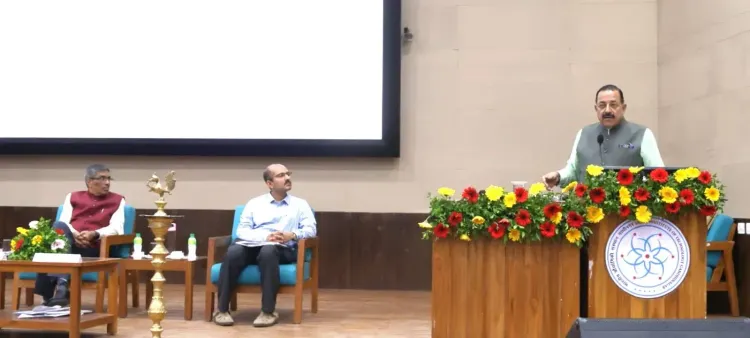
Jitendra Singh addressed faculty and students at IIT Gandhinagar, Ahmedabad on 11 June 2026 .
The Anusandhan National Research Foundation (ANRF) , chaired by PM Narendra Modi , is designed to extend research funding beyond traditional centres of excellence.
The National Quantum Mission carries an outlay of Rs 6,003 crore for 2023–2031 to advance quantum computing and communications.
The India AI Mission , approved in 2024 , focuses on domestic AI compute infrastructure, datasets and skilling.
The minister called for industry collaboration to begin at the 'stage of conceptualisation' rather than post-research completion.
India's research ecosystem was described as drawing strength from science, humanities, social sciences and traditional knowledge working together.
Union Science and Technology Minister Dr. Jitendra Singh addressed faculty and students at IIT Gandhinagar, Ahmedabad on 11 June 2026, outlining the government's push to democratise research funding and deepen industry linkages in India's evolving science ecosystem.
Context
Speaking to the academic community, Dr. Jitendra Singh highlighted that recent science policy initiatives are 'aimed at democratising access to research funding and opportunity, for overall ease of research.' He pointed specifically to the Anusandhan National Research Foundation (ANRF), whose Governing Body is chaired by Prime Minister Narendra Modi, as the central vehicle for channelling financial and technical support to institutions beyond traditional centres of excellence.
The minister underscored that India's research strength lies in its diversity — drawing together expertise from 'science, humanities, social sciences and traditional knowledge to address national challenges in a holistic manner.' This multidisciplinary framing aligns with the broader thrust of the National Education Policy 2020, which called for breaking disciplinary silos in higher education and research.
Policy Backdrop
The Anusandhan National Research Foundation was established under the ANRF Act, 2023, replacing the earlier Science and Engineering Research Board to create a larger, more flexible national research funding agency with a mandate to reach newer and smaller institutions. The minister described the 'last decade' as 'the decade of science and technology,' citing India's emergence as 'an active participant in frontier technologies.'
Two flagship missions were specifically named. The National Quantum Mission, approved by the Union Cabinet in April 2023 with an outlay of Rs 6,003 crore for the period 2023–2031, aims to accelerate quantum computing and communications capabilities. The India AI Mission, approved in 2024, is designed to build a domestic artificial intelligence ecosystem encompassing compute infrastructure, datasets, and skilling programmes. Together, these missions reflect an integrated strategy for technology sovereignty under the Atmanirbhar Bharat framework.
Stakeholders and Impact
A recurring emphasis in the minister's address was the need for 'early industry linkage in research programmes.' Dr. Jitendra Singh argued that collaboration with industry 'should begin at the stage of conceptualisation itself rather than after the completion of research,' enabling smoother technology transfer and stronger alignment with societal needs. This marks a notable shift in framing — from research-as-output to research-as-partnership.
For institutions such as IIT Gandhinagar — a second-generation IIT in Gujarat with a strong interdisciplinary research culture — the ANRF's mandate to fund non-traditional centres of excellence carries direct relevance. Faculty and students at such institutions stand to benefit from competitive grant windows that were previously concentrated among older, better-resourced institutes. Academic researchers, industry R&D partners, and science administrators across the country are the primary stakeholders in these policy shifts.
What's Next
The first tranche of ANRF competitive grants to non-IIT and non-NIT institutions, as well as mid-term reviews of National Quantum Mission deliverables, are expected to come up during the 2026–27 parliamentary session. How effectively funds flow to newer institutions will be a key test of the ANRF's stated democratisation mandate.
The minister's remarks at IIT Gandhinagar signal that the government intends to keep science and technology policy at the centre of its economic and strategic agenda, with early-stage industry engagement increasingly positioned as a non-negotiable feature of publicly funded research.
Point of View
Rather than after research completion, represents a structural shift in how publicly funded science is expected to justify itself. Together, these remarks position the Science Ministry as a key enabler of the Atmanirbhar Bharat economic agenda, using research policy as both an instrument of equity and a driver of strategic technology independence.
NationPress
26 Oct 2026
Frequently Asked Questions
What is the Anusandhan National Research Foundation (ANRF)?
The ANRF is a statutory body established under the ANRF Act, 2023, to expand and diversify research funding across India. Its Governing Body is chaired by Prime Minister Narendra Modi, and it replaced the earlier Science and Engineering Research Board to create a broader, more flexible national research funding agency.
What is the budget for India's National Quantum Mission?
The Union Cabinet approved the National Quantum Mission in April 2023 with a total outlay of Rs 6,003 crore, covering the period from 2023 to 2031, to accelerate quantum computing, communications and related technologies.
What did Dr. Jitendra Singh say at IIT Gandhinagar?
Dr. Jitendra Singh said that government science policy is aimed at democratising research funding, highlighted the roles of ANRF, the National Quantum Mission and the India AI Mission, and stressed that industry collaboration in research should begin at the conceptualisation stage rather than after research is completed.
What is the India AI Mission?
The India AI Mission was approved in 2024 to build a domestic artificial intelligence ecosystem, focusing on compute infrastructure, datasets, and skilling programmes to position India as a global AI player.
How does ANRF benefit smaller or newer institutions in India?
ANRF is specifically mandated to channel financial and technical support to institutions beyond traditional centres of excellence such as older IITs and central universities, giving newer and smaller institutions access to competitive national research grants for the first time at scale.