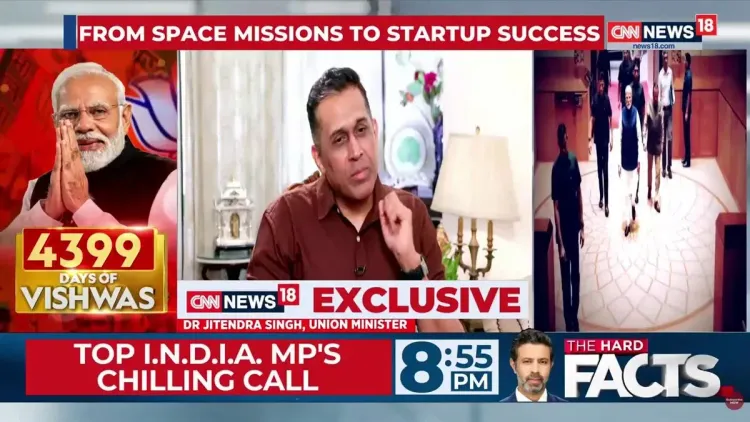
Dr. Jitendra Singh: BJP survived decades in Opposition unlike Congress
Synopsis
Union Minister Dr. Jitendra Singh highlighted the BJP's ability to remain organisationally intact through nearly half a century in opposition as its defining difference from the Congress and other parties, in a post on June 11, 2026.
Key Takeaways
Jitendra Singh , Union Minister for Science and Technology, posted on June 11, 2026 contrasting BJP and Congress on organisational resilience.
He argued that the BJP's defining trait is surviving 'almost half a century' in opposition without fragmenting.
The BJP was formally founded in 1980 after the collapse of the Janata Party coalition, inheriting the Jana Sangh's organisational base.
The Congress dominated post-independence politics for decades but has faced sustained fragmentation since the mid-1990s.
The remarks come ahead of multiple state assembly elections scheduled through 2026–2027 , making party-organisation narratives politically significant.
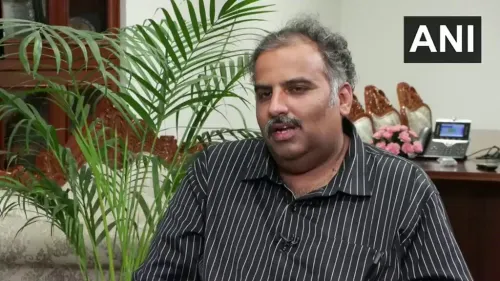
Union Science and Technology Minister Dr. Jitendra Singh on Thursday, June 11, 2026, drew a sharp organisational contrast between the Bharatiya Janata Party (BJP) and the Indian National Congress, asserting that the BJP's defining trait is its ability to remain cohesive and intact through nearly half a century in opposition — something rival parties have historically failed to achieve.
Context
In his post on X, Dr. Jitendra Singh stated: 'The difference between BJP and Congress (or even other parties) is that this (BJP) is a party which could survive and remain intact though being in Opposition for almost half a century.' The remark positions organisational durability — not electoral dominance — as the BJP's foundational strength.
The comment arrives at a politically charged moment, with state assembly elections scheduled across multiple states through 2026–2027, making party-organisation narratives a recurring theme in political discourse.
Policy Backdrop
The BJP traces its ideological lineage to the Bharatiya Jana Sangh, founded in 1951, which spent decades as a minority opposition force during the era of Congress dominance. After the Janata Party experiment of 1977–1979 — a broad anti-Emergency coalition that collapsed from within — the BJP was formally established in 1980 as a reorganised, disciplined entity.
Through the 1980s and much of the 1990s, the party built grassroots infrastructure despite repeated electoral setbacks, eventually forming its first central government in 1998. It returned to power with a majority in 2014 and has held it since. The Congress, by contrast, has seen multiple regional and factional breakaways over the same period.
Stakeholders and Impact
Dr. Singh's framing speaks directly to a narrative the BJP has cultivated for years: that its RSS-backed organisational structure gives it resilience that personality-driven or coalition-dependent parties lack. The Indian National Congress, once the undisputed hegemon of Indian politics for nearly five decades after independence, has faced sustained fragmentation since the mid-1990s coalition era.
Smaller regional formations and third-front experiments have similarly struggled to maintain cohesion when out of power, lending some empirical weight to the minister's argument — though the claim of 'almost half a century' in continuous opposition is a political characterisation rather than a precise historical metric.
What's Next
With assembly elections in several states on the horizon and national-level alliance realignments under discussion, organisational strength will remain a central talking point for all major parties. Statements like Dr. Singh's signal that the BJP intends to keep its institutional durability front and centre in the political conversation heading into the next electoral cycle.
Point of View
He implicitly contrasts the BJP's RSS-backed organisational spine with the Congress's history of splits and the short shelf-life of third-front formations. The timing — ahead of a busy state election calendar — suggests the party is keen to project itself as a permanent, disciplined force rather than a contingent electoral coalition. It also subtly raises the bar for opposition credibility, framing durability as the true test of a national party.
NationPress
13 Sept 2026
Frequently Asked Questions
What did Dr. Jitendra Singh say about BJP and Congress?
Dr. Jitendra Singh said the key difference between the BJP and the Congress (or other parties) is that the BJP survived and remained intact through nearly half a century in opposition, something rival parties have not managed.
How long was the BJP in opposition before forming a government?
The BJP was formally founded in 1980 and first formed a central government in 1998 , meaning it spent roughly 18 years in opposition after its founding. Including its predecessor the Bharatiya Jana Sangh (founded 1951 ), the broader political lineage spent several decades as an opposition force before achieving national power.
Why did the Janata Party collapse and how does it relate to the BJP?
The Janata Party , a broad anti-Emergency coalition that governed from 1977 to 1979 , collapsed due to internal contradictions and personality conflicts. Its breakup led to the formation of the BJP in 1980 , which positioned itself as a more ideologically coherent and organisationally disciplined alternative.
What is the BJP's organisational background?
The BJP draws its organisational strength from its ideological parent, the Rashtriya Swayamsevak Sangh (RSS) , and traces its political lineage to the Bharatiya Jana Sangh founded in 1951 . This cadre-based structure is often cited as the source of the party's resilience across electoral cycles.
Why is Dr. Jitendra Singh making this statement in June 2026?
With multiple state assembly elections scheduled through 2026–2027 and ongoing national-level political realignments, BJP leaders are actively reinforcing narratives around the party's organisational strength and long-term stability ahead of the next electoral cycle.