Dr. Jitendra Singh Addresses Rajya Sabha on DAE

Synopsis
Union Minister Dr. Jitendra Singh signalled a Rajya Sabha engagement on the Department of Atomic Energy on 23 July 2026. The post highlights parliamentary oversight of India's nuclear and atomic energy portfolio, a domain placed directly under the Prime Minister since 1954.
Key Takeaways
Jitendra Singh , Union MoS (Independent Charge) for Science and Technology, flagged a Rajya Sabha engagement on 23 July 2026 .
The post carried hashtags #DAE and #RajyaSabha , pointing to a parliamentary intervention on the Department of Atomic Energy .
The Department of Atomic Energy was established in 1954 and has been placed directly under the Prime Minister since its inception.
The Atomic Energy Act of 1962 governs all nuclear activities in India, from power generation to research and safety.
Parliamentary sessions routinely include questions on DAE projects, nuclear power capacity, and international civil nuclear cooperation.
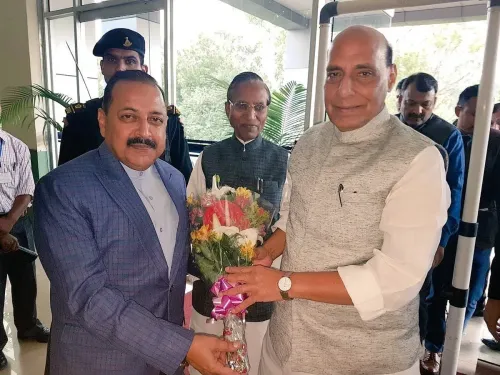
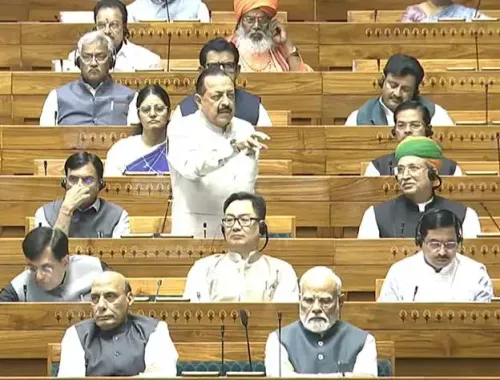
Union Minister of State (Independent Charge) for Science and Technology Dr. Jitendra Singh flagged his engagement with the Rajya Sabha on matters relating to the Department of Atomic Energy (DAE) on Thursday, 23 July 2026, sharing the development on social media to highlight parliamentary activity in his portfolio.
Context
The post, carrying the hashtags #DAE and #RajyaSabha, signals a ministerial intervention in the upper house of Parliament concerning the Department of Atomic Energy. Parliamentary sessions routinely include starred and unstarred questions directed at the DAE, covering topics such as nuclear power capacity, research programmes, and international cooperation agreements.
Dr. Jitendra Singh holds charge of the Science and Technology and Earth Sciences ministries as well as the Ministry of State in the Prime Minister's Office, making him a key interlocutor between the government's scientific establishment and Parliament.
Policy Backdrop
The Department of Atomic Energy was established in 1954 and placed directly under the Prime Minister, a structural arrangement that underscores the strategic sensitivity of India's nuclear programme. The Atomic Energy Act of 1962 governs all nuclear activities, from power generation to research and safety regulation.
India's atomic energy apparatus spans civilian nuclear power through the Nuclear Power Corporation of India Limited, basic research at the Bhabha Atomic Research Centre, and a range of applications in medicine, agriculture, and industry. Parliamentary oversight through both houses has been a consistent mechanism for public accountability of the department's work and expenditure.
Stakeholders and Impact
Nuclear scientists, engineers at DAE-affiliated institutions, and the broader energy sector have a direct stake in the policy directions communicated during such parliamentary proceedings. Questions raised in the Rajya Sabha on DAE matters often shape public discourse around India's nuclear power capacity addition targets and the pace of new reactor construction.
Successive governments have used Rajya Sabha sessions to update members on DAE project timelines, safety standards, and bilateral agreements on civil nuclear cooperation. Ministerial social media posts flagging such interventions have become a standard practice for amplifying parliamentary activity to a wider public audience.
What's Next
Observers will watch for the specific questions tabled and answers provided during this Rajya Sabha session, which could shed light on the government's current priorities for the atomic energy sector. Any follow-up statements on nuclear power capacity addition targets or updates on ongoing reactor projects are expected to draw attention from both the energy sector and the scientific community.
The broader trajectory of India's civil nuclear programme, including its international partnerships and domestic expansion goals, is likely to remain a recurring subject of parliamentary scrutiny in the months ahead.
Point of View
Strategic autonomy, and scientific capacity — making any parliamentary engagement on it politically significant even when the specifics are not immediately visible. For the ruling dispensation, demonstrating active parliamentary oversight of the nuclear domain serves a dual purpose: signalling governance seriousness to a domestic audience and reinforcing India's image as a responsible nuclear state. Watchers of India's energy transition will read this as a cue to track whether the session surfaces new timelines or targets for the country's ambitious nuclear power expansion agenda.
NationPress
22 Oct 2026
Frequently Asked Questions
What is the Department of Atomic Energy in India?
The Department of Atomic Energy (DAE) is a Government of India department established in 1954 and placed directly under the Prime Minister. It oversees India's nuclear power, research, and strategic programmes, and is governed by the Atomic Energy Act of 1962.
Why did Dr. Jitendra Singh post about DAE and Rajya Sabha?
Dr. Jitendra Singh posted the hashtags #DAE and #RajyaSabha on 23 July 2026 to signal a parliamentary engagement on the Department of Atomic Energy in the upper house, a common practice among ministers to highlight their portfolio's legislative activity.
What is Dr. Jitendra Singh's role in the Indian government?
Dr. Jitendra Singh is the Union Minister of State (Independent Charge) for Science and Technology and Earth Sciences. He also holds the position of Minister of State in the Prime Minister's Office, and for Personnel, Public Grievances and Pensions.
What topics are typically discussed in Rajya Sabha on DAE matters?
Rajya Sabha proceedings on the Department of Atomic Energy typically cover nuclear power capacity addition, reactor construction timelines, research programme updates, safety standards, and India's international civil nuclear cooperation agreements.
When was the Atomic Energy Act passed in India?
The Atomic Energy Act was enacted in 1962. It provides the legal framework regulating all nuclear activities in India, including power generation, research, and safety oversight under the Department of Atomic Energy.