Dr. Jitendra Singh Amplifies PM Modi on India Youth Space Potential
Synopsis
Union Science and Technology Minister Dr. Jitendra Singh on 20 July 2026 amplified a Prime Minister Modi statement declaring that India's youth potential is 'as limitless as space', framing national space milestones as a message of generational ambition rather than coincidence.
Key Takeaways
Jitendra Singh shared a PM Modi quote on 20 July 2026 calling India's youth potential 'as limitless as space.' The Prime Minister's statement frames India's space achievements as a 'strong message,' not a coincidence.
IN-SPACe , established in 2020 , opened India's space sector to private players and young innovators.
The Chandrayaan-3 lunar landing in 2023 was a landmark cited by the government as proof of Indian youth capability.
The communication fits a pattern of ministerial amplification that often precedes major ISRO or space-sector announcements.
Observers are watching for updates on the Gaganyaan human spaceflight mission and new IN-SPACe guidelines.
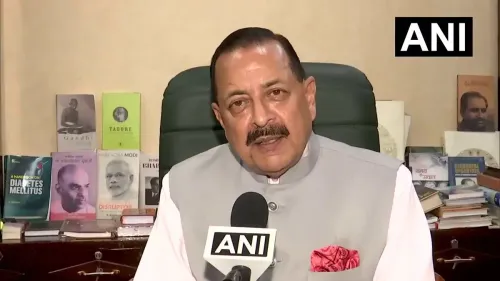
Union Science and Technology Minister Dr. Jitendra Singh on Monday, 20 July 2026 shared a statement by Prime Minister Narendra Modi on social media, underscoring the boundless capacity and ambition of India's youth in the domain of space science. The minister's post, carrying a quote attributed to the Prime Minister, framed India's space achievements not as coincidence but as a deliberate signal of the country's rising generation.
Context
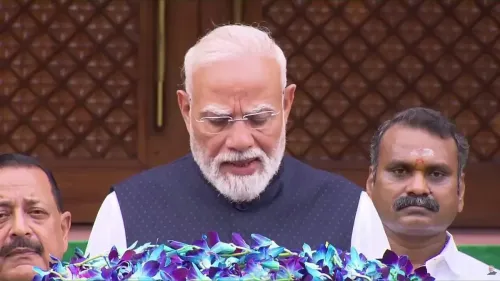
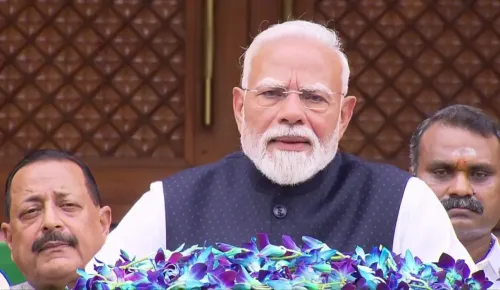
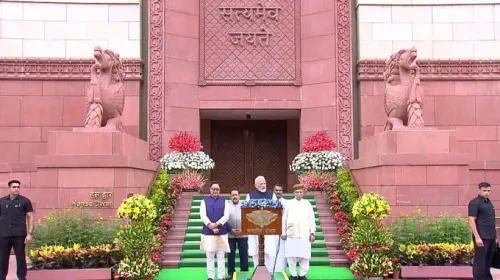
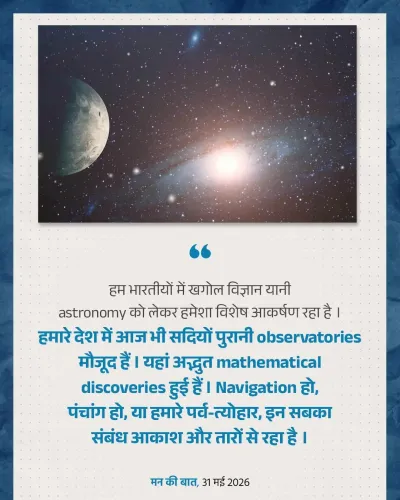
The post quotes PM Modi as saying: 'ये संयोग नहीं, बल्कि एक संदेश है। और बड़ा मजबूत संदेश है कि हमारे देश के युवाओं की क्षमता और उनकी आकांक्षा अंतरिक्ष जितनी असीम हैं।' — translated as: 'This is not a coincidence, but a message. And it is a very strong message that the potential and aspirations of our country's youth are as limitless as space.' Dr. Jitendra Singh amplified the statement through his official X handle, attaching an image to reinforce the message.
The minister, who holds independent charge of the Ministry of Science and Technology and the Ministry of Earth Sciences, has been a consistent voice in communicating India's space milestones to the public. His amplification of prime-ministerial statements on youth potential is part of a recognisable pattern that typically accompanies or precedes significant announcements from ISRO or the private space sector.
Policy Backdrop
India's space sector has undergone structural transformation over the past several years. The establishment of IN-SPACe (Indian National Space Promotion and Authorisation Centre) in 2020 opened the sector to private players and young innovators, signalling a deliberate policy shift toward democratising access to space technology. The landmark Chandrayaan-3 lunar landing in 2023 was presented by the government as concrete evidence of what Indian talent — much of it young — could achieve on a global stage.
These milestones have been consistently woven into the government's Atmanirbhar Bharat narrative, positioning domestic innovation in high-technology and strategic domains as both an economic and an aspirational priority. Ministerial communications have repeatedly tied space achievements to the motivation of students and early-career professionals toward STEM careers.
Stakeholders and Impact
The primary audience for such messaging is India's large and growing youth demographic — students, STEM aspirants, and early-stage innovators who look to national space achievements as proof of what domestic ambition can deliver. ISRO, which remains the anchor institution of India's space programme, benefits from the public goodwill generated by such high-profile endorsements, as does the nascent private space ecosystem that depends on talent pipelines from universities and technical institutes.
Start-ups operating under the IN-SPACe framework and academic institutions with space-technology programmes stand to gain from the narrative reinforcement, as government messaging of this kind tends to increase interest in space-related courses and careers among young Indians.
What's Next
Attention will now turn to whether this communication is a precursor to a concrete policy or programme announcement. Observers will watch for updates on the Gaganyaan human spaceflight mission timeline, any new guidelines expanding student or start-up access to ISRO facilities and data, or fresh initiatives under the IN-SPACe framework. If the pattern holds, ministerial amplification of this nature often signals that a substantive announcement is in the pipeline, making the coming days significant for India's space and science policy landscape.
Point of View
Reinforcing the ruling dispensation's brand identity around science-led nationalism and generational aspiration. The choice to frame space achievements as a 'message' rather than a 'coincidence' subtly credits policy intent over circumstance — a rhetorical move that bolsters the government's Atmanirbhar Bharat narrative. Such ministerial social-media activity has historically served as a signal flare ahead of substantive announcements, making this post worth tracking beyond its motivational surface. The convergence of youth-focused messaging with space policy also reflects a longer arc of positioning ISRO and IN-SPACe as vehicles for demographic dividend, not merely scientific achievement.
NationPress
20 Oct 2026
Frequently Asked Questions
What did PM Modi say about Indian youth and space?
PM Modi stated that India's space achievements are 'not a coincidence but a message,' adding that the potential and aspirations of Indian youth are 'as limitless as space.' The quote was shared by Union Minister Dr. Jitendra Singh on 20 July 2026.
Why did Dr. Jitendra Singh share PM Modi's space quote?
Dr. Jitendra Singh, as the Union Minister for Science and Technology, regularly amplifies government messaging on space and youth. His post on 20 July 2026 reinforced the government's narrative connecting space milestones to youth aspiration and national capability.
What is IN-SPACe and how does it relate to Indian youth in space?
IN-SPACe (Indian National Space Promotion and Authorisation Centre) was established in 2020 to allow private companies and young innovators to participate in India's space sector, opening opportunities beyond the traditional ISRO framework.
What is the Gaganyaan mission and when will it launch?
Gaganyaan is India's first human spaceflight mission being developed by ISRO. Exact launch timelines remain subject to official updates, and observers are watching for fresh announcements following recent government communications on space ambition.
How has Chandrayaan-3 inspired Indian youth in STEM?
The Chandrayaan-3 lunar landing in 2023 was widely cited by the government as evidence of Indian scientific talent. It spurred increased interest in STEM careers and was used as a symbol of what domestic innovation under the Atmanirbhar Bharat agenda can achieve.