Pralhad Joshi Defends NEET Re-Exam, Cites Merit Push Since 2014
Synopsis
Union Minister Pralhad Joshi defended the government's NEET re-examination on 23 July 2026, citing 19 alleged paper leaks in Rajasthan under Ashok Gehlot, a near-tripling of medical seats since 2014, and AIIMS expansion, while calling for parliamentary debate on exam reform.
Key Takeaways
Joshi cited 19 paper leaks in Rajasthan during Ashok Gehlot's tenure as context for the current NEET controversy.
He referenced Priyanka Gandhi Vadra's own admission that paper leaks could not be prevented despite efforts.
Medical seats have grown from approximately 51,000 in 2014 to nearly three times that number under the Modi government.
The government cancelled the NEET examination after confirming a paper leak and conducted the Re-NEET in record time.
Management quota seats in medical education were abolished to promote merit-based admissions.
Joshi called for any exam-system reform debate to be conducted through Parliament , not outside it.
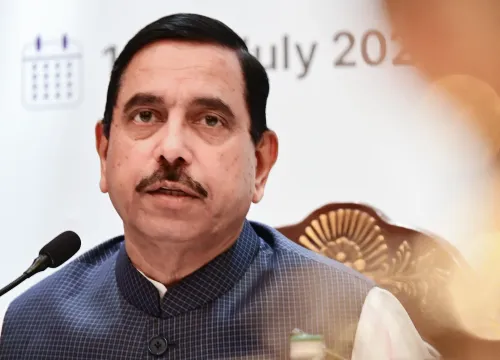
Union Consumer Affairs Minister Pralhad Joshi on Thursday, 23 July 2026, took to X to defend the central government's handling of the recent NEET paper leak, invoking Rajasthan's record under former Chief Minister Ashok Gehlot and framing the Narendra Modi government's response as part of a decade-long commitment to merit-based education.
Context
Joshi opened his post with a pointed reference to examination integrity under the previous Congress-led government in Rajasthan, stating that there were 19 paper leaks during Gehlot's tenure. He also noted that Priyanka Gandhi Vadra had herself acknowledged that, despite their best efforts, paper leaks could not be prevented — citing this as evidence that the problem predates and transcends the current administration.
The minister's remarks come amid ongoing political debate over a NEET paper leak that prompted the central government to cancel and subsequently re-conduct the examination. Joshi asserted that the government acted 'with a heavy heart' after confirming the leak, and that the Re-NEET was conducted 'in record time with complete sincerity,' with results declared promptly.
Policy Backdrop
NEET was made the single mandatory national entrance test for undergraduate medical admissions following Supreme Court directions, replacing a fragmented system of state-level and institutional tests. The move was intended to standardise access and reduce malpractice. The government also phased out management quota seats in deemed universities through regulations notified around 2019–2020, aiming to shift admissions entirely to merit.
On medical infrastructure, Joshi highlighted that the number of medical seats has grown from approximately 51,000 in 2014 to nearly three times that figure today. The AIIMS network has also been significantly expanded under the Pradhan Mantri Swasthya Suraksha Yojana, with multiple new institutes approved in phases starting 2015 to increase undergraduate capacity and widen access for meritorious students.
Stakeholders and Impact
Medical aspirants across the country remain the most directly affected constituency in this debate. The cancellation and re-conduct of NEET disrupted the academic calendars of hundreds of thousands of students, making the government's claim of a swift and sincere re-examination politically significant.
State education boards and opposition-ruled state governments have been vocal critics of the centralised examination system, arguing that a single national test concentrates risk. Joshi's post implicitly pushes back on that narrative by pointing to alleged failures at the state level under Congress rule.
What's Next
Joshi concluded by stating that the government remains committed to implementing 'every constructive suggestion' to strengthen the examination system, but stressed that 'such a discussion should take place through the collective wisdom of Parliament.' This framing signals that the government intends to channel any reform debate into the legislative process rather than concede ground to street-level or media-driven pressure.
Observers will watch for parliamentary committee recommendations on a national examination authority and further announcements on medical seat expansion in the next Union Budget cycle. The political contest over exam integrity is likely to intensify ahead of state elections, with both the BJP and Congress seeking to own the narrative on youth opportunity and institutional accountability.
Point of View
The BJP seeks to neutralise opposition attacks with the opposition's own concessions. The call for parliamentary deliberation on reform is strategically significant — it sets the government up as the responsible actor while slowing down pressure for immediate executive action. This messaging fits a broader BJP pattern of contesting the 'anti-youth' label by pointing to measurable infrastructure expansion, a frame the party is likely to sustain through the next election cycle.
NationPress
22 Oct 2026
Frequently Asked Questions
Why did the government cancel the NEET exam?
The government cancelled the NEET examination after confirming that a paper leak had occurred, according to Minister Pralhad Joshi, in order to protect the interests of students. A re-examination was subsequently conducted in record time.
How many paper leaks happened in Rajasthan under Ashok Gehlot?
Minister Pralhad Joshi stated that there were 19 paper leaks in Rajasthan during Ashok Gehlot's tenure as Chief Minister, citing this to contextualise the broader national problem of examination malpractice.
How many medical seats are there in India now compared to 2014?
According to Joshi's post, the number of medical seats has grown from approximately 51,000 in 2014 to nearly three times that number today, driven by new AIIMS campuses and expanded institutional capacity.
What is the government's plan to fix the NEET paper leak problem?
Joshi stated that the government is committed to implementing every constructive suggestion to strengthen the examination system, and called for such discussions to take place through Parliament rather than outside it.
Did the government abolish management quota seats in medical colleges?
Yes, the Modi government abolished management quota seats in medical education as part of its push for merit-based admissions, a move Joshi cited as evidence of the administration's commitment to fair opportunity for students.