Pralhad Joshi Hails India's 2016 MTCR Entry as Strategic Milestone
Synopsis
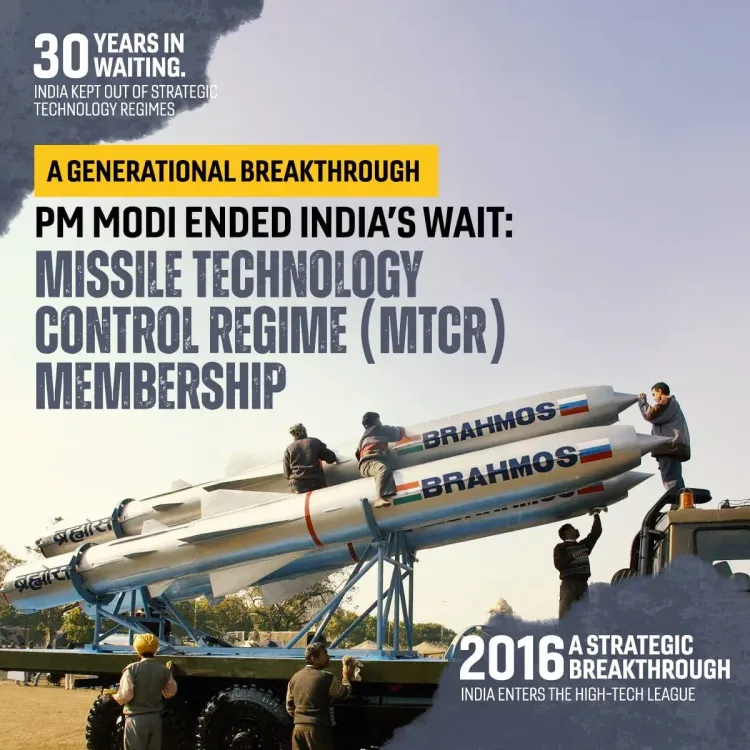
Union Minister Pralhad Joshi marked India's 2016 entry into the Missile Technology Control Regime as a landmark strategic achievement, noting the country joined the 1987-founded grouping as its 35th member after nearly 30 years, bolstering its defence and technology credentials globally.
Key Takeaways
Union Minister Pralhad Joshi posted in Kannada on 19 June 2026 hailing India's MTCR membership as a major strategic milestone.
The Missile Technology Control Regime (MTCR) was established in 1987 by G7 nations to control exports of missile and UAV technologies capable of carrying weapons of mass destruction.
India joined the MTCR on 27 June 2016 as its 35th member , nearly 30 years after the regime's founding.
The accession followed India's Integrated Guided Missile Development Programme (IGMDP) launched in 1983 and years of sustained diplomatic outreach after the 1998 nuclear tests .
MTCR entry was part of a sequence that included the Wassenaar Arrangement (2017) and the Australia Group (2018) .
Membership eased technology access for DRDO and India's defence industry while strengthening co-production partnerships with member states.
Union Consumer Affairs Minister Pralhad Joshi on Friday, 19 June 2026, took to X to mark India's accession to the Missile Technology Control Regime (MTCR) as a landmark moment in the country's strategic journey, calling it a proud milestone that reinforced India's defence and advanced technology credentials on the global stage.
Writing in Kannada, Joshi described the development as a 'ಭಾರತದ ಕಾರ್ಯತಂತ್ರದ ಯಶಸ್ಸಿನ ಮಹತ್ತರ ಮೈಲಿಗಲ್ಲು' ('A great milestone in India's strategic success'), underlining the significance of the country joining the regime roughly 30 years after its founding — as its 35th member in 2016.
Context
The MTCR was established in 1987 by the G7 nations as an informal multilateral arrangement to restrict the export of missiles, unmanned aerial vehicles, and related technologies capable of delivering weapons of mass destruction. For nearly three decades, India — despite possessing a robust indigenous missile programme — remained outside this influential grouping.
India's formal accession came on 27 June 2016, a diplomatic achievement that arrived after years of sustained engagement with member states. The move gave India greater legitimacy for its missile and space-launch programmes while opening doors to previously restricted dual-use technologies.
Policy Backdrop
India's path to the MTCR was shaped by its own missile ambitions and the international responses they triggered. The Integrated Guided Missile Development Programme (IGMDP), launched in 1983 under the Defence Research and Development Organisation (DRDO), produced systems such as Prithvi and Agni, which drew the attention of technology-control regimes worldwide.
After India's 1998 nuclear tests, MTCR-related technology denials tightened considerably. New Delhi responded with a long-term strategy of building non-proliferation credentials while demonstrating responsible stewardship of advanced capabilities — a posture that ultimately persuaded existing members to open the door.
The 2016 MTCR entry was not an isolated event. It was the first in a sequence of export-control regime memberships: India joined the Wassenaar Arrangement in 2017 and the Australia Group in 2018, completing a near-comprehensive integration into the principal multilateral non-proliferation frameworks short of the Nuclear Suppliers Group (NSG).
Stakeholders and Impact
India's defence industry and DRDO scientists were among the most direct beneficiaries of the MTCR accession. Membership eased access to propulsion, guidance, and materials technologies that had previously been subject to supplier-country restrictions, accelerating domestic development timelines.
The accession also strengthened India's position as a credible partner for co-development and co-production arrangements with member states, aligning with the broader 'Make in India' push in defence manufacturing. For Indian space and missile exporters, MTCR membership conferred a legitimacy signal that facilitated commercial outreach to prospective partner nations.
What's Next
As a full MTCR member, India participates in the regime's periodic plenaries, where emerging categories such as hypersonic glide vehicles and advanced UAV systems are increasingly under discussion. New Delhi's positions on these evolving control lists will be closely watched by both partner nations and domestic industry.
Joshi's post, tagged #12YearsOfIndiaFirst, reflects a broader ruling-party effort to document and communicate foreign and strategic policy achievements to domestic audiences. The MTCR milestone, now a decade old, continues to serve as a reference point in India's narrative of rising global stature — one that the government is keen to keep in public view.
Point of View
Technology access, and non-proliferation responsibility — three distinct audiences in one milestone. By framing a decade-old diplomatic achievement through the lens of the #12YearsOfIndiaFirst campaign, the BJP is signalling that foreign policy gains, not just welfare delivery, are electoral assets. The post also keeps public attention on India's still-pending NSG membership bid, the one major export-control gap that remains unresolved.
NationPress
18 Sept 2026
Frequently Asked Questions
What is the MTCR and why did India want to join it?
The Missile Technology Control Regime (MTCR) is an informal multilateral grouping founded in 1987 to restrict exports of missiles and related technologies capable of delivering weapons of mass destruction. India sought membership to gain legitimacy for its missile and space programmes, access restricted dual-use technologies, and strengthen its standing as a responsible technology power.
When did India join the MTCR?
India formally acceded to the MTCR on 27 June 2016, becoming its 35th member — nearly 30 years after the regime was established by G7 nations.
What benefits did India get from joining the MTCR?
MTCR membership gave India greater access to propulsion, guidance, and materials technologies previously denied under supplier-country restrictions, boosted its defence co-production prospects with member states, and enhanced the credibility of its space and missile export outreach.
What other export control regimes has India joined?
Following its 2016 MTCR entry, India joined the Wassenaar Arrangement in 2017 and the Australia Group in 2018, completing integration into three of the four principal multilateral export-control frameworks. Membership in the Nuclear Suppliers Group (NSG) remains pending.
Why is Pralhad Joshi posting about MTCR in 2026?
Minister Joshi's post is tagged #12YearsOfIndiaFirst, indicating it is part of a broader ruling-party campaign to highlight strategic and policy achievements of the government over the past 12 years, with the 2016 MTCR accession cited as a landmark in India's defence and technology diplomacy.