Pralhad Joshi Marks 12 Years of Make in India
Synopsis
Union Minister Pralhad Joshi marked 12 years of Make in India on 25 September 2026, praising PM Modi's flagship manufacturing initiative for transforming India's industrial landscape and reinforcing the Atmanirbhar Bharat and Viksit Bharat 2047 goals.
Key Takeaways
Make in India completed 12 years on 25 September 2026 , having been launched by PM Narendra Modi on the same date in 2014 .
Union Minister Pralhad Joshi hailed the initiative for driving world-class manufacturing, generating employment, and raising India's global industrial profile.
The Atmanirbhar Bharat Abhiyan , launched in May 2020 , built directly on Make in India with PLI schemes and supply-chain localisation.
Both programmes are now framed as stepping stones toward Viksit Bharat by 2047 — India's developed-economy centenary target.
Key sectors linked to the initiative include electronics, automobiles, defence and pharmaceuticals .
Upcoming FDI data and any PLI scheme revisions in the Union Budget will be the next indicators of programme momentum.
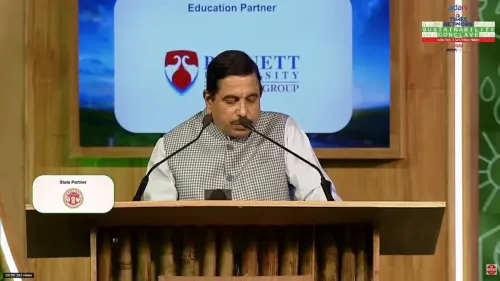
Twelve years after Prime Minister Narendra Modi launched a programme that would reshape India's industrial identity, the anniversary of Make in India is drawing fresh salutes from the Cabinet. Union Consumer Affairs and New and Renewable Energy Minister Pralhad Joshi marked the milestone on Friday, 25 September 2026, crediting the initiative with driving world-class manufacturing, generating employment, and cementing India's position on the global stage.
A programme born on 25 September 2014
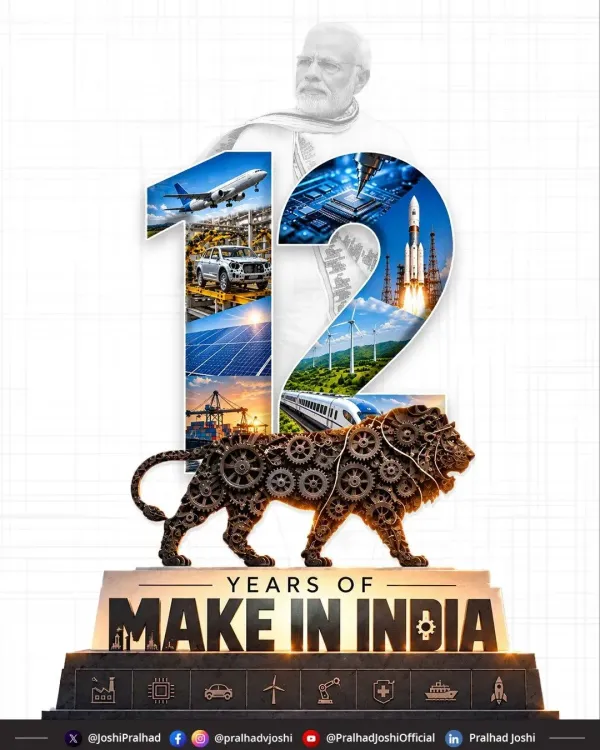
Make in India was unveiled by PM Modi exactly twelve years ago — on 25 September 2014 — with a single, audacious goal: raise manufacturing's share of India's GDP and turn the country into a destination of choice for global industry. The iconic growling lion logo, assembled from industrial cogs and gears, became a symbol of the ambition. At launch, the initiative identified 25 priority sectors, from defence and automobiles to electronics and pharmaceuticals, and paired them with regulatory reforms, faster clearances, and an open invitation to foreign investors.
Joshi's post, written in both English and Kannada, captures the dual intent of the original mission. In Kannada he wrote: 'Make in India abhiyānavu ātmanirbhar Bhāratada saṃkalpakke maṭṭaṣṭu bala tumbide' — ('The Make in India campaign has further strengthened the resolve of an Atmanirbhar Bharat') — framing twelve years of industrial policy as a continuous, reinforcing journey rather than a single event.
How Atmanirbhar Bharat extended the original arc
The policy lineage here matters. When the COVID-19 pandemic exposed global supply-chain vulnerabilities in 2020, the government launched the Atmanirbhar Bharat Abhiyan — a self-reliant India drive that built directly on Make in India's foundations. Production-Linked Incentive (PLI) schemes were the centrepiece: sector-specific cash bonuses tied to incremental domestic output, designed to pull manufacturing investment home and reduce import dependence in everything from semiconductors to solar panels.
Together, the two programmes represent a decade-long bet that India can position itself as the world's next great manufacturing corridor — especially as companies diversify supply chains away from a single geography. Sectors like electronics, automobiles, and pharmaceuticals have seen notable activity under this framework.
Viksit Bharat 2047 as the horizon
Joshi's post anchors the anniversary to the government's longest-range target: Viksit Bharat by 2047, the official vision to build a fully developed Indian economy by the centenary of independence. Make in India, in this framing, is not a twelve-year retrospective — it is the foundation of a twenty-one-year sprint. Manufacturing competitiveness, employment generation, and export market share are the metrics that will determine whether that 2047 ambition holds.
The next hard data points — fresh FDI figures, manufacturing PMI trends, and any PLI scheme expansions flagged in the next Union Budget — will tell whether the programme's momentum is matching its milestone.
Point of View
The twelve-year milestone is a chance to claim ownership of India's manufacturing narrative at a moment when global supply-chain realignment is still live and electorally visible. Joshi's bilingual post, reaching both a national English audience and a Kannada-speaking Karnataka base, also reflects the party's effort to regionalise credit for national schemes ahead of future state cycles. The real test of the framing will come when the next set of FDI and manufacturing output data lands — numbers, not anniversaries, will determine whether the arc holds.
NationPress
25 Sept 2026
Frequently Asked Questions
When was Make in India launched?
Make in India was launched by Prime Minister Narendra Modi on 25 September 2014, making 25 September 2026 its 12th anniversary.
What is the goal of Make in India?
Make in India aims to raise the share of manufacturing in India's GDP, attract foreign and domestic investment, and create large-scale employment by positioning India as a global manufacturing hub.
How is Atmanirbhar Bharat related to Make in India?
Atmanirbhar Bharat, launched in May 2020, extended Make in India's goals by focusing on domestic supply-chain resilience and introducing Production-Linked Incentive schemes to boost local manufacturing.
What is Viksit Bharat 2047?
Viksit Bharat 2047 is the Indian government's vision to achieve fully developed-economy status by 2047 — the centenary of independence — with manufacturing competitiveness as one of its central pillars.
Who is Pralhad Joshi?
Pralhad Joshi is a senior BJP leader from Karnataka serving as Union Minister of Consumer Affairs, Food and Public Distribution, and Minister of New and Renewable Energy.