HP Govt Eases Wedding Costs via Kanyadaan Yojana
Synopsis
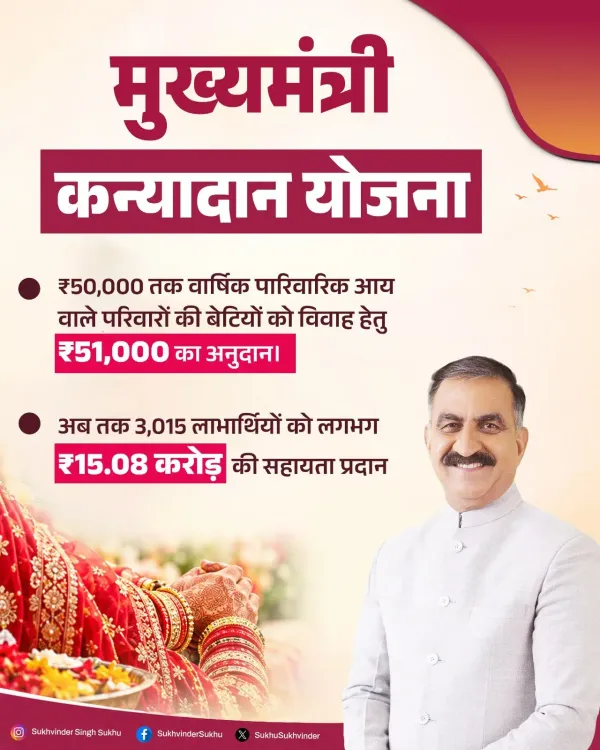
The Himachal Pradesh government is providing financial assistance to families for daughters' marriages through the Mukhya Mantri Kanyadaan Yojana, aiming to prevent wedding expenses from becoming an undue burden on low-income households.
Key Takeaways
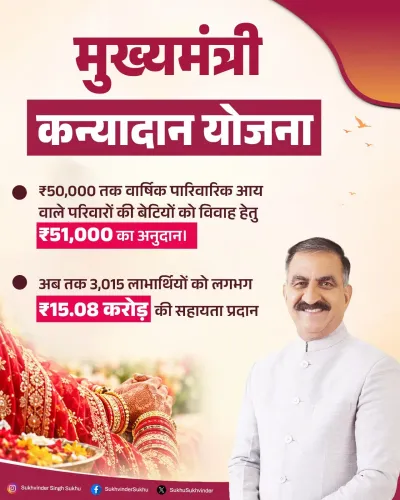
The Chief Minister's Office of Himachal Pradesh highlighted the Mukhya Mantri Kanyadaan Yojana on 25 September 2026 .
The scheme provides direct financial assistance to families to help cover daughters' wedding expenses.
The government's stated aim is to ensure wedding costs do not become an 'additional burden' on families who sacrifice personal needs to save for a daughter's marriage.
The Yojana is part of Himachal Pradesh's broader welfare framework targeting women and low-income households.
Similar marriage assistance schemes operate across multiple Indian states as part of national girl-child welfare policy thinking.
Every parent of a daughter carries a quiet, years-long financial anxiety — setting aside money, cutting personal needs, building a fund for her wedding day. The Chief Minister's Office of Himachal Pradesh on Friday, 25 September 2026, turned a spotlight on that reality, announcing that the state government's Mukhya Mantri Kanyadaan Yojana is designed specifically to lift that burden off families' shoulders.
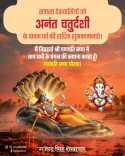
The post, in Hindi, frames the scheme in strikingly human terms: 'बेटी के विवाह की चिंता हर माता-पिता को होती है' — 'Every parent worries about their daughter's marriage.' It goes on to note that families sacrifice their own comforts and needs for years to save for a wedding, and that the government's financial assistance through the Yojana is meant to ensure wedding expenses do not become 'an additional burden on the family.'
What the Mukhya Mantri Kanyadaan Yojana covers
The Mukhya Mantri Kanyadaan Yojana is a Himachal Pradesh government welfare scheme that provides direct financial assistance to eligible families at the time of a daughter's marriage. It sits within a broader architecture of state-level welfare initiatives in Himachal Pradesh targeting women and low-income households — a segment of the population that bears the sharpest end of high customary wedding costs.
While the exact benefit amount and eligibility criteria are subject to government notification and revision, the scheme's intent is consistent with national policy thinking: reduce the financial pressure that can push families into debt, and signal the state's commitment to girl-child welfare through concrete economic support.
A pattern playing out across Indian states
Himachal Pradesh is far from alone here. Across India, state governments have rolled out marriage assistance schemes — from cash transfers at the time of wedding registration to subsidised trousseau kits — targeted at families from weaker economic sections. What unites them is the recognition that deep-rooted social customs place enormous financial weight on the bride's family, and that without state intervention, many households will simply go into debt to meet those expectations.
The Kanyadaan Yojana follows this established model. By cushioning the cost of a daughter's wedding, the scheme also indirectly reinforces a message that daughters are not a financial liability — a framing the government's communication strategy appears to lean into deliberately.
With state budgets and assembly sessions ahead, any revisions to benefit amounts or eligibility thresholds will be closely tracked by welfare advocates and the families already enrolled in the scheme. For now, the government's message is clear: no parent should have to choose between their own needs and their daughter's wedding.
Point of View
Himachal Pradesh's communication strategy humanises what is otherwise a line item in a welfare budget. The broader pattern of such schemes across Indian states reflects an enduring policy consensus that high wedding costs are a driver of household debt and, historically, of son preference — making these programmes both social and economic interventions. The real test, as always, lies in benefit levels keeping pace with rising wedding costs and in outreach reaching the most vulnerable families who may not know the scheme exists.
NationPress
25 Sept 2026
Frequently Asked Questions
What is the Mukhya Mantri Kanyadaan Yojana in Himachal Pradesh?
The Mukhya Mantri Kanyadaan Yojana is a Himachal Pradesh government scheme that provides financial assistance to eligible families to help cover the costs of a daughter's wedding, aiming to reduce the economic burden on low-income households.
Who is eligible for the Kanyadaan Yojana in Himachal Pradesh?
The scheme targets families from weaker economic sections in Himachal Pradesh. Specific eligibility criteria are set by the state government and may be revised; families should check with their local administration or the official HP government portal for the latest requirements.
How much financial assistance does the HP Kanyadaan Yojana provide?
The exact benefit amount is determined by the Himachal Pradesh government and is subject to revision through budget and policy decisions. Official figures are available from the state's social welfare department.
How do I apply for the Mukhya Mantri Kanyadaan Yojana in HP?
Applications are typically processed through local government offices or the state's social welfare department in Himachal Pradesh. Families should contact their nearest block or district office for the current application process.
Are there similar marriage assistance schemes in other Indian states?
Yes. Several Indian states run comparable schemes providing cash transfers or in-kind support to families from weaker economic sections at the time of a daughter's marriage, as part of national girl-child welfare policy.