CM Gujarat marks 12 years of Make in India

Synopsis
On its 12th anniversary, Gujarat's Chief Minister's Office hailed Make in India's journey from resolve to achievement, spotlighting semiconductor fabrication and indigenous naval shipbuilding as emblems of India's Atmanirbhar Bharat vision under PM Modi.
Key Takeaways
Make in India was launched by PM Narendra Modi on 25 September 2014 and completed 12 years on 25 September 2026.
Gujarat's Chief Minister's Office marked the anniversary, framing the campaign as a journey 'from resolve to achievement' ( sankalp thi siddhi ).
The post specifically cited semiconductor chips and naval ships as symbols of India's manufacturing and technology capability.
Make in India has been reinforced by PLI schemes , a semiconductor mission , and the Atmanirbhar Bharat framework launched in 2020.
Gujarat is home to key investments in electronics, defence corridors, and an approved semiconductor fabrication project.
Upcoming milestones include commissioning of semiconductor fabrication units and delivery of indigenously built naval vessels .
Twelve years after a single lion-emblem logo changed how the world thought about Indian manufacturing, Gujarat's Chief Minister's Office marked the anniversary of Make in India on Friday, 25 September 2026 with a sweeping tribute — invoking semiconductor chips and naval warships as twin symbols of how far the programme has travelled from promise to product.
The post, in Gujarati, saluted Prime Minister Narendra Modi's 'visionary leadership' and declared that India today stands as a global symbol of capability, skill, and self-confidence in manufacturing and technology — 'from semiconductor chips to massive naval ships' — and as the embodiment of the Atmanirbhar-Viksit Bharat (self-reliant, developed India) vision.
From the lion logo to chips and warships
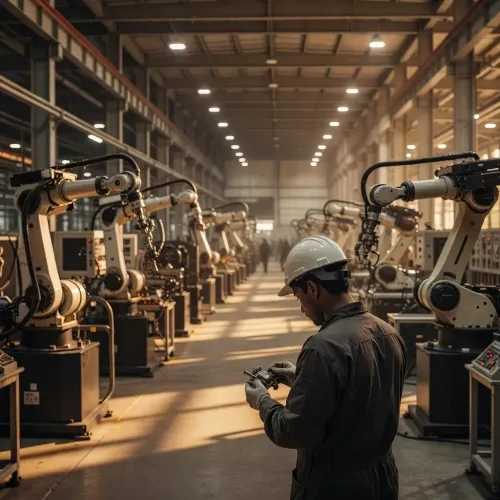
Make in India was launched by Prime Minister Modi on 25 September 2014, anchored by an iconic prowling lion crafted from machine cogs — a deliberate signal that India intended to industrialise its ambition. The original objective: raise the manufacturing sector's share of GDP, attract foreign direct investment, and move India up the global value chain. Defence platforms and electronics were always part of the vision; they are now the headline story.
Over the following decade, the campaign dovetailed with a series of reinforcing policy levers — Production Linked Incentive (PLI) schemes across more than a dozen sectors, a dedicated semiconductor mission with incentives for greenfield fabrication units, and the Atmanirbhar Bharat self-reliance framework launched in 2020 to sharply reduce import dependence in strategic industries. The convergence of those programmes is precisely what Gujarat's CMO was pointing to: the journey, as the post put it in Gujarati, from sankalp thi siddhi — 'from resolve to achievement'.
Defence and semiconductors: the two frontiers
The pairing of naval ships and semiconductor chips is deliberate and pointed. Indigenous warship construction — from frigates to aircraft-carrier projects — has long been a showcase of the 'design in India, build in India' doctrine inside the defence ministry. Meanwhile, semiconductor fabrication represents the frontier that India is still actively scaling: approved fab units are expected to be commissioned in the years ahead, with delivery timelines closely watched by industry and policymakers alike.
Together, these sectors illustrate the programme's ambition to graduate India from assembler of imported components to originator of critical technology — the distinction that separates a manufacturing hub from a manufacturing power.
Gujarat's stake in the story
Gujarat occupies a central position in the Make in India narrative. The state has attracted significant investment in electronics, defence corridors, and is home to one of the approved semiconductor projects. The Chief Minister's Office marking this anniversary is as much a statement of regional pride as national policy — a reminder that the industrial geography of self-reliance runs through Gandhinagar and Ahmedabad as much as through any national capital corridor.
Twelve years on, the scoreboard is contested and the race unfinished — but the ambition written in machine-gear lions back in 2014 has, at minimum, reshaped the vocabulary of Indian economic policy forever.
Point of View
The messaging pivots from inputs to outcomes, which is a more demanding standard and a riskier one. The Atmanirbhar-to-Viksit Bharat arc embedded in the post also signals continuity: this is not just a 12-year lookback but a forward mandate, reinforcing that the self-reliance doctrine remains the governing economic ideology heading into the next phase of Modi-era industrial policy.
NationPress
25 Sept 2026
Frequently Asked Questions
When was Make in India launched?
Make in India was launched by Prime Minister Narendra Modi on 25 September 2014 , making 25 September 2026 its 12th anniversary.
What is the connection between Make in India and Atmanirbhar Bharat?
Atmanirbhar Bharat , launched in 2020 , built upon Make in India by focusing on reducing import dependence in strategic sectors such as electronics and defence, with both programmes sharing the goal of boosting domestic manufacturing.
What role does Gujarat play in Make in India?
Gujarat is a key hub within the Make in India ecosystem, attracting investment in electronics, defence production corridors, and hosting one of India's approved semiconductor fabrication projects.
Why are semiconductor chips mentioned in the Make in India anniversary post?
Semiconductor fabrication represents India's most ambitious frontier in manufacturing self-reliance. India has approved greenfield fab units under its semiconductor mission, and chip production is cited as a marker of how far the country has progressed up the technology value chain since 2014.
What is PLI scheme and how does it relate to Make in India?
Production Linked Incentive (PLI) schemes are financial incentives offered by the Indian government across more than a dozen sectors to boost domestic manufacturing — they are a direct policy instrument designed to accelerate the Make in India mission's goals.