Shekhawat marks 12 years of Make in India under PM Modi
Synopsis
Union Culture and Tourism Minister Gajendra Singh Shekhawat marked 12 years of Make in India on 25 September 2026, crediting PM Modi's visionary leadership for elevating India's talent, technology, and products onto the world stage.
Key Takeaways
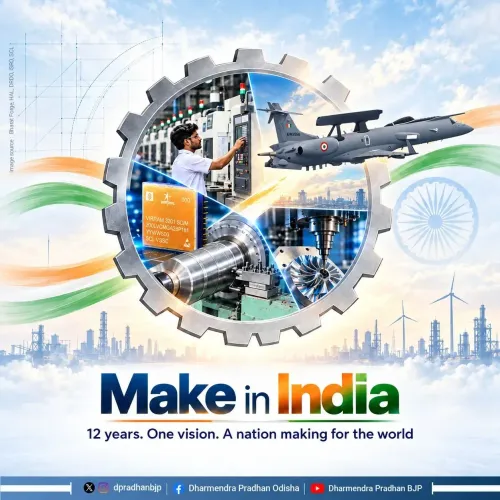
25 September 2026 marks exactly 12 years since PM Modi launched Make in India on 25 September 2014 .
Union Minister Gajendra Singh Shekhawat posted a video tribute on X under #12YearsOfMakeInIndia , framing the programme as a national identity milestone.
Make in India was designed to raise manufacturing's share of GDP and attract foreign direct investment into Indian production.
Production-Linked Incentive (PLI) schemes have become the key policy instrument extending the Make in India framework across sectors including electronics, pharma, and defence.
The post signals the BJP government's continued use of Make in India as broad political branding, with ministers across portfolios amplifying the message.
Twelve years after Prime Minister Narendra Modi launched one of independent India's most ambitious industrial bets, the anniversary of Make in India is drawing renewed salutes from across the Cabinet. Union Culture and Tourism Minister Gajendra Singh Shekhawat marked the milestone on Friday, 25 September 2026, with a post on X that placed India's talent, technology, hard work, products, and name at the centre of the story.
Posting under the hashtag #12YearsOfMakeInIndia, Shekhawat wrote: 'Bharat ka talent, Bharat ki technology, Bharat ki mehnat, Bharat ke utpad aur Bharat ka hi naam' — 'India's talent, India's technology, India's hard work, India's products and India's very own name.' He credited PM Modi's 'visionary leadership' for drawing the world's attention to the programme.
A flagship born on 25 September 2014
Make in India was launched on 25 September 2014 — exactly twelve years to the day — as a direct pitch to global manufacturers and investors to set up production inside India. The goal was straightforward and audacious in equal measure: raise manufacturing's share of GDP, absorb a young and growing workforce, and break India's historical dependence on imported goods in sectors ranging from electronics to defence.
The programme's lion logo became one of the most recognisable symbols of the Modi government's economic branding. Over the following decade-plus, it was layered with successive policy instruments — most notably Production-Linked Incentive (PLI) schemes — that extended its reach into sectors such as semiconductors, smartphones, pharmaceuticals, and automobiles.
Ministers across portfolios amplify the message
The fact that it is a Culture and Tourism minister — not an industry or commerce counterpart — celebrating this manufacturing milestone is itself a signal of how deeply Make in India has become part of the BJP government's shared political vocabulary. Shekhawat's post, accompanied by a video, frames the initiative not as a narrow industrial policy but as an expression of national identity: talent, technology, and hard work as inherently Indian attributes on a global stage.
That framing has been a consistent thread since 2014. MSMEs, foreign investors, and domestic manufacturers have all been cast as stakeholders in a story the government has deliberately kept broad — expansive enough that any minister in any portfolio can credibly attach themselves to it.
As India's manufacturing data releases and fresh PLI expansions continue to be watched by investors worldwide, the 12-year mark is less a finish line than a staging post — and the government is making sure the world knows it.
Point of View
India's name' — is a deliberate strategy to keep domestic audiences emotionally invested in what is fundamentally an investor-attraction exercise. Whether the sentiment translates into measurable manufacturing-GDP movement will be the harder question investors and analysts will press.
NationPress
25 Sept 2026
Frequently Asked Questions
When was Make in India launched?
Make in India was launched by Prime Minister Narendra Modi on 25 September 2014 , making 25 September 2026 its 12th anniversary.
What is the goal of Make in India?
The initiative aims to position India as a global manufacturing hub by attracting foreign investment, boosting domestic production, and increasing manufacturing's share of GDP.
What did Gajendra Singh Shekhawat say about Make in India?
Shekhawat posted that India's talent, technology, hard work, products, and name — under PM Modi's visionary leadership — have drawn the attention of the entire world through #12YearsOfMakeInIndia .
What are PLI schemes and how do they relate to Make in India?
Production-Linked Incentive (PLI) schemes are a policy layer built on the Make in India framework, offering financial incentives to manufacturers in sectors like semiconductors, smartphones, and pharmaceuticals to produce in India.
Who is Gajendra Singh Shekhawat?
Gajendra Singh Shekhawat is India's Union Minister of Culture and Tourism, a senior BJP leader, and a Lok Sabha MP from Jodhpur, Rajasthan.