Rajnath Singh marks 12 years of Make in India
Synopsis
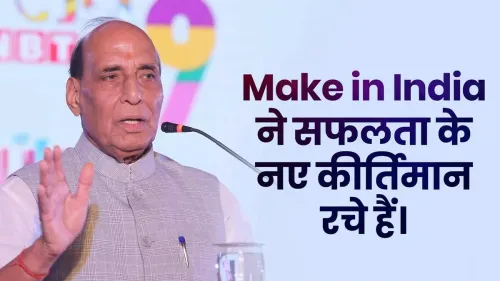
Union Defence Minister Rajnath Singh marked the twelfth anniversary of Make in India on 25 September 2026, crediting the initiative with expanding production across electronics, defence, pharma and other sectors while laying the groundwork for an Atmanirbhar and Viksit Bharat.
Key Takeaways
Make in India was launched by PM Narendra Modi on 25 September 2014 , completing 12 years on this date.
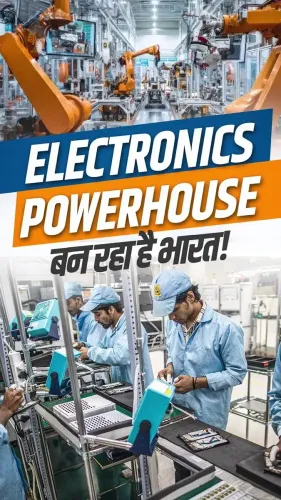
Defence Minister Rajnath Singh highlighted expansion across electronics, automobiles, pharmaceuticals, steel, railways and defence .
The initiative is framed as foundational to both Atmanirbhar Bharat (launched May 2020) and the long-term Viksit Bharat 2047 vision.
Atmanirbhar Bharat added a self-reliance and strategic dimension, particularly strengthening domestic defence production.
Singh positioned India as 'a powerful global manufacturing force' at the twelve-year milestone.
Twelve years after Prime Minister Narendra Modi stood before the nation and declared India would manufacture for the world, Union Defence Minister Rajnath Singh marked the anniversary of Make in India on 25 September 2026 — saluting a programme that has reshaped the country's industrial identity across a dozen sectors and two defining national visions.
From a 2014 pledge to a twelve-year manufacturing march
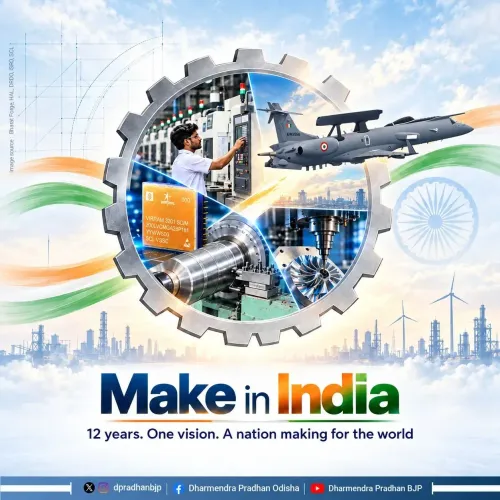
Singh's post is precise about the origin: 25 September 2014, when Modi launched the initiative with the stated ambition of turning India into 'a global manufacturing hub.' The sectors that have expanded under its umbrella read like a cross-section of the modern economy — electronics, automobiles, pharmaceuticals, steel, railways and, significantly for a sitting Defence Minister, defence. Each of those verticals carries its own supply-chain story, its own foreign-investment chapter, and its own jobs multiplier.
The Make in India lion logo debuted at a time when India's manufacturing share of GDP was under pressure and the country was running large current-account deficits driven by imported goods — from smartphones to fighter aircraft. The initiative was, at its core, a supply-side bet: de-regulate, build infrastructure, signal to global capital that India was open for factory floors, not just service desks.
How Atmanirbhar Bharat deepened the original wager
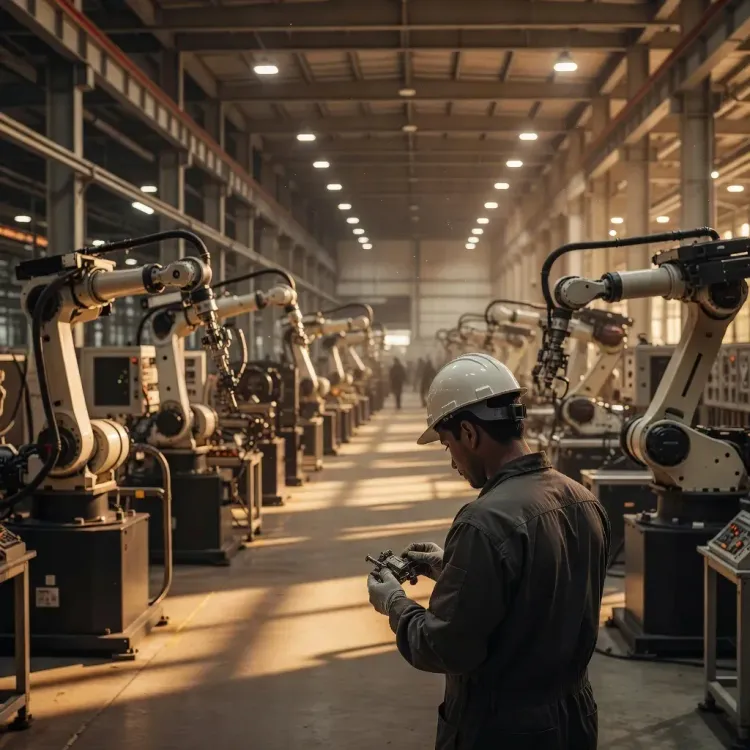
The trajectory Singh describes is not a single straight line. May 2020 marked a strategic inflection when the government announced Atmanirbhar Bharat — the self-reliance campaign that gave Make in India a harder, more urgent edge. Where the 2014 initiative courted foreign manufacturers to produce in India, Atmanirbhar Bharat added a defensive dimension: reduce import dependence, especially in sectors with strategic exposure. Defence production became a centrepiece, with positive indigenisation lists barring imports of specific weapons platforms and components to force domestic substitution.
Singh, who oversees the defence portfolio, is well-placed to register that pivot. Under his tenure, domestic defence production has been pushed through mechanisms like Defence Public Sector Units, private-sector partnerships, and iDEX — the innovation ecosystem for start-ups building military technology. The Make in India anniversary, in his framing, is inseparable from this strategic layer.
Viksit Bharat: the longer horizon Make in India is meant to serve
Singh ties the twelve-year arc to Viksit Bharat — the government's long-horizon vision of a developed India by 2047, the centenary of independence. The logic is sequential: Make in India builds the manufacturing base, Atmanirbhar Bharat reinforces its resilience, and together they are supposed to generate the industrial mass that a developed economy requires. For a country that still needs to absorb millions of workers into formal employment each year, manufacturing is not an optional policy preference — it is an arithmetic necessity.
The Defence Minister's framing — 'a powerful global manufacturing force' — signals that the government's self-assessment at the twelve-year mark is confident, even as independent analysts watch for updated output figures in upcoming economic surveys and any revisions to the Defence Production and Export Promotion Policy that would test those claims against hard data.
Twelve years in, Make in India is no longer a launch event — it is the baseline expectation India has set for itself, and every production number that follows will be measured against it.
Point of View
Not a commerce or industry counterpart, underscoring how thoroughly Make in India has been recast as a strategic security agenda since 2020. The Atmanirbhar Bharat overlay gave the original FDI-attraction logic a nationalist charge that proved durable across election cycles. Tying both to Viksit Bharat 2047 also serves a forward-projection purpose: it converts a twelve-year record into an ongoing mandate, insulating the policy from near-term criticism by embedding it in a generational timeline. The real test will come when independent production and export data for the defence sector are published — those numbers will either validate the confident tone or invite scrutiny.
NationPress
25 Sept 2026
Frequently Asked Questions
When was Make in India launched and by whom?
Make in India was launched by Prime Minister Narendra Modi on 25 September 2014 , with the goal of transforming India into a global manufacturing hub.
Which sectors has Make in India covered over 12 years?
The initiative has expanded production across electronics, automobiles, pharmaceuticals, steel, railways and defence , among other sectors.
What is the connection between Make in India and Atmanirbhar Bharat?
Atmanirbhar Bharat , announced in May 2020 , deepened Make in India by emphasising self-reliance and reducing import dependence, especially in strategically sensitive sectors like defence.
What is Viksit Bharat and how does it relate to Make in India?
Viksit Bharat is the government's vision for a developed India by 2047 . Make in India is seen as building the manufacturing foundation required to achieve that long-term goal.
Why did Rajnath Singh comment on Make in India's anniversary?
As Union Defence Minister and a senior BJP leader, Singh marked the milestone to highlight industrial and defence manufacturing progress under the initiative, linking it to broader national self-reliance goals.