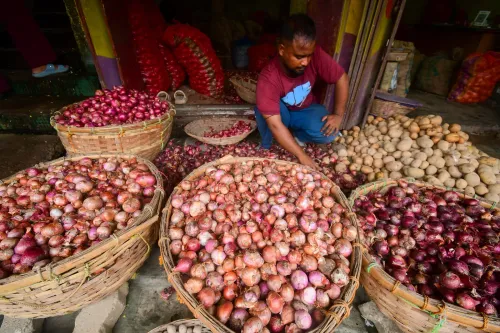
Kanda Express, buffer stocks push Delhi onion prices to ₹35–40/kg

Synopsis
Delhi onion prices, which had climbed to ₹50–60 per kg, are now retreating to ₹35–45 as the Centre deploys the 'Kanda Express' — a rail-and-road hybrid supply chain — from Nashik and releases NAFED buffer stocks into mandis. It is a familiar government playbook, and traders say the real test is whether direct Delhi allocations follow.
Key Takeaways
The Centre dispatched the first Kanda Express from Nashik, Maharashtra on Wednesday to supply onions to Delhi .
Onion prices in Delhi have eased from ₹50–60 per kg to ₹35–45 per kg following buffer stock releases.
Onions will be retailed at approximately ₹35 per kg through NCCF , NAFED , and Kendriya Bhandar outlets.
The Nashik consignment was expected to reach Delhi's mandis by Thursday evening , according to traders at Ghazipur market.
NAFED buffer stocks have been released at multiple locations nationally, but a direct Delhi allocation had not yet been made as of the latest reports.
Onion prices in Delhi have started easing and are expected to stabilise at ₹35 to ₹40 per kg following the Central government's dispatch of the 'Kanda Express' — a hybrid rail-and-road supply initiative — and the release of government buffer stocks into the capital's vegetable mandis. The move offers direct relief to consumers who had been paying as high as ₹50 to ₹60 per kg in recent weeks.
What Is the Kanda Express
The Centre flagged off the first Kanda Express from Nashik, Maharashtra on Wednesday, bound for New Delhi. The initiative uses a combination of railway and road transport to accelerate onion supply to major consumption centres. Once the consignment arrives, onions are expected to be retailed at approximately ₹35 per kg through agencies including the National Cooperative Consumers' Federation of India Limited (NCCF), the National Agricultural Cooperative Marketing Federation of India Limited (NAFED), Kendriya Bhandar, and other retail outlets.
Ground Situation at Delhi Mandis
Rajkumar Luthra, an onion trader at Ghazipur vegetable market in East Delhi, said the Nashik consignment had not yet arrived as of his last update but was anticipated by Thursday evening. He noted that onions reaching the capital's Adarsh Nagar vegetable market would reportedly be sold through an 'online auction' mechanism. Luthra said current market prices ranged from ₹35 to ₹45 per kg, and that the incoming stock would bring significant relief.
At Okhla Mandi, traders confirmed that prices had already begun falling on account of government stocks being channelled into the market. Trader Mohammad Bilal said onion prices in Delhi had not crossed ₹45 per kg, attributing the earlier spike to reduced supply volumes. He noted that while NAFED had been releasing subsidised buffer stocks at several locations across the country, Delhi was yet to receive a direct allocation — though prices were expected to ease further once it did.
Trader Naeem Rahman said: 'Now more quantity of onions is being supplied across markets in Delhi. Currently, the best quality of onions is priced at ₹35–40. This reduction in price (compared to the previous ₹50–60) is because buffer stocks have been released and markets are now receiving sufficient quantity of the vegetable.' He added that the earlier price surge was directly linked to constrained supply.
Why Prices Spiked and What Changed
According to traders, the price escalation was driven by a supply shortfall — compounded, in part, by NAFED's own stocking activity, which temporarily reduced volumes available to open markets. The government's decision to release buffer stocks and deploy the Kanda Express is a direct counter to that squeeze. This is not the first time the Centre has intervened in onion markets; similar buffer-stock releases and subsidised retail operations have been deployed during previous price surges, including in 2019 and 2023.
What Comes Next
With the Nashik consignment expected in Delhi by Thursday evening, traders anticipate further downward pressure on retail prices. If NAFED extends its subsidised stock release directly to Delhi mandis — which has not yet happened — prices could fall closer to the ₹35 per kg mark at cooperative and government retail outlets. Markets will watch whether the Kanda Express becomes a recurring supply mechanism or remains a one-off intervention.
Point of View
But it underscores a structural problem: India's onion supply chain remains fragile enough that a seasonal dip in arrivals can push retail prices up by 50–70% within weeks. The government's buffer-stock mechanism exists precisely for this scenario, yet traders in Delhi's mandis confirm that direct NAFED allocations to the capital had not materialised as of Wednesday — meaning the intervention is still playing catch-up. Repeated deployments of emergency supply tools without addressing cold-chain infrastructure or mandi-level price transparency will keep this cycle recurring every lean season.
NationPress
27 Aug 2026
Frequently Asked Questions
What is the Kanda Express and why was it launched?
The Kanda Express is a Central government initiative that uses a combination of railway and road transport to rapidly move onions from surplus-producing regions to high-demand cities. It was launched to counter a sharp spike in onion prices in Delhi and other major consumption centres, with the first consignment departing Nashik, Maharashtra on Wednesday.
What are onion prices in Delhi right now?
As of Wednesday, onion prices in Delhi ranged from ₹35 to ₹45 per kg at major mandis, down from ₹50–60 per kg before the government's intervention. Once the Nashik consignment arrives and cooperative outlets begin retailing, prices are expected to stabilise around ₹35 per kg.
Why did onion prices rise in the first place?
Traders attributed the price surge to a reduction in supply volumes reaching Delhi's mandis. NAFED's own stocking activity also contributed by temporarily reducing open-market availability, according to trader Mohammad Bilal at Okhla Mandi.
Where will subsidised onions be available in Delhi?
Subsidised onions are expected to be sold through NCCF, NAFED, Kendriya Bhandar, and other designated retail outlets at approximately ₹35 per kg. Onions arriving at Adarsh Nagar vegetable market are reportedly to be sold via an online auction mechanism.
When will the Kanda Express consignment reach Delhi?
According to Ghazipur market trader Rajkumar Luthra, the consignment from Nashik was anticipated to arrive in Delhi by Thursday evening. Its arrival is expected to put further downward pressure on retail onion prices across the capital.