Karnataka Bill proposes 3-5 years jail, ₹5-10 lakh fine for unauthorised use of public property

Synopsis
Karnataka's new public property Bill isn't just a regulatory measure — it's a political flashpoint. With jail terms of up to five years and fines of ₹10 lakh for repeat offenders, and the BJP openly accusing the Congress government of targeting the RSS, the legislation is set to ignite one of the sharpest legislative battles in the state this year.
Key Takeaways
The Karnataka Regulation of Use of Government Premises and Public Property Bill, 2026 proposes up to 3 years imprisonment and a ₹5 lakh fine for first-time offenders.
Repeat offences attract up to 5 years imprisonment and a ₹10 lakh fine, plus ₹5,000 per day if violation continues post-conviction.
Prior written permission required at least 7 days before any procession or public gathering on government property; silence from authority within 7 days equals approval.
All offences under the Bill are proposed to be cognizable and non-bailable ; a Sub-Inspector or above can arrest without warrant.
BJP State President B.Y.
Vijayendra accused the government of targeting the RSS through the legislation.
The Bill is mooted by the Home Department under Priyank Kharge and is yet to be passed by the Karnataka legislature.
The Karnataka government has proposed sweeping penalties for unauthorised use of government premises and public property under the Karnataka Regulation of Use of Government Premises and Public Property Bill, 2026, tabled on 14 August 2026. First-time offenders could face up to three years in prison and/or a fine of up to ₹5 lakh, while repeat offenders risk up to five years imprisonment and a fine of up to ₹10 lakh.
Key Provisions of the Bill
The Bill, mooted by the state Home Department headed by Home Minister Priyank Kharge, covers government lands, buildings, roads, parks, playgrounds, water bodies and other public assets. Unauthorised use is classified as trespass and can attract an additional fine of up to ₹5,000 per day if the violation continues after conviction.
Prior written permission is mandatory for any procession, meeting, assembly, function, celebration, event, training programme or other activity on government property. An application must be submitted at least seven days before the proposed activity. If the competent authority does not respond within seven days, permission is deemed granted.
Who Regulates and How
The competent authority — identified as the jurisdictional Deputy Commissioner, Superintendent of Police or another authorised officer — can refuse permission after inquiry and consultation with local bodies or police. Grounds for refusal include public order, communal harmony, safety, traffic management, noise and the prevention of utterances likely to cause resentment among religious, political, social, linguistic or cultural groups.
The Bill defines a procession as a gathering of more than 10 people moving as a group on public property with a common objective, covering political, religious and social processions and route marches. Marriage and funeral processions and certain unorganised gatherings are excluded.
Enforcement Powers
A police officer not below the rank of Sub-Inspector can arrest without a warrant any person who commits an offence under the proposed law. All offences are proposed to be cognizable and non-bailable. Unauthorised structures, objects or materials on public property can be seized, confiscated or removed. Authorities can evict unauthorised occupants with police assistance, though a show-cause notice must be issued beforehand unless immediate public safety intervention is required.
A person aggrieved by an order can appeal to the Commissioner of the concerned Division within 30 days.
Political Controversy
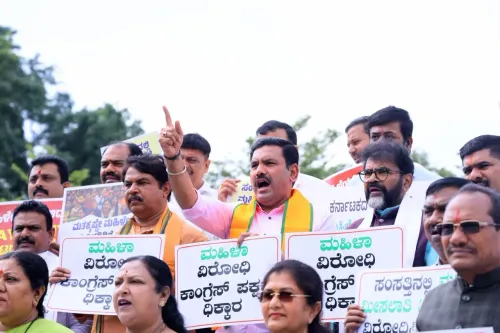
The Bill has triggered sharp political reactions. Bharatiya Janata Party (BJP) State President and MLA B.Y. Vijayendra accused the state government of attempting to curb the activities of the Rashtriya Swayamsevak Sangh (RSS), a day after the Cabinet approved the Bill. He challenged Chief Minister D.K. Shivakumar and Home Minister Priyank Kharge to ban the RSS outright if they had the resolve to do so. Critics argue the legislation is targeted at the public activities of the RSS, an allegation the government has not directly addressed.
What Comes Next
The Bill is yet to be passed by the Karnataka legislature. Once enacted, the government is empowered to frame rules covering the application process, fees for using government premises, inspection and eviction procedures and maintenance of permission records. The proposed law will operate in addition to existing statutes including the Karnataka Police Act, 1963, the Karnataka Parks, Play-fields and Open Spaces (Preservation and Regulation) Act, 1985, and the Bharatiya Nagarik Suraksha Sanhita, 2023. All eyes are now on the legislature session, where the Bill is expected to face sustained opposition from the BJP and allied groups.
Point of View
One that could affect civil society groups, trade unions and religious bodies well beyond the RSS. The seven-day deemed-approval clause is a procedural safeguard, but the grounds for refusal — including 'utterances likely to cause resentment' — are broad enough to invite arbitrary application. Karnataka's Congress government will need to demonstrate that the law is enforced uniformly, not selectively, if it is to withstand constitutional challenge. The political optics, for now, are working against it.
NationPress
28 Sept 2026
Frequently Asked Questions
What is the Karnataka Regulation of Use of Government Premises and Public Property Bill, 2026?
It is a proposed Karnataka state law that regulates the use of government lands, buildings, roads, parks and other public assets by private individuals and organisations. First-time offenders face up to 3 years in jail and a ₹5 lakh fine; repeat offenders face up to 5 years and ₹10 lakh.
Why has the BJP opposed the Karnataka public property Bill?
BJP State President B.Y. Vijayendra alleged that the Bill is designed to curb the public activities of the RSS. He challenged Chief Minister D.K. Shivakumar and Home Minister Priyank Kharge to ban the RSS directly if that was their intent, calling the legislation an indirect attempt at suppression.
What permissions are required under the new Bill for public gatherings?
Organisers must submit a written application at least 7 days before any procession, meeting, event or training programme on government property. If the competent authority does not respond within 7 days, permission is deemed granted. Applicants must provide the route, expected participants, responsible persons' contact details and vehicle information.
Are all offences under the Bill bailable?
No. All offences under the proposed Bill are cognizable and non-bailable. A police officer of Sub-Inspector rank or above can arrest an offender without a warrant.
How can someone challenge a refusal of permission under the Bill?
A person aggrieved by an order of the competent authority can appeal to the Commissioner of the concerned Division within 30 days. The appellate authority can confirm, modify or set aside the order after hearing both parties.