Karnataka CM Calls for 'Team Karnataka' Unity in Assembly
Synopsis
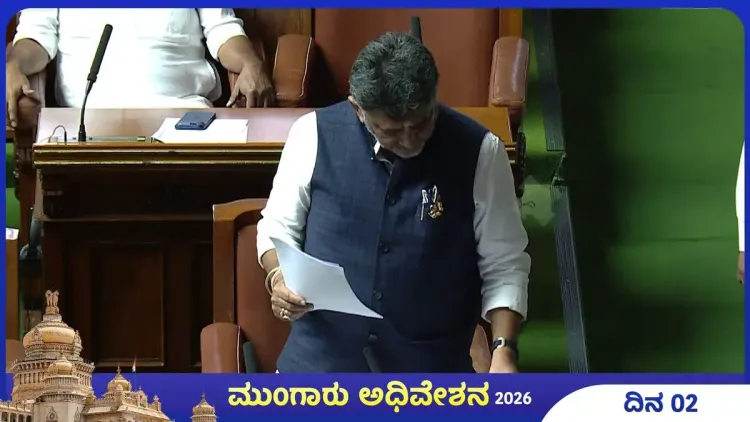
Chief Minister D.K. Shivakumar addressed the Karnataka Legislative Assembly on 14 August 2026, invoking the 'Team Karnataka' spirit and calling on all stakeholders to unite for the state's development. The Chief Minister's Office shared key highlights of the speech on X.
Key Takeaways
The Chief Minister's Office of Karnataka shared highlights of CM D.K.
Shivakumar's address in the Karnataka Legislative Assembly on 14 August 2026 .
The speech centred on the 'Team Karnataka' theme, urging collective, unified effort for state development.
The address was delivered in Kannada and framed development as a shared mission beyond party lines.
Shivakumar is a senior Indian National Congress leader and a key figure in Karnataka's ruling establishment.
The Karnataka Vidhan Sabha is the principal forum where the government's development commitments are debated and legislated.
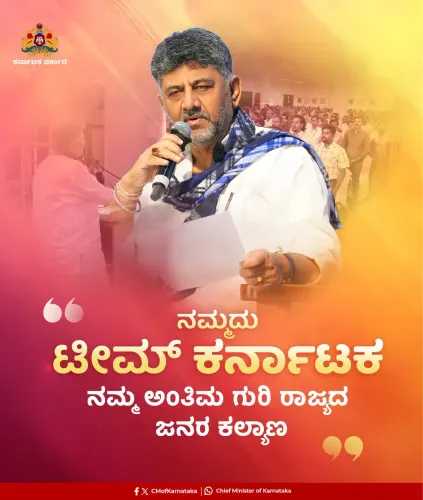
A call for collective resolve echoed through the Karnataka Legislative Assembly on Friday, 14 August 2026, as the Chief Minister's Office of Karnataka shared key highlights from a speech delivered by Chief Minister D.K. Shivakumar — a pitch to set aside divisions and work as one for the state's development.
The post, shared in Kannada, carried a pointed message: 'Team Karnataka' — urging every stakeholder to unite in purpose. The phrase 'ಟೀಮ್ ಕರ್ನಾಟಕ' (Team Karnataka) frames the development agenda not as a government project, but as a collective mission demanding participation across party lines and institutions.
What Shivakumar Said on the Assembly Floor
The Chief Minister's Office described the address as covering 'key points' (ಪ್ರಮು��ಅಂಶಗಳು) from Shivakumar's remarks in the Vidhan Sabha. While the full speech text was not reproduced in the post, the framing — unity, collective effort, state progress — signals a broad developmental pitch, the kind that typically accompanies budget sessions or major policy discussions in the assembly.
D.K. Shivakumar is a senior Indian National Congress leader with deep roots in Karnataka politics, known for his organisational acumen and his role in steering the party's state machinery. An address from him in the assembly carries significant political weight, both as a policy signal and as a message to legislators within and beyond the ruling coalition.
The 'Team Karnataka' Frame and What It Signals
The choice of the 'Team Karnataka' label is deliberate. Indian state governments — particularly those navigating coalition dynamics or seeking to build broad public legitimacy — routinely deploy unity rhetoric during assembly sessions to soften political friction and anchor the development narrative. For Karnataka, a state with a complex multi-party history and significant economic ambitions in sectors like technology, infrastructure, and agriculture, a Chief Minister publicly invoking collective effort in the legislature is a signal worth watching. It sets the tone for how the government wants its development agenda received — not as partisan policy, but as shared purpose.
The assembly remains the primary arena where these commitments get tested — through budget allocations, legislative debates, and the passage of schemes that translate rhetoric into outcomes on the ground.
Point of View
Making the assembly's subsequent proceedings worth monitoring closely.
NationPress
14 Aug 2026
Frequently Asked Questions
What did Karnataka CM D.K. Shivakumar say in the assembly on 14 August 2026?
The Chief Minister's Office shared that Shivakumar called for unity under the 'Team Karnataka' banner, urging all stakeholders to work collectively for the state's development. The full speech text was not published, but the key highlights were shared on X.
Who is D.K. Shivakumar?
D.K. Shivakumar is a senior Indian National Congress leader from Karnataka, known for his organisational role in the party and his prominence in the state's political landscape.
What is the Karnataka Legislative Assembly?
The Karnataka Legislative Assembly, or Vidhan Sabha, is the lower house of Karnataka's bicameral state legislature, where policy debates, budget discussions, and government statements take place.
What does 'Team Karnataka' mean?
'Team Karnataka' is a phrase used by the Karnataka government to invoke collective, cross-party unity in pursuing the state's development goals, framing progress as a shared mission rather than a partisan agenda.
Why did the Karnataka CM speak in the assembly on 14 August 2026?
The specific occasion for the address was not detailed in the post, but assembly speeches by chief ministers in India typically accompany budget sessions, policy announcements, or significant legislative discussions.