Why is Karnataka CM Urging Farmers to Reject the Centre’s MGNREGA Move?
Synopsis
In a passionate address, Karnataka Chief Minister Siddaramaiah implores farmers to stand against the Centre's decision to abolish MGNREGA in favor of a new scheme. He emphasizes the importance of empowering farmers through entrepreneurship and post-harvest activities, while also celebrating women's contributions in agriculture.
Key Takeaways
Farmers are encouraged to engage in post-harvest activities .
Government subsidies support agricultural machinery .
Karnataka leads in crop insurance implementation .
Women’s participation in agriculture is crucial .
CM Siddaramaiah advocates for MGNREGA restoration .
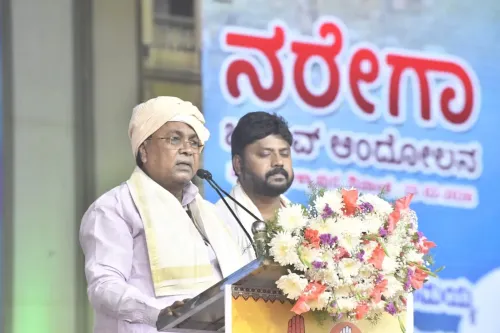
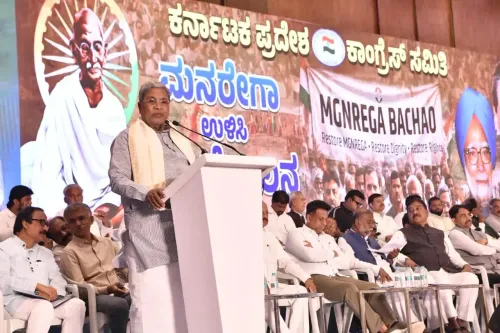
Bengaluru, Feb 6 (NationPress) Karnataka Chief Minister Siddaramaiah urged farmers throughout the state to collectively resist what he described as the “conspiracy” of the Union government aimed at abolishing the Mahatma Gandhi National Rural Employment Guarantee Act (MGNREGA) and replacing it with the Viksit Bharat—Guarantee for Rozgar and Ajeevika Mission (Gramin) Act.
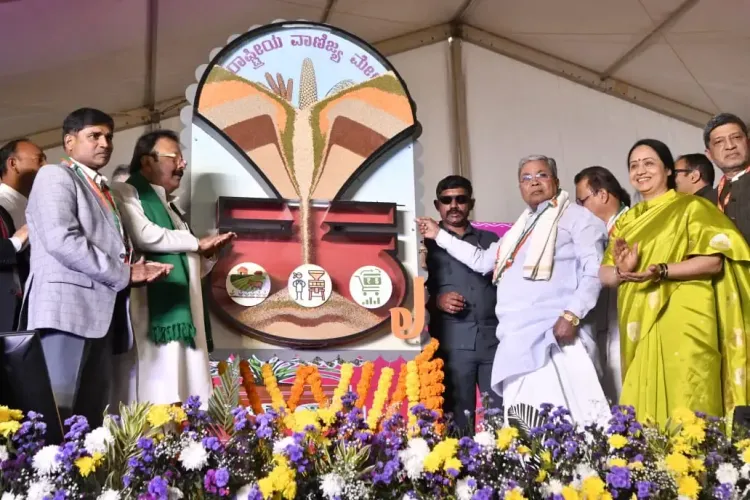
During his address at the International Trade Fair–2026, focusing on Post-Harvest Agriculture and the Farmers’ Empowerment ceremony, he reaffirmed his administration's commitment to the agriculture sector, emphasizing efforts to enhance profitability and empower farmers.
The Chief Minister stated that agriculture can become lucrative by motivating farmers to delve into post-harvest activities.
“Farmers should evolve into entrepreneurs. Besides cultivating crops, they should engage in storage, processing, packaging, marketing, and the creation of by-products. It's essential to boost female participation in agriculture. The accomplishments of women farmers recognized today are genuinely inspiring,” he remarked.
CM Siddaramaiah highlighted that the government is supplying top-quality seeds, fertilizers, and pesticides, alongside providing subsidies worth Rs 1,500 crore for agricultural machinery. Karnataka has distinguished itself as the leading state in the nation for implementing the crop insurance scheme, disbursing Rs 6,000 crore in compensation to farmers.
He mentioned that farmers predominantly focus on crops like sugarcane and ragi and stressed the importance of increased participation in post-harvest processes. “After engaging with sugarcane farmers, appropriate prices were established. Likewise, procurement centers for tur dal were inaugurated a month ahead to benefit farmers,” he added.
Discussing maize production, the Chief Minister noted that a surplus could yield 54 lakh metric tonnes. The Centre set the price at Rs 2,400 per quintal, and discussions have been initiated with maize-based industries and ethanol manufacturers to ensure the procurement of 40 lakh metric tonnes.
CM Siddaramaiah encouraged the youth to embrace agriculture more widely. “Before Independence, almost 80% of the population relied on agriculture. This figure has now decreased to 62%. Profitability in agriculture is only achievable through post-harvest initiatives,” he stated.
He pointed out that India has attained self-sufficiency in food production, and numerous pledges from the Congress manifesto have been honored, including the significant revival of the Krushi Bhagya scheme. “The BJP had suspended this initiative during its time. Our government has reinstated it and allocated nearly Rs 200 crore for its execution,” he remarked.
The Chief Minister mentioned that the guarantee schemes launched by the state government—Shakti, Gruha Jyothi, and Gruha Lakshmi—are especially vital for women. He noted that through the Anna Bhagya scheme, the less privileged can save and invest. “These pro-people initiatives aim to ensure equal opportunities for all,” he said.
Siddaramaiah recalled that the MGNREGA scheme was initiated during the tenure of former Prime Minister Manmohan Singh, providing employment to women, tribals, and laborers, with projects determined in gram sabhas.
“Currently, these powers have been assumed by the Centre, which dictates the nature of works and funding. I urge all farmers in the state to advocate for the reinstatement of MGNREGA and to reject the VB-G RAM G scheme,” he appealed.
He highlighted that previously, the Centre covered the full wage costs under MGNREGA, but now only contributes 60% of the funds, compelling states to shoulder the remaining 40%. “Previously, 100 days of work were guaranteed. Without state government consent, MGNREGA has been terminated, and the VB-G RAM G scheme has taken its place, erasing Mahatma Gandhi’s name from it,” the Chief Minister concluded.
Point of View
He not only highlights the importance of employment security for rural populations but also calls for increased local engagement in agricultural practices. This conflict showcases the ongoing tension between state and central government policies on rural employment and agricultural sustainability.
NationPress
10 Sept 2026
Frequently Asked Questions
What is the new scheme proposed by the Centre?
The Centre has proposed the Viksit Bharat—Guarantee for Rozgar and Ajeevika Mission (Gramin) Act, which will replace MGNREGA.
Why is CM Siddaramaiah opposing the scrapping of MGNREGA?
He believes the scrapping of MGNREGA is a conspiracy against farmers, undermining their employment and livelihood security.
What are the benefits of MGNREGA?
MGNREGA provides employment, financial stability, and empowers local communities through participatory decision-making in rural projects.
How does the new scheme differ from MGNREGA?
Details on the new scheme are limited, but it is perceived as less favorable for rural employment compared to MGNREGA's provisions.