Karnataka CM's Office: ₹16,000 Cr Rural Road Push Across 31 Districts

Synopsis
The Chief Minister's Office of Karnataka has announced a ₹16,000 crore programme to build 15,000 km of rural roads, CC roads, and drains across 31 districts, with transparent tendering, three-tier quality checks, and a 15-month completion target.
Key Takeaways
The Karnataka government has committed ₹16,000 crore to a major rural infrastructure programme announced on 19 November 2026 .
15,000 kilometres of rural roads will be developed across 31 districts , along with cement concrete roads and drainage channels.
All works are targeted for completion within a 15-month deadline .
The programme mandates transparent tendering and a three-tier inspection mechanism to ensure construction quality.
The drive complements central schemes like PMGSY , which has underpinned rural road connectivity across India since 2000.
Key milestones to watch: tender finalisation, mid-construction quality audits, and physical progress reports across all 31 districts.
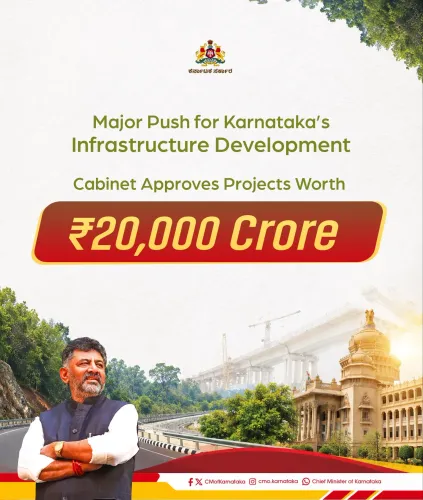
A ₹16,000 crore commitment to rewire the face of rural Karnataka — that is the scale of the infrastructure drive the Chief Minister's Office of Karnataka announced on Thursday, 19 November 2026, pledging to transform villages across all 31 districts of the state through roads, concrete lanes, and drainage systems.
The post, shared in Kannada, frames the initiative as a resolve to fundamentally alter the character of Karnataka's countryside: 'ನಾಡಿನ ಗ್ರಾಮೀಣ ಭಾಗದ ಚಿತ್ರಣವನ್ನೇ ಬದಲಿಸುವ ಸಂಕಲ್ಪ' — 'a resolve to change the very picture of the state's rural landscape.' At the heart of it: 15,000 kilometres of rural roads to be developed, alongside CC (cement concrete) roads and drains, all to be completed within a strict 15-month deadline.
15,000 km of Roads, Drains, and a 15-Month Clock
The sheer geography of the ambition is striking. Spread across Karnataka's 31 districts, the programme targets rural connectivity gaps that have long constrained agricultural movement, school access, and emergency services in village habitations. Cement concrete roads — more durable than black-top in rain-heavy terrain — and drainage channels form the backbone of the works, addressing both mobility and sanitation in a single infrastructure sweep.
What gives the announcement structural teeth is its execution framework. The government has specified transparent tendering, quality-assured construction, and a three-tier inspection mechanism to prevent the cost overruns and quality failures that have dogged previous rural road programmes. The 15-month completion target adds a public accountability clock that district administrations will now have to run against.
Where This Fits: State Drive Alongside PMGSY
India's rural road story runs through the Pradhan Mantri Gram Sadak Yojana (PMGSY), the central scheme launched in 2000 that set the template for all-weather village connectivity nationwide, including in Karnataka. State governments have layered their own district-level upgradation programmes on top of PMGSY over the years — but the ₹16,000 crore figure, if executed in full, would represent one of Karnataka's largest single rural infrastructure commitments in recent memory.
The three-level monitoring model the government is signalling mirrors quality-assurance practices adopted in several other state-level infrastructure drives, where independent technical audits at the planning, mid-construction, and completion stages have been used to enforce contractor accountability. Whether Karnataka's framework includes community-level oversight — a rising standard in rural public works — remains to be detailed in the tender documents.
Who Watches the ₹16,000 Crore
For the rural villagers who will live with these roads and drains, the promise is tangible: smoother access to mandis, hospitals, and schools; cleaner surrounds as drainage replaces open run-off channels. For local contractors and district administrations, the transparent tender mandate signals that the government wants this programme to be auditable and defensible. The real test, as always, begins when tenders close and the first machinery rolls into the first village lane.
Fifteen months is an ambitious runway for 15,000 kilometres across 31 districts. Karnataka has set the target out loud — now every pothole on a village track becomes a data point.
Point of View
000 crore rural infrastructure announcement at this scale is as much a political statement as an engineering one — it signals that the Karnataka government is betting on visible, ground-level delivery as its core governance narrative heading into the next electoral cycle. The three-tier quality monitoring clause is significant: it is a direct response to the credibility deficit that has plagued state rural road programmes, where funds were allocated but quality and timelines collapsed. If the 15-month deadline is met with auditable quality, it sets a replicable model for other large states; if it slips, the loudly-stated targets become a liability. The alignment with PMGSY also raises a question worth tracking — how much of the ₹16,000 crore is state funds versus central pass-through, a distinction that matters for assessing the government's fiscal commitment.
NationPress
19 Nov 2026
Frequently Asked Questions
What is the Karnataka rural road project announced in November 2026?
The Chief Minister's Office of Karnataka announced a ₹16,000 crore programme on 19 November 2026 to develop 15,000 km of rural roads, cement concrete roads, and drainage systems across all 31 districts of the state within 15 months.
How many kilometres of rural roads will Karnataka develop under this scheme?
Karnataka plans to develop 15,000 kilometres of rural roads as part of this ₹16,000 crore infrastructure initiative.
How will Karnataka ensure quality in the rural road construction?
The government has mandated transparent tendering, quality-assured construction, and a three-tier inspection mechanism to monitor and enforce standards throughout the project lifecycle.
What is the deadline for completing Karnataka's rural road project?
The government has set a 15-month deadline for completing all works under the ₹16,000 crore rural infrastructure programme.
How does Karnataka's rural road drive relate to PMGSY?
Karnataka's state-level programme builds on the foundation of the Pradhan Mantri Gram Sadak Yojana (PMGSY), the central scheme launched in 2000 for all-weather rural road connectivity, adding a large state-funded layer of upgradation and drainage works.