CM Karnataka Marks 3 Years With Journalist Cards, Film Subsidies
Synopsis
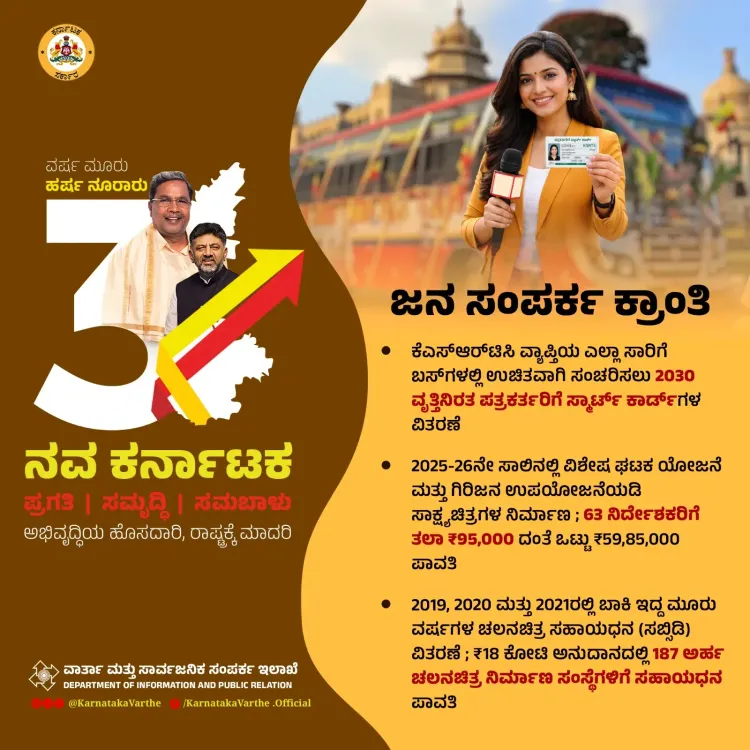
On its third anniversary, the Karnataka Congress government credited citizens for its achievements and announced KSRTC smart cards for 2,030 journalists, Rs 59.85 lakh for 63 documentary directors under welfare sub-plans, and Rs 18 crore in cleared film subsidies for 187 production houses covering 2019-2021.
Key Takeaways
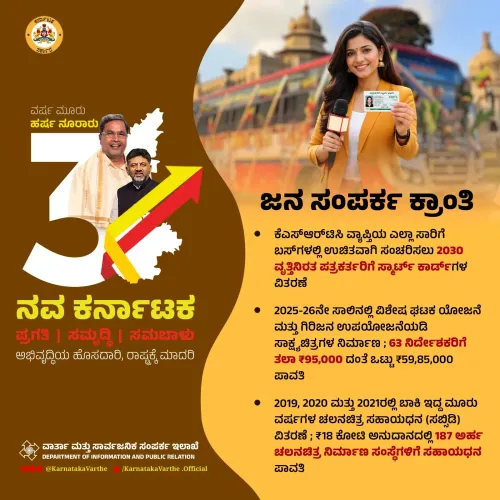
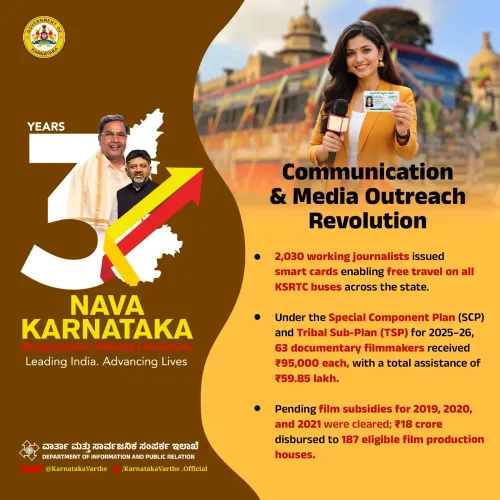
2,030 working journalists in Karnataka have been issued KSRTC smart cards for free travel on all state transport buses.
63 documentary directors received Rs 95,000 each — totalling Rs 59,85,000 — under the 2025-26 Special Component Plan and Tribal Sub-Plan.
Rs 18 crore in pending film subsidies for 2019, 2020, and 2021 has been cleared and paid to 187 eligible Kannada film production companies .
The announcements mark the Congress government's third year in power in Karnataka, branded under #3YearsOfNavaKarnataka .
The government pledged that its implementation pace will accelerate in the coming period.
The Chief Minister's Office of Karnataka marked the ruling Congress government's third anniversary in power on 24 May 2026, crediting every Kannadiga for the administration's achievements and listing a set of targeted disbursements across transport, documentary filmmaking, and the Kannada film industry.
Context
The post, published in Kannada, states: 'ರಾಜ್ಯದ ಜನರ ಆಶೀರ್ವಾದದೊಂದಿಗೆ ನಾವು ಅಧಿಕಾರಕ್ಕೆ ಬಂದು ಮೂರು ವರ್ಷಗಳು ಪೂರೈಸಿರುವ ಈ ಸಾರ್ಥಕ ಸಂದರ್ಭದಲ್ಲಿ' ('On this meaningful occasion of completing three years in power with the blessings of the people of the state'). The government says it takes pride in having 'walked the talk' on every pre-election promise and pledges to accelerate its work toward a 'strong, prosperous and self-respecting Karnataka.'
The anniversary falls under the hashtag #3YearsOfNavaKarnataka, the Congress government's branding for its term, positioning the occasion as a public accountability exercise rather than a ceremonial milestone.
Policy Backdrop
Three specific disbursements were highlighted. First, 2,030 working journalists have been issued smart cards entitling them to free travel on all buses under the Karnataka State Road Transport Corporation (KSRTC) network. Karnataka has a precedent of extending concessional or free travel to designated professional groups, and the Congress party's 2023 election manifesto included welfare commitments for journalists and cultural workers.
Second, under the 2025-26 Special Component Plan and the Tribal Sub-Plan — centrally anchored schemes directing funds toward Scheduled Caste and Scheduled Tribe welfare respectively — 63 documentary directors have each been paid Rs 95,000, totalling Rs 59,85,000, for documentary film production. Third, the government cleared a long-pending backlog: film subsidies for the years 2019, 2020, and 2021 have now been disbursed. A total of Rs 18 crore has been paid to 187 eligible Kannada film production companies. Karnataka has maintained a state film subsidy scheme since the 1970s to support regional cinema.
Stakeholders and Impact
For the 2,030 journalists receiving KSRTC smart cards, the benefit offers direct cost relief on intercity and intrastate travel — a meaningful support for field reporters and correspondents. The documentary filmmakers under the Special Component Plan and Tribal Sub-Plan represent a niche creative community tied to state-mandated social welfare mandates.
The clearance of three years' worth of pending Kannada film subsidies is significant for the 187 production houses that had been waiting since 2019. Delayed subsidy payments have historically been a point of contention between the Karnataka film industry and successive state administrations, making this disbursement a politically visible gesture toward the Kannada entertainment sector.
What's Next
The government has signalled that its pace of implementation will 'become faster and more effective going forward.' Watchers of Karnataka's budget cycle will track disbursement progress under the 2025-26 Special Component Plan allocations and any supplementary film policy revisions in the next state budget session. Whether the anniversary messaging translates into sustained policy momentum or remains a one-day accountability exercise will be tested in the months ahead.
Point of View
Documentary filmmaker grants under SC/ST welfare sub-plans, and a three-year film subsidy backlog clearance signals a deliberate outreach to three distinct constituencies: the media, marginalised communities, and the influential Kannada film industry. The backlog clearance is particularly pointed, as it implicitly frames the previous administration's record as one of neglect. Whether these announcements signal a broader pre-election recalibration ahead of the next Karnataka assembly cycle will be the underlying question for political observers.
NationPress
7 Oct 2026
Frequently Asked Questions
What is the Karnataka government's 3-year anniversary announcement about?
The Chief Minister's Office of Karnataka marked three years in power on 24 May 2026 by listing key welfare disbursements, including KSRTC smart cards for 2,030 journalists, Rs 59.85 lakh for 63 documentary directors, and Rs 18 crore in cleared film subsidies for 187 Kannada film production companies.
Who gets free KSRTC bus travel in Karnataka?
The Karnataka government has issued smart cards to 2,030 working journalists that allow them to travel free of charge on all KSRTC buses across the state.
Why were Kannada film subsidies pending since 2019?
Film subsidies for the years 2019, 2020, and 2021 had accumulated as a backlog under previous administrations. The current Karnataka government says it has now cleared this pending amount of Rs 18 crore to 187 eligible production companies.
What is the Special Component Plan in Karnataka?
The Special Component Plan is a centrally anchored scheme that directs a portion of state plan funds specifically toward the welfare and development of Scheduled Caste communities. Karnataka used it in 2025-26 to fund documentary film production by 63 directors.
What is #NavaKarnataka and #3YearsOfNavaKarnataka?
'Nava Karnataka' — meaning 'New Karnataka' — is the branding used by the Congress government for its current term. The hashtag #3YearsOfNavaKarnataka was used to mark the administration's third anniversary on 24 May 2026.