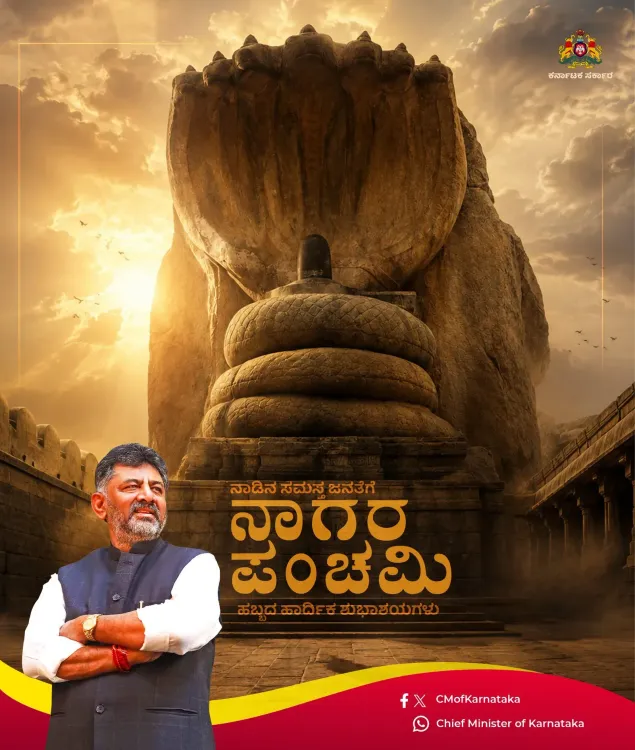
Karnataka CM's Office greets Nagara Panchami, flags ecology link
Synopsis
The Chief Minister's Office of Karnataka greeted the state on Nagara Panchami 2026, using the festival message to highlight the ecological role of snakes in agriculture, the conservation value of Nagabanas along the coast, and the folk traditions of the Bayaluseeme plains — framing a religious occasion as a call for biodiversity co-existence.
Key Takeaways
The Chief Minister's Office of Karnataka posted a Nagara Panchami greeting on 17 August 2026 during the Shravana month.
The message frames snake veneration as an ecological practice: serpents control rodents and insects that damage crops, making them natural allies of farmers.
Nagabanas — sacred groves on Karnataka's coast — are highlighted as natural conservation sites that protect snake habitats and water sources.
The post notes regional diversity: Bayaluseeme plains celebrate with Jokali (swings) and Tambittu (rice-flour sweets), and the festival honours sibling bonds.
The CMO calls for co-existence with all living beings and protection of natural water bodies and forest groves.
Folk tradition describes Nagara Panchami as the opening festival of Karnataka's Shravana-month festive calendar.
As the rains of Shravana drench Karnataka's fields and sacred groves, the Chief Minister's Office of Karnataka marked Nagara Panchami 2026 with a message that went well beyond ritual greetings — weaving together biodiversity, agrarian wisdom, and the living folklore of a festival that folk tradition calls 'the greatest in the land.'
The post, shared on Monday, 17 August 2026, offered greetings in Kannada to the people of Karnataka while articulating what the state sees as the ecological logic behind snake worship: 'Nagaaradhane' (serpent veneration) is not merely religious belief, it is, the message argues, a centuries-old practice of honouring a species that controls rodents and crop-destroying insects — making the snake a silent guardian of the farmer's harvest.
Nagabanas and the science inside the sacred
Central to the post is a pointed ecological argument. The Nagabanas — dense sacred groves found especially along coastal Karnataka — have long served as de-facto wildlife sanctuaries, protecting snake habitats and water sources precisely because communities treated them as inviolable holy ground. The CMO's message explicitly calls for the protection of these groves and natural water bodies, framing their preservation as a duty rooted in the festival's own philosophy.
Karnataka governments have periodically used festival communications to reinforce this conservation message, linking traditional customs to biodiversity goals. The Nagabana tradition in particular has drawn attention as an indigenous model of community-led conservation — one that predates formal wildlife legislation by generations.
From coastal groves to Bayaluseeme's swings and sweets
The message also captures the festival's regional variety. On the Bayaluseeme plains — Karnataka's interior tableland — Nagara Panchami takes on a different texture: Jokali (swing games) and Tambittu (a traditional sweet made from rice flour and jaggery) define the celebrations, and the sibling bond between brothers and sisters is foregrounded in the ritual. The CMO's post draws these strands together as evidence of Karnataka's layered cultural identity — coastal reverence, agrarian joy, and familial affection all braided into a single festival.
The Shravana month, which falls during the monsoon, is considered the most festival-dense period in the Karnataka calendar. Folk tradition holds that Nagara Panchami writes the prologue to that entire chain of celebrations.
Co-existence as the closing note
The post closes with a wish that resonates beyond ceremony: that the spirit of co-existence with every living being become a shared value, and that the grace of Nagadevaru (the serpent deity) bring health, peace, and prosperity to all. It is a closing that, intentionally or not, doubles as a conservation ethic — the kind of public messaging that state governments in agrarian India increasingly find useful at the intersection of culture and ecology.
As Karnataka moves through its Shravana calendar, the state's next test will be whether this cultural messaging translates into tangible policy attention for sacred-grove protection programmes — the Nagabanas are watching.
Point of View
The state government signals alignment with biodiversity goals without announcing a new policy. It is a low-cost way to keep sacred-grove protection on the public agenda during a high-attention cultural moment. Whether such messaging precedes concrete legislative or budgetary action on Nagabana protection will be the real indicator of intent.
NationPress
17 Aug 2026
Frequently Asked Questions
What is Nagara Panchami and when is it celebrated?
Nagara Panchami is a traditional Hindu festival dedicated to snake worship, observed on the fifth day of the bright fortnight in the Shravana month (July-August). In Karnataka it is considered the opening celebration of the Shravana festive season.
What are Nagabanas in Karnataka?
Nagabanas are sacred groves found predominantly in coastal Karnataka, preserved by communities as habitats for snakes and sites of ritual worship. They function as informal wildlife sanctuaries protecting biodiversity and local water sources.
Why is Nagara Panchami important for farmers?
Snakes prey on rodents and crop-damaging insects, making them natural protectors of agricultural fields. The festival's tradition of honouring serpents is seen as an ancient acknowledgement of this ecological role in protecting harvests.
How is Nagara Panchami celebrated in the Bayaluseeme region of Karnataka?
In the Bayaluseeme plains, the festival is marked by Jokali (swing games) and the preparation of Tambittu, a sweet made from rice flour and jaggery. It also celebrates the bond between brothers and sisters.
What did the Karnataka Chief Minister's Office say about Nagara Panchami 2026?
The CMO posted a Kannada message greeting the people of Karnataka, linking the festival to biodiversity conservation, calling for protection of Nagabanas and water bodies, and wishing all citizens health, peace, and prosperity through the grace of Nagadevaru.