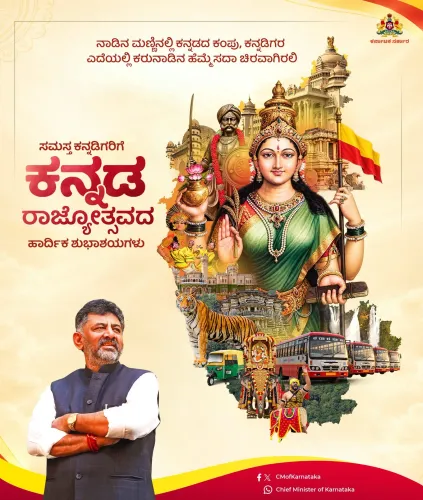
Karnataka CM Plans Official State Flag Nod at Belagavi Session

Synopsis
The Chief Minister's Office of Karnataka announced on 1 November 2026 that the state government is deliberating on granting official status to the red-yellow Kannada flag, with a decision to be taken during the upcoming Belagavi winter legislative session.
Key Takeaways
The Chief Minister's Office of Karnataka announced plans to officially recognise the red-and-yellow Kannada flag as the state's official flag ( naadadhwaja ).
The final decision will be discussed and taken at the Belagavi winter legislative session of the Karnataka legislature.
The government frames the flag as a symbol of Kannada knowledge, culture, religious equality, and peace — comparable in status to the existing state anthem.
A similar proposal was examined in 2018 under then Chief Minister Siddaramaiah but did not result in a formal resolution.
The move raises constitutional questions, as Jammu and Kashmir was the only Indian state to have had a formally recognised state flag before the abrogation of Article 370 in 2019.
Belagavi , a border city at the centre of Karnataka's linguistic identity politics, was deliberately chosen as the venue for this deliberation.
A red-and-yellow banner that Kannadigas have carried through decades of linguistic pride marches may soon earn the weight of official law. The Chief Minister's Office of Karnataka announced on Sunday, 1 November 2026 that the state government is actively deliberating on granting formal recognition to the Kannada flag — and that the Belagavi winter legislative session will be the arena where the decision is made.
The statement, attributed to the Chief Minister's Office, frames the aspiration in cultural terms: 'Bharatada janani ya tanujate' — Karnataka, born of Mother India — already has a state anthem (naadageethe), and it deserves an official state flag (naadadhwaja) as an equal emblem of Kannada pride. 'Just as Kannada has a state anthem, we aspire for an official state flag that represents the self-respect of Kannadigas,' the post reads in translation.
What the red-yellow flag already means to Kannadigas
The red-and-yellow (kempu-haladi) Kannada flag is not new — it has functioned for years as an emotional and cultural emblem without carrying any legal status. It flies at Rajyotsava celebrations, at Karnataka Ekeekarana rallies, and at Kannada Sahitya Sammelanas. The CMO's post describes it as a symbol of 'Kannada's knowledge tradition, culture, equality of all faiths, and a message of peace.' Giving it official status would transform sentiment into statute.
This is not the first time the idea has surfaced inside state corridors. In 2018, the Karnataka government under then Chief Minister Siddaramaiah examined proposals for an official state flag — a move that sparked both enthusiasm among Kannada activists and questions about constitutional permissibility under India's federal structure. That attempt did not produce a formal resolution, leaving the debate unfinished.
Belagavi session as the chosen stage
Belagavi, the northern Karnataka city that hosts the state legislature's annual winter session, carries its own symbolic charge — it sits in a border district that has been the subject of a long-running interstate dispute with Maharashtra over linguistic boundaries. Choosing Belagavi as the venue to debate and decide on a Kannada state flag is itself a statement: the government is planting the flag, metaphorically, on contested cultural terrain.
The CMO's post is explicit that no final decision has been taken yet — the phrase used is 'chintane nadesiruthe', meaning 'the government is deliberating.' The Belagavi session is cast as the forum for discussion and resolution. That framing gives the announcement the character of a policy commitment rather than a done deal, which means the real test lies in what emerges from the legislative floor.
The constitutional question that hovers over every state flag debate
India's Constitution does not explicitly bar states from having their own flags, but it also does not provide a framework for them. Only Jammu and Kashmir had a constitutionally recognised state flag before the abrogation of Article 370 in 2019. Any attempt by Karnataka to formalise its flag will inevitably draw scrutiny from the Centre and legal analysts on whether state symbols can carry official status without a constitutional amendment or a specific legislative framework. That is the conversation the Belagavi session is being asked to begin — and to conclude.
For Karnataka's Congress government, the move carries political logic that runs deeper than symbolism: asserting state identity within India's federal compact has become a recurring theme for regional parties and state governments across the political spectrum. The Kannada flag proposal fits neatly into that broader national pattern — a reminder that federalism in India is not just an administrative arrangement, but a living, contested negotiation over who gets to represent what.
If Belagavi delivers a resolution, Karnataka would be charting genuinely new constitutional territory. If it defers again, the red-and-yellow banner will keep flying — unofficially, but no less passionately.
Point of View
A city at the heart of the Karnataka-Maharashtra border dispute, as the decision-making venue is a deliberate signal, not an administrative convenience. Constitutionally, the proposal enters genuinely uncharted waters: with the J&K precedent erased by Article 370's abrogation, there is no active template for a state flag in India's legal architecture, meaning any formal recognition would invite Centre scrutiny and potentially landmark judicial review. For the Congress government in Bengaluru, the announcement is simultaneously a cultural commitment and a calculated political move — one that tests the boundaries of cooperative federalism while wrapping the argument in the safe, broadly popular language of Kannada pride.
NationPress
1 Nov 2026
Frequently Asked Questions
What is the Karnataka government proposing about the Kannada flag?
The Karnataka government is deliberating on granting official legal recognition to the red-and-yellow Kannada flag, transforming it from an unofficial cultural symbol into a formally recognised state flag. The decision is expected to be taken during the Belagavi winter legislative session.
What does the red-yellow Kannada flag represent?
The red-and-yellow flag has long been an unofficial emblem of Kannada cultural identity, representing the state's knowledge tradition, linguistic heritage, equality of all faiths, and a message of peace. It is widely flown at Kannada Rajyotsava and other cultural events.
Is it constitutionally allowed for an Indian state to have its own flag?
India's Constitution does not explicitly prohibit state flags but also does not provide a clear framework for them. Jammu and Kashmir was the only state to have had a constitutionally recognised flag, a status that ended with the abrogation of Article 370 in 2019, making Karnataka's proposal legally significant and potentially precedent-setting.
When and where will the decision on the Karnataka state flag be taken?
The Chief Minister's Office stated that the decision will be discussed and finalised during the Belagavi winter session of the Karnataka state legislature. No specific date for the session was mentioned in the announcement.
Has Karnataka tried to get an official state flag before?
Yes. In 2018, the Karnataka government under Chief Minister Siddaramaiah examined proposals for an official state flag, but the effort did not result in a formal resolution, leaving the current proposal as a renewed attempt at the same goal.