Karnataka farmers intensify Hubballi protest, demand ₹5,500 per tonne sugarcane
Synopsis
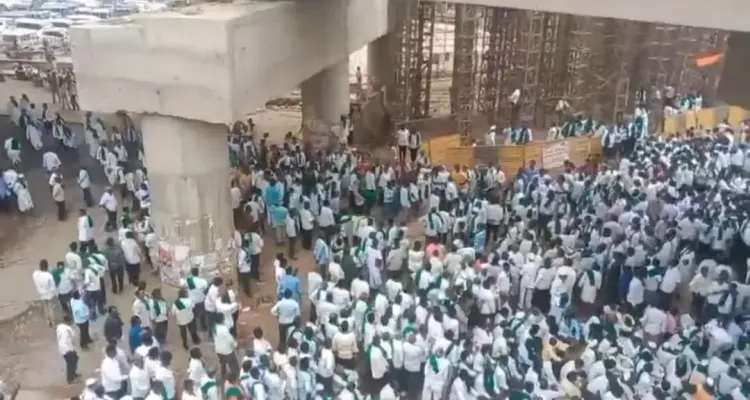
Over 2,000 Karnataka farmers descended on Hubballi on 29 September, marching to Union Minister Pralhad Joshi's residence to demand ₹5,500 per tonne for sugarcane — citing a near-threefold rise in cultivation costs since 2019. With police barricades, traffic gridlock, and an ultimatum by 5 pm, the protest is shaping up as one of the most visible farmer agitations in north Karnataka this crushing season.
Key Takeaways
More than 2,000 farmers from Dharwad , Belagavi and other districts gathered in Hubballi on 29 September 2026 .
Core demand: minimum sugarcane price of ₹5,500 per tonne for the 2025–26 crushing season, up from existing levels.
Farmers also sought a rise in the minimum selling price of sugar from ₹31 per kg to ₹60 per kg .
Farmer leader Chunnappa Poojari said cultivation costs had risen nearly threefold between 2019 and 2026 .
More than 250 police personnel were deployed; barricades erected near Union Minister Pralhad Joshi's residence.
Protest leaders vowed to continue the agitation until the government responds; next phase to be decided after 5 pm on Tuesday.
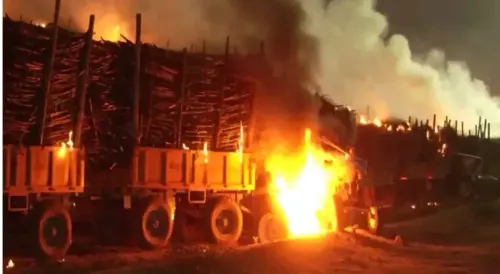
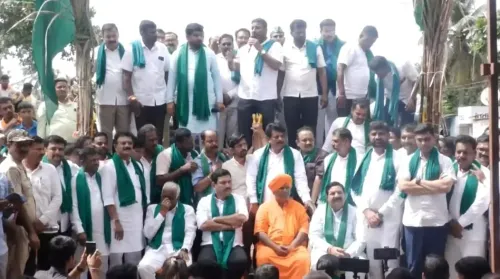
More than 2,000 farmers from across Karnataka intensified their agitation in Hubballi on Tuesday, 29 September 2026, demanding a minimum price of ₹5,500 per tonne for sugarcane, a near-doubling of the minimum selling price of sugar, and full implementation of the Dr M.S. Swaminathan Commission report. The protest, organised by the Karnataka Rajya Raitha Sangha and Hasiru Sene, drew participants from Dharwad, Belagavi, and several other districts, bringing parts of the city to a standstill.
How the Protest Unfolded
Farmers first assembled at Kittur Rani Chennamma Circle before marching towards the residence of Union Minister Pralhad Joshi. The original plan to lay siege to Joshi's Hubballi office was reportedly shelved after police denied permission, with demonstrators redirecting to Nehru Maidan instead.
Authorities deployed more than 250 police personnel around Nehru Maidan and erected barricades near Joshi's office and residence. Tension briefly escalated when some farmers attempted to remove the barricades. Traffic was disrupted on several major roads, with vehicles stranded in queues stretching for kilometres as protesters staged sit-ins.
Key Demands of the Farmers
Farmer leader Chunnappa Poojari stated that cultivation costs had risen nearly threefold between 2019 and 2026, making the current price structure untenable. He demanded that sugarcane prices be determined scientifically based on estimates submitted by the Commission for Agricultural Costs and Prices (CACP), and called for an additional payment of ₹300 per tonne to farmers supplying sugarcane during the 2025–26 season.
The protesters also sought an increase in the minimum selling price of sugar from ₹31 per kg to ₹60 per kg, citing sharply rising input costs. Additional demands included full loan waivers for farmers, a scientifically determined Fair and Remunerative Price (FRP) for sugarcane, declaration of minimum support prices for all crops, implementation of the Mahadayi irrigation project, and government purchase of the state's entire ethanol production. Farmers also criticised the state government for providing only ₹2,500 in crop-loss compensation, calling the amount inadequate.
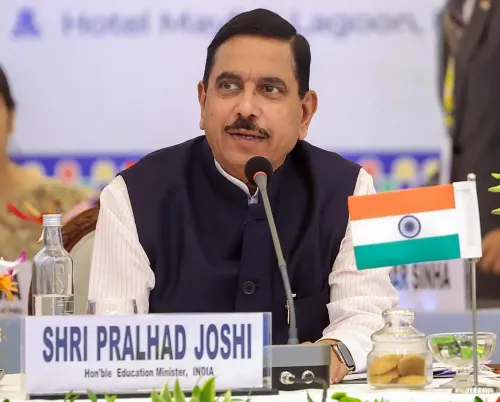
Farmers Target Union Minister Joshi
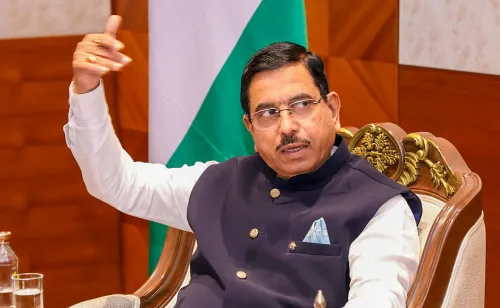
Farmer leader Shashikant Guruji of Inchageri Math directly accused Union Minister Joshi of failing to address farmers' grievances and urged him to meet protesters in person rather than communicate through a video message. The call for a face-to-face response underscored the deepening frustration with what demonstrators described as a lack of political accountability.
This comes amid a broader national debate over agricultural pricing, with sugarcane farmers across several states pressing for higher FRP and state advisory prices. Notably, the demand to implement the Swaminathan Commission report — which has been a rallying point for farmer movements since the mid-2000s — signals that structural grievances remain unaddressed nearly two decades after the report's submission.
What Happens Next
Protest leaders warned the agitation would continue until the government formally responded to their demands. They indicated that the next phase of the protest would be decided after 5 pm on Tuesday, with more farmers expected to join. The escalation near a sitting Union Minister's residence and the large turnout raise the likelihood of further political pressure on both the Centre and the Karnataka state government in the days ahead.
Point of View
Squeezing small and marginal growers the hardest. The farmers' demand to implement the Swaminathan Commission report — submitted nearly two decades ago — is a pointed reminder that successive governments, Centre and state alike, have treated landmark agricultural reforms as political instruments rather than binding commitments. Targeting a sitting Union Minister's residence also signals a deliberate escalation strategy: Karnataka's sugarcane belt knows how to apply electoral pressure, and with the crushing season beginning, the timing is calculated.
NationPress
29 Sept 2026
Frequently Asked Questions
What are Karnataka farmers demanding at the Hubballi protest?
Farmers are demanding a minimum price of ₹5,500 per tonne for sugarcane, an increase in the minimum selling price of sugar from ₹31 per kg to ₹60 per kg, full implementation of the Dr M.S. Swaminathan Commission report, and complete loan waivers. They also want the Centre to scientifically determine the Fair and Remunerative Price for sugarcane based on CACP estimates.
Who organised the Hubballi farmer protest on 29 September 2026?
The protest was organised by the Karnataka Rajya Raitha Sangha and Hasiru Sene, with farmers participating from Dharwad, Belagavi, and several other districts of Karnataka. More than 2,000 farmers reportedly gathered at Kittur Rani Chennamma Circle and later marched towards Union Minister Pralhad Joshi's residence.
Why are farmers targeting Union Minister Pralhad Joshi?
Farmers targeted Joshi's Hubballi residence and office because, as a senior Union Minister from the region, they hold him responsible for not addressing their concerns at the Centre. Farmer leader Shashikant Guruji accused Joshi of responding only through a video message rather than meeting protesters in person.
Why have sugarcane prices become such a flashpoint in Karnataka?
Farmer leader Chunnappa Poojari stated that cultivation costs have risen nearly threefold between 2019 and 2026, while government-set prices have not kept pace. The demand for ₹5,500 per tonne, compared to existing levels, reflects farmers' argument that the current Fair and Remunerative Price fails to cover their input costs.
What happens next after the Hubballi protest?
Protest leaders said the next phase of the agitation would be decided after 5 pm on 29 September, with more farmers expected to join. They have warned that the protests will continue until the Centre and state government formally respond to their demands, including on the Mahadayi irrigation project and full crop-loan waivers.