Karnataka CM Shivakumar Launches Drive to Fill 72,186 Govt Posts
Synopsis
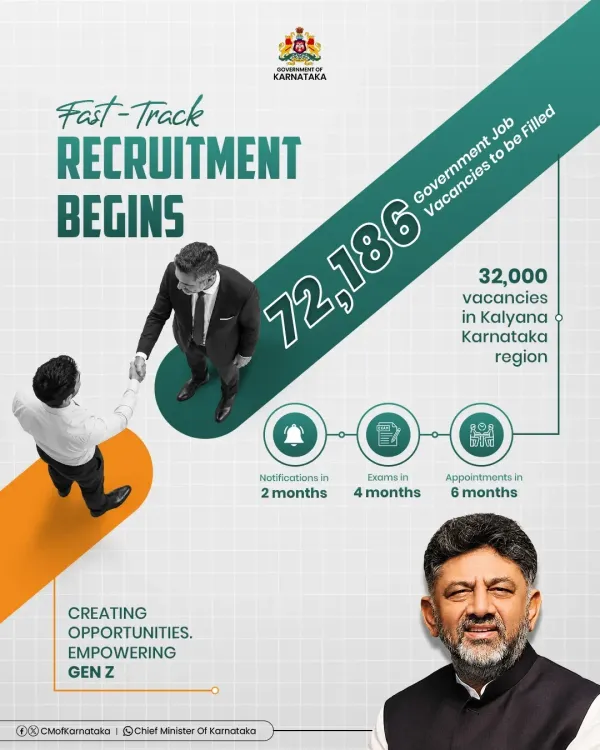
Karnataka's Chief Minister's Office has announced a mission-mode drive to fill 72,186 vacant government posts statewide, with over 32,000 earmarked for the Kalyana Karnataka region. Notifications are due within two months, examinations within four, and appointment letters within six months.
Key Takeaways
72,186 vacant government posts across Karnataka are to be filled in a single mission-mode recruitment drive.
Over 32,000 posts are earmarked specifically for the Kalyana Karnataka region, which holds special status under Article 371J of the Constitution.
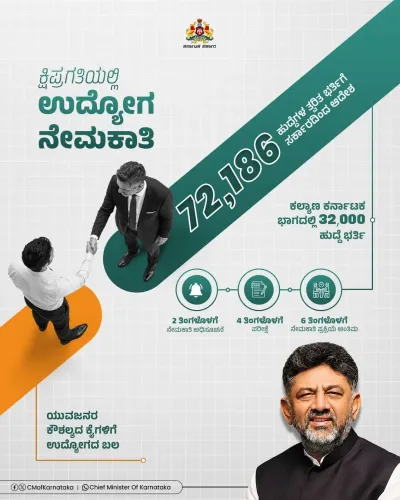
A binding three-stage timeline has been announced: notifications within 2 months , examinations within 4 months , and appointment letters within 6 months .
The drive is attributed to the leadership of Chief Minister D.K.
Shivakumar and is framed as both an employment and public service delivery initiative.
The Karnataka Public Service Commission (KPSC) is the constitutional body expected to administer the recruitment notifications and examinations.
Fiscal implications — including state budget provisions for new recruits' salaries — and potential legal challenges over reservation policy remain key factors to watch.
The Chief Minister's Office of Karnataka announced on Friday, 26 June 2026 that a mission-mode recruitment drive has been launched to fill 72,186 vacant government posts across the state, with a structured timeline binding notifications, examinations, and appointment letters within six months.
Context
The official post from the Chief Minister's Office states that notifications for the vacancies will be issued within 2 months, examinations conducted within 4 months, and appointment letters dispatched within 6 months. The announcement attributes the drive to the leadership of Chief Minister Shri D.K. Shivakumar, describing it as 'a major step towards creating employment opportunities and strengthening public service delivery.'
Of particular note is the scale of recruitment earmarked for the Kalyana Karnataka region, with over 32,000 posts to be filled there alone — representing nearly half the total vacancies announced statewide.
Policy Backdrop
Kalyana Karnataka — comprising seven districts formerly known as Hyderabad-Karnataka — holds special constitutional status under Article 371J of the Indian Constitution, which mandates targeted quotas and accelerated development measures to address historical regional disparities. Recruitment drives in this region have long been a benchmark for assessing the state's commitment to equitable governance.
The Karnataka Public Service Commission (KPSC), the constitutional body responsible for civil service recruitment in the state, is expected to issue department-wise notifications as the first step in the process. Karnataka had previously announced a large-scale drive in 2023 to clear accumulated vacancies across departments including education, health, and revenue in the wake of that year's assembly elections.
State governments across India have periodically launched such mission-mode campaigns to address vacancy backlogs, with the dual objective of improving public service delivery and absorbing youth unemployment. These drives frequently intersect with fiscal planning for salary provisions and legal challenges over reservation policies.
Stakeholders and Impact
The primary beneficiaries are government job aspirants across Karnataka, particularly those from the Kalyana Karnataka region who stand to gain from the disproportionately large share of posts allocated there. Departments spanning education, health, revenue, and other public services are expected to see significant additions to their workforce.
For residents of Kalyana Karnataka — historically underserved in terms of administrative capacity — the recruitment of over 32,000 personnel could meaningfully improve access to public services. Broader state departments will also benefit from reduced vacancy burdens that have long strained service delivery.
What's Next
The immediate trigger to watch is the release of detailed, department-wise recruitment notifications by the KPSC within the two-month window announced by the government. Any associated court petitions — particularly those contesting reservation provisions — could affect the examination schedule.
State budget provisions for the salaries of the new recruits will also come under scrutiny, as absorbing tens of thousands of employees into the government payroll carries significant fiscal implications. If the six-month timeline holds, Karnataka could see appointment letters issued by the end of 2026, marking one of the largest single recruitment cycles in the state's recent history.
Point of View
Time-bound drive to fill 72,186 posts is politically significant for the Congress government in Karnataka, which has faced pressure to deliver on employment promises since its 2023 assembly win. The deliberate emphasis on Kalyana Karnataka — allocating nearly half the vacancies to a constitutionally protected but historically neglected region — signals an effort to consolidate support in districts that have long felt peripheral to Bengaluru-centric governance. Mission-mode timelines in Indian state recruitment have a mixed record of being met, and the credibility of this drive will ultimately be tested by whether KPSC notifications and examinations adhere to the announced schedule. Litigation over reservation categories, a recurring feature of large Karnataka recruitment cycles, remains the most likely variable that could disrupt the six-month roadmap.
NationPress
25 Sept 2026
Frequently Asked Questions
How many government posts are being filled in Karnataka in 2026?
The Karnataka government has announced a drive to fill 72,186 vacant government posts across the state, with the recruitment process set to be completed within six months of the announcement in June 2026 .
How many posts are reserved for Kalyana Karnataka in this recruitment?
Over 32,000 of the 72,186 posts are earmarked for the Kalyana Karnataka region, which comprises seven districts with special constitutional status under Article 371J .
What is the timeline for Karnataka government recruitment notifications and exams?
According to the Chief Minister's Office, recruitment notifications will be issued within 2 months , examinations will be held within 4 months , and appointment letters will be given within 6 months of the announcement.
Which body conducts Karnataka government recruitment examinations?
The Karnataka Public Service Commission (KPSC) is the constitutional body responsible for issuing notifications and conducting examinations for state civil service and government department posts.
What is Kalyana Karnataka and why does it get special recruitment quotas?
Kalyana Karnataka is a region of seven districts in northern Karnataka, formerly known as Hyderabad-Karnataka, that was accorded special development status under Article 371J of the Indian Constitution to address historical socio-economic disparities through targeted quotas in education and employment.