Karnataka releases ₹600 cr for farmer procurement support
Synopsis
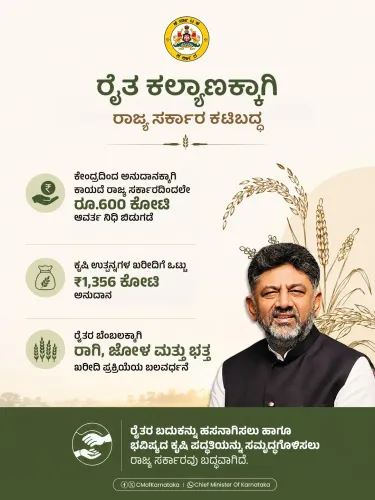
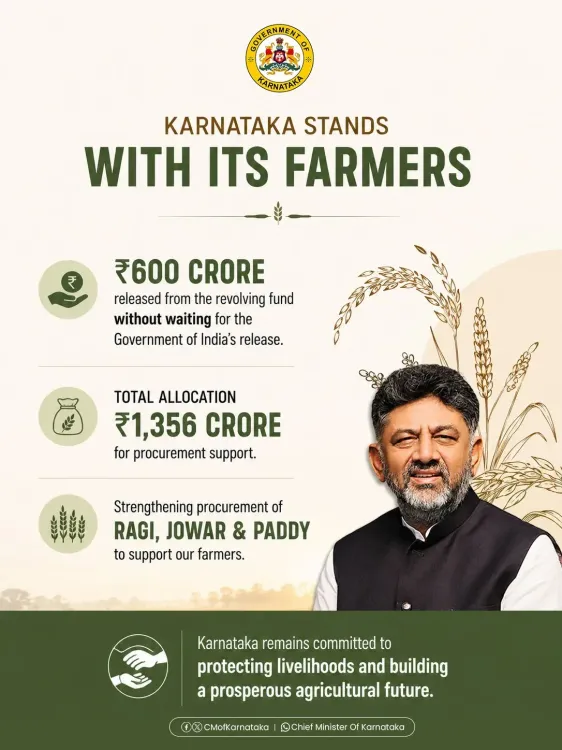
The Karnataka government has released ₹600 crore from its revolving fund for ragi, jowar and paddy procurement without waiting for central funds, raising total support to ₹1,356 crore. Chief Minister D K Shivakumar's office called it a timely intervention to protect farmer livelihoods.
Key Takeaways
₹600 crore released by the Karnataka government from its revolving fund for agricultural procurement on 16 June 2026 .
The release was made independently, without waiting for the Government of India to disburse its share.
Total procurement support allocation now stands at ₹1,356 crore for the current season.
The funds are directed at procurement of ragi, jowar, and paddy — crops central to Karnataka's agrarian economy.
The move is attributed to the leadership of Chief Minister D K Shivakumar by the official CMO account.
The intervention aims to ensure farmers receive MSP-linked payments without delays caused by inter-governmental fund-transfer cycles.
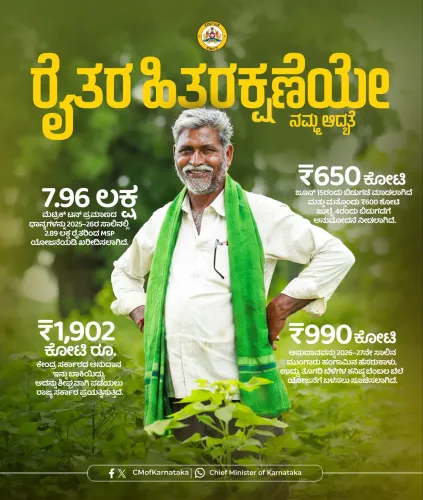
The Chief Minister's Office of Karnataka announced on Tuesday, 16 June 2026, that the state government has released ₹600 crore from its revolving fund to support agricultural procurement — without waiting for a corresponding release from the Government of India — bringing the total allocation for procurement support to ₹1,356 crore.
Context
The post, shared from the official Chief Minister's Office of Karnataka account, credits the move to the leadership of Chief Minister Shri D K Shivakumar. The release is intended to strengthen procurement operations for three key crops: ragi, jowar, and paddy — staples that anchor the livelihoods of a significant share of Karnataka's farming community. The government described the step as a 'timely intervention' to ensure farmers receive support without delay.
Policy Backdrop
Agricultural procurement in India operates under a shared federal structure, where the central government sets Minimum Support Prices (MSP) and typically releases funds to states for procurement operations. When central disbursements are delayed, state governments may draw on revolving funds — dedicated corpus accounts — to advance payments and keep procurement machinery running. Karnataka has a documented history of such interventions, particularly for millets like ragi and jowar, which hold cultural and nutritional significance in the region and are grown extensively across the Deccan plateau.
The decision to release funds without waiting for the Centre underscores the state's stated priority of ensuring that farmers are not left in limbo during inter-governmental fund-transfer cycles. The cumulative figure of ₹1,356 crore signals that this latest tranche of ₹600 crore is an addition to earlier allocations already committed for the current procurement season.
Stakeholders and Impact
The primary beneficiaries are farmers growing ragi, jowar, and paddy across Karnataka who sell their produce through government procurement channels at MSP. Timely fund availability allows state procurement agencies to make prompt payments, reducing the financial stress on smallholder and marginal farmers who depend on the crop cycle for their annual income. Delayed procurement payments have historically pushed farmers toward distress sales to private traders at below-MSP prices.
The move also carries political significance: the ruling Congress government, led by Chief Minister D K Shivakumar, has positioned farmer welfare as a central pillar of its governance agenda in Karnataka. Proactive state-level funding — ahead of central releases — allows the government to demonstrate responsiveness independent of the pace of central transfers.
What's Next
Attention will now turn to the actual procurement volumes recorded for the ragi, jowar, and paddy season and whether the Government of India subsequently releases its share of funds to replenish the revolving corpus. The speed and scale of farmer payments made against this allocation will be a key measure of the intervention's on-ground impact. Observers will also watch whether the Centre's release, when it arrives, matches the state's advance outlay or leaves a gap that Karnataka must absorb.
Point of View
The Congress government is also making a clear electoral statement about state-level agency in agricultural welfare. The cumulative figure of ₹1,356 crore signals that this is not an isolated gesture but part of a sustained procurement push. How quickly the central government replenishes the revolving corpus will determine whether this model is financially sustainable beyond a single season.
NationPress
15 Sept 2026
Frequently Asked Questions
Why did Karnataka release ₹600 crore without waiting for the central government?
Karnataka drew on its revolving fund to ensure timely payments to farmers procuring ragi, jowar and paddy, rather than delay operations while awaiting the Government of India's disbursement.
What is the total procurement support Karnataka has allocated for farmers?
The total allocation for procurement support has reached ₹1,356 crore after the latest release of ₹600 crore from the state's revolving fund.
Which crops are covered under Karnataka's latest procurement fund release?
The funds are directed at the procurement of ragi, jowar, and paddy — three crops that are economically and nutritionally significant for Karnataka's farming communities.
What is a revolving fund in the context of agricultural procurement?
A revolving fund is a dedicated state corpus used to advance payments for procurement operations; it is replenished once the central government releases its share of funds.
Who is the Chief Minister of Karnataka credited with this decision?
The Chief Minister's Office credited Chief Minister Shri D K Shivakumar with the leadership behind this farmer-support intervention.