Karnataka hikes Nandini milk price by ₹8, farmers get ₹7
Synopsis
Karnataka raises Nandini milk prices by ₹8 per litre from November 1, channelling ₹7 directly to farmers and lifting procurement earnings to ₹47 per litre. The revision is projected to add ₹1,850–2,100 crore annually to rural dairy incomes across the state's 28.84 lakh dairy farmers.
Key Takeaways
Nandini milk price rises by ₹8 per litre effective November 1 , announced by the Chief Minister's Office of Karnataka. ₹7 of the ₹8 increase goes directly to farmers, raising the base procurement price from ₹35 to ₹42 per litre .
Including the existing ₹5 government incentive , farmers will receive ₹47 per litre .
A farmer supplying 10 litres daily gains approximately ₹2,100 in additional monthly income .
The revision is projected to inject ₹1,850 crore to ₹2,100 crore in additional annual income into rural dairy households statewide.
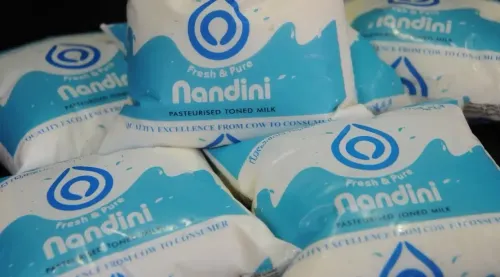
Post-revision, Nandini Toned Milk at ₹54/litre and Nandini Shubham at ₹60/litre remain priced below most competing national dairy brands.
Starting November 1, every litre of milk sold under the Nandini brand will cost ₹8 more — but the Karnataka government is at pains to explain who really gains from this revision. Of the ₹8 hike, ₹7 flows directly to the farmer, lifting the procurement rate from ₹35 to ₹42 per litre. Add the existing government incentive of ₹5 per litre, and a dairy farmer now earns ₹47 per litre — a significant step up in a sector where margins have been squeezed for years.
Why the revision became unavoidable
The Chief Minister's Office of Karnataka cited a confluence of pressures driving the decision: a sharp rise in cattle fodder and feed costs, higher fuel and packaging expenditures, and — critically — a drought-induced fall in daily milk procurement volumes across the state. When supply drops and input costs climb simultaneously, the cooperative model comes under stress. The price revision, the government argued, was not a choice but a correction.
Karnataka Milk Federation (KMF), the apex dairy cooperative that operates the Nandini network, procures milk from 28.84 lakh dairy farmers across the state. 67 percent of KMF members are small or marginal farmers — the cohort most exposed to input-cost volatility and least able to absorb losses.
What ₹7 more per litre means for a farming household
The government put a household-level number on the announcement: a farmer supplying 10 litres a day will see roughly ₹2,100 in additional monthly income. Scaled across the cooperative's membership, the revision is projected to channel an additional ₹1,850 crore to ₹2,100 crore annually into rural dairy households across Karnataka.
These figures, drawn directly from the government's statement, underline the scale of what a single procurement-price adjustment can do when routed through a cooperative structure of this size. For smallholder families where dairy income is often the only regular cash flow, the difference is not marginal.
Nandini still priced below national competitors
Despite the revision, the government was quick to benchmark Nandini's retail prices against the national landscape. Nandini Toned Milk will remain at ₹54 per litre — below several major national dairy brands. Nandini Shubham, the 4.5% fat variant, is priced at ₹60 per litre, still under the average of ₹62.80 recorded across ten other states for a comparable product.
That positioning matters: the political risk of a milk-price hike is real, and the Karnataka government's immediate counter-narrative — 'we are still cheaper than the rest' — is a calculated move to soften consumer pushback ahead of the November 1 implementation date.
KMF's balancing act in a drought year
For KMF, the revision is the latest chapter in a long-running tension at the heart of cooperative dairy economics: procurement prices must be high enough to keep farmers supplying milk, yet retail prices must stay low enough to hold consumer loyalty against private brands. Droughts tilt that equation sharply — procurement volumes fall, per-unit costs rise, and the cooperative's ability to cross-subsidise weakens.
The government's decision to absorb ₹1 of the ₹8 hike within KMF's operational margin — rather than passing all of it to consumers — signals that it is willing to take some fiscal pressure to preserve Nandini's price-competitive edge. Whether daily procurement volumes recover after November 1, and whether further adjustments follow, will be the real test of this revision's durability.
Point of View
The government pre-empts the familiar charge that cooperatives absorb price increases rather than passing them on. The drought backdrop gives the revision defensible economic cover, but the projected ₹2,100 crore income infusion — if it materialises — would rank among the more consequential rural-income interventions in Karnataka's recent dairy policy history. Watch whether the November 1 implementation holds and whether KMF procurement volumes recover as the key indicators of whether this revision achieves its stated goals.
NationPress
30 Oct 2026
Frequently Asked Questions
By how much has Nandini milk price been increased in Karnataka?
The Karnataka government has increased the Nandini milk price by ₹8 per litre , effective November 1 . Of this, ₹7 goes directly to farmers as a higher procurement price.
What will Karnataka dairy farmers earn per litre after the price hike?
After the revision, farmers receive ₹42 per litre as the base procurement price. Adding the state's existing ₹5 incentive , total farmer earnings come to ₹47 per litre .
Why has Karnataka increased Nandini milk prices?
The government cited rising cattle fodder and feed costs, increased fuel and packaging expenses, and a drought-induced drop in daily milk procurement volumes as the key reasons for the price revision.
How much extra income will Karnataka dairy farmers earn after the Nandini price hike?
A farmer supplying 10 litres daily will earn roughly ₹2,100 more per month . Across the state's 28.84 lakh dairy farmers , the annual additional income is projected at ₹1,850 crore to ₹2,100 crore .
Is Nandini milk still cheaper than other brands after the price hike?
Yes. Nandini Toned Milk remains at ₹54 per litre and Nandini Shubham (4.5% fat) at ₹60 per litre , both still below the prices of several major national dairy brands and below the average of ₹62.80 across ten comparable states.