Why are BJP and JD(S) Criticizing the Karnataka Government Over Liquor Sales?
Synopsis
In Karnataka, the JD(S) and BJP are raising alarms about the unchecked availability of liquor in small ration shops under the Siddaramaiah government. They argue that this undermines welfare programs aimed at women while contributing to increasing addiction issues among youth. Can the government implement effective measures to address this growing concern?
Key Takeaways
Concerns about liquor sales in small shops Impact on women welfare programs Rising youth addiction issues Proposed online liquor sales Government's stance on regulation
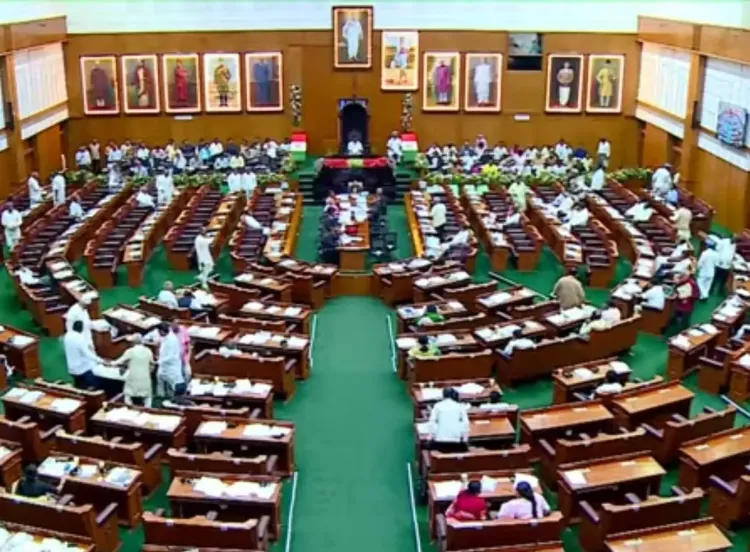
Belagavi, Dec 9 (NationPress) The JD(S) and BJP have criticized the Siddaramaiah administration in Karnataka regarding the presence of liquor in small ration shops. They mockingly suggested that the Congress government should consider online sales of alcohol.
During the Question Hour on Tuesday, JD(S) floor leader C. B. Suresh Babu highlighted the contradiction of the government providing Rs 2,000 monthly to women heads of households through the Gruha Laxmi scheme, only for it to be spent on liquor.
He noted that family members, particularly men, often misuse these funds for alcohol purchases.
"In rural areas, we see young children falling prey to alcohol addiction, causing distress in families. Shouldn't the government ponder over these pressing issues?" he inquired.
Senior BJP MLA S. Sureshkumar pointed out that the government had acknowledged this issue in a written response.
"Liquor has been accessible in small shops for an extended period. Instead of this, I propose the government utilize online platforms to deliver liquor directly to consumers' homes. What on earth is happening in our state?" he questioned.
In response, Minister for Excise R.B. Timmapur stated, "The government is actively conducting raids to control this issue. Only a limited number of incidents are reported, and we will address them accordingly."
Suresh Babu countered that the situation is far from minor, alleging that the government has established sales targets for the Excise Department.
"They assert that sales targets are set per taluk, leading to liquor being sold in small and ration shops. In every village, this has become a significant problem, even affecting Class 10 students who are succumbing to addiction," he claimed.
Minister Timmapur insisted that no targets exist.
"Sales are determined by demand and supply," he clarified.
However, senior BJP MLA V. Sunil Kumar opposed this statement, asserting that the government has established a sales target of Rs 43,000 crore for the Excise Department, which creates pressure to sell more. "Let the minister confirm this in the House," he demanded.
Timmapur reiterated that no targets were set.
"We only have approximate sales figures. Even in Gujarat, where liquor is prohibited, it is accessible in shops. It is prevalent across the nation, and we are working to control it," he added.
Speaker U.T. Khader advised him to focus on Karnataka instead of citing Gujarat as an example.
Deputy Chief Minister D.K. Shivakumar interjected, stating that nearly everything, including medications, can now be ordered online and delivered to doorsteps.
"What assurance do we have that liquor is not being supplied in this manner? It is available—maybe not through official channels. I have become aware of these practices. In the coastal regions, even when bar licenses are revoked, liquor continues to be supplied to beaches. In my opinion, it would be wiser to issue licenses. This is merely my personal perspective," he stated.
He added, "They also say that keeping more than seven liquor bottles at home is prohibited. Every visitor brings a bottle. If authorities investigate, I could face legal issues. These regulations should be regularized and warrant discussion."
BJP MLA Suresh Kumar disagreed, asserting, "If my information is accurate, drugs are being distributed via gig workers. The government must not appear powerless. Society is deteriorating, and youth are being harmed. Are they unaware of who is behind this?" he questioned.
State Home Minister G. Parameshwara replied, "Sureshkumar is a senior leader, and his claim that drugs are being delivered through platforms like Swiggy and Zomato is serious. He should provide us with this information. The Karnataka CM has announced plans to make the state drug-free. We have initiated significant operations, confiscating narcotics worth billions. This is not a trivial matter, and I urge you to share the details."
Point of View
It is crucial to present an unbiased view of the ongoing debate surrounding liquor sales in Karnataka. The concerns raised by the JD(S) and BJP highlight significant social issues affecting families and youth. While the government asserts control measures, the call for accountability and effective regulation remains paramount in ensuring community welfare.
NationPress
6 Oct 2026
Frequently Asked Questions
What are the main concerns raised by the JD(S) and BJP regarding liquor sales?
They are concerned that liquor availability in small ration shops undermines welfare programs and increases addiction among youth.
What solution did BJP MLA S. Sureshkumar propose?
He suggested that the government should utilize online platforms for liquor sales instead of allowing it in small shops.
How did the Karnataka government respond to these concerns?
The government asserted that they are conducting raids to control illegal liquor sales and denied setting any sales targets for the Excise Department.