CM Shivakumar Vows New Law to Protect Karnataka Apartment Owners

Synopsis
Chief Minister D.K. Shivakumar announced on 15 July 2026 that the Karnataka government will introduce a law to protect apartment owners' legal, property, and civic rights, following persistent complaints over e-Khata delays, property tax issues, and slow building approvals. The announcement followed a direct consultation with apartment owners' associations.
Key Takeaways
Shivakumar announced a new law to protect the legal, property, and civic rights of apartment owners in Karnataka .
Key grievances driving the legislation include delays in e-Khata issuance, property tax assessment concerns, slow building approvals, and poor inter-departmental coordination.
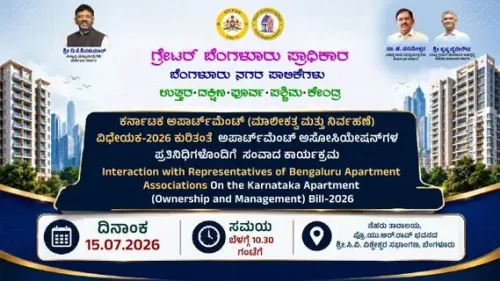
The government held a consultation with apartment owners' associations on 15 July 2026 as a step toward shaping the draft legislation.
Karnataka RERA and BBMP are among the existing bodies whose functioning is central to the complaints being addressed.
The proposed law follows Karnataka's existing framework under the Karnataka Ownership Flats Act and the central Real Estate (Regulation and Development) Act, 2016 .
The legislation, once drafted, will be introduced in the Karnataka legislature ; rules on grievance mechanisms and single-window clearances are being watched.
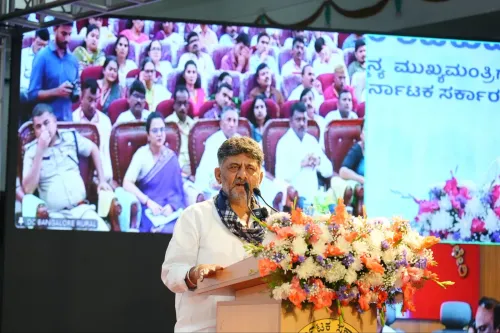
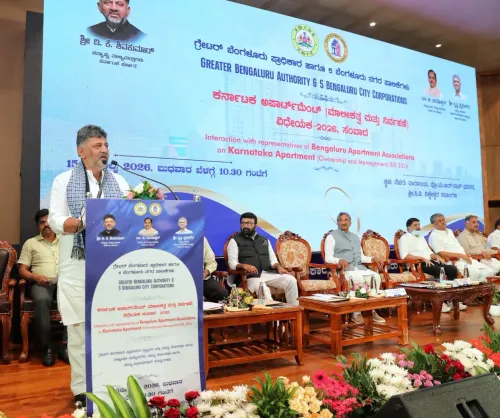
The Chief Minister's Office of Karnataka on Wednesday, 15 July 2026, shared a statement from Chief Minister D.K. Shivakumar announcing the government's intent to introduce a dedicated law protecting the legal, property, and civic rights of apartment owners in the state. The announcement came on the occasion of a consultation meeting between the Chief Minister and apartment owners' associations.
Context
In his statement, CM Shivakumar acknowledged that his office had received 'several representations from apartment owners and residents' covering a range of persistent issues: delays in the issuance of e-Khatas, concerns over property tax assessments, slow building approvals, inadequate grievance redressal, and poor coordination among government departments. He described these as 'genuine issues that deserve timely and effective solutions.'
The Chief Minister grounded the announcement in an empathetic framing, noting that 'for many families, purchasing an apartment is the result of decades of hard work, sacrifice and savings,' and asserting that 'every homeowner deserves the confidence that their investment is secure.'
Policy Backdrop
Karnataka's apartment governance framework has historically rested on the Karnataka Ownership Flats Act from the 1970s, supplemented over the decades by municipal reforms and, more recently, by state-level implementation of the central Real Estate (Regulation and Development) Act, 2016. The Karnataka Real Estate Regulatory Authority (RERA) was established under that central mandate to oversee project registrations and buyer protections.
The e-Khata initiative — a digitisation drive for electronic property title documents — was introduced to reduce paperwork and title disputes in urban areas, but implementation delays have drawn sustained complaints from flat owners, particularly in Bengaluru. The Bruhat Bengaluru Mahanagara Palike (BBMP), which handles building plan approvals and property tax assessments across the city, has been a focal point of many of these grievances.
Across Indian states, rapid urbanisation in metros has prompted progressive legislative updates on apartment ownership, municipal service delivery, and digital governance — a broader pattern that Karnataka's proposed law would follow.
Stakeholders and Impact
The proposed legislation is positioned to directly benefit apartment owners and home buyers across Karnataka, a constituency that has grown substantially as Bengaluru expanded into one of India's largest urban centres. Apartment owners' associations, which participated in today's consultation, are being positioned as active stakeholders in shaping the draft law.
CM Shivakumar described the day's interaction as 'an important step towards shaping this legislation through meaningful consultations and ensuring that it addresses the real concerns and aspirations of homeowners.' The consultation-first approach signals an attempt to build legislative legitimacy before the bill is tabled.
What's Next
The immediate next step is the drafting and introduction of the proposed bill in the Karnataka legislature. Observers will watch for whether the law mandates a single-window clearance mechanism for building approvals, prescribes timelines for e-Khata issuance, or creates a dedicated grievance redressal authority for apartment-related disputes. Rules notified under the eventual Act will determine how effectively the protections reach individual homeowners on the ground.
If enacted, Karnataka's law could serve as a model for other urbanising states grappling with similar backlogs in property documentation and civic approvals — continuing the national trend of state-level legislative responses to urban housing governance challenges.
Point of View
BBMP delays, and opaque property tax assessments — into a legislative promise ahead of any potential electoral cycle. By framing apartment buyers as hardworking families whose life savings are at stake, the government is building an emotional and moral case for a law that could also reduce friction with the influential apartment-owners' lobby in Bengaluru. The consultation-first approach mirrors a broader national trend of states seeking legislative legitimacy through stakeholder dialogue before tabling urban housing bills. Whether the law delivers structural reform or remains a symbolic gesture will depend entirely on the enforcement architecture written into its rules.
NationPress
13 Oct 2026
Frequently Asked Questions
What is the new Karnataka apartment owners law about?
The Karnataka government has announced plans to introduce a law that will protect the legal, property, and civic rights of apartment owners, addressing issues such as e-Khata delays, property tax disputes, slow building approvals, and grievance redressal gaps.
What is an e-Khata and why are there delays?
An e-Khata is an electronic property title document issued by urban local bodies in Karnataka as part of a digitisation initiative. Delays in its issuance have been widely reported, particularly in Bengaluru, leaving apartment owners without formal property records needed for transactions and civic services.
What role does BBMP play in apartment owner grievances?
The Bruhat Bengaluru Mahanagara Palike (BBMP) is responsible for building plan approvals and property tax assessments in Bengaluru. Delays and inconsistencies in these functions have been a primary source of complaints from apartment residents and owners.
How does Karnataka RERA relate to apartment buyer protection?
Karnataka RERA , established under the central Real Estate (Regulation and Development) Act of 2016 , oversees project registrations and builder disclosures. The proposed new law is expected to complement RERA by addressing post-possession civic and property rights issues not fully covered by existing regulations.
When will the Karnataka apartment owners protection bill be introduced?
No specific date has been announced yet. The government is currently in a consultation phase with apartment owners' associations, and the draft bill is expected to be introduced in the Karnataka legislature after this process concludes.