Kerala BJP escalates CMRL-Exalogic attack, targets UDF over Crime Branch probe
Synopsis
The CMRL-Exalogic case has ignited a fresh political firestorm in Kerala, with BJP's former top cop R. Sreelekha and ex-vice-chancellor K.S. Radhakrishnan accusing the UDF government of shielding CPI(M) leaders by routing a probe through the Crime Branch instead of launching a full criminal investigation — directly naming Pinarayi Vijayan, his daughter Veena, and MLA Mohammed Riyas.
Key Takeaways
Senior BJP leaders R.
Radhakrishnan attacked the UDF government on 23 September over the CMRL-Exalogic case.
Sreelekha , former Kerala DGP and now a BJP councillor, alleged the government used the Lalitha Kumari judgment to order a fresh preliminary probe via the Crime Branch rather than act on prior ED findings.
Radhakrishnan named former CM Pinarayi Vijayan , his daughter Veena , and CPI(M) MLA Mohammed Riyas as figures implicated in the ED material.
Satheesan defended the process, saying the ED material was sent to the State Police Chief before any further steps were taken.
The BJP is demanding a full criminal investigation; CPI(M) has described the targeting of its leaders as politically motivated.
A fresh political confrontation has erupted in Kerala over the CMRL-Exalogic case, with two senior Bharatiya Janata Party (BJP) leaders on Wednesday, 23 September sharply questioning the United Democratic Front (UDF) government's decision to entrust a preliminary investigation to the Crime Branch rather than pursue a full criminal probe. The controversy centres on alleged irregular payments by Cochin Metro Rail Limited (CMRL) to Exalogic Solutions, a matter that has already drawn scrutiny from central agencies.
Sreelekha's Salvo: 'UDF Does Not Intend to Do Much'
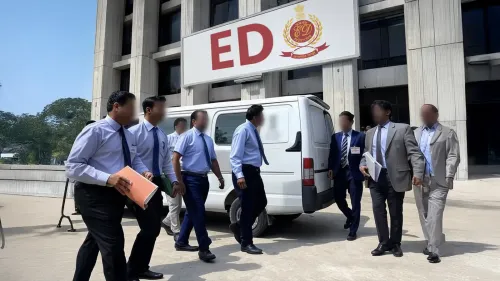
R. Sreelekha, former Kerala Director General of Police — the first woman to head the state police force — and now a BJP councillor in the Thiruvananthapuram Corporation, said the government's move signalled a lack of seriousness. In a social media post, she noted that after the Enforcement Directorate (ED) had investigated and identified an offence in the monthly-payment case, the state had ordered yet another preliminary probe by invoking the Lalitha Kumari judgment — and had assigned it not to the Vigilance department but to the Crime Branch under the Police Department.
'What this makes clear is that the UDF government does not intend to do much in this matter. After all, it is the 'Indi alliance', isn't it? What else can one expect?' she said.
Radhakrishnan Raises Stakes, Names Vijayan and Family
Shortly before Sreelekha's remarks, senior BJP leader and former Kerala vice-chancellor K.S. Radhakrishnan alleged that the ED material forwarded to the State Police Chief raised serious questions about former Chief Minister and current Leader of the Opposition Pinarayi Vijayan, his daughter Veena, and former minister and Communist Party of India (Marxist) [CPI(M)] MLA Mohammed Riyas. Radhakrishnan argued that the government had deliberately delayed criminal investigation while seeking legal opinions on procedural steps.
He further contended that a vigilance inquiry could not substitute for a criminal investigation where the material disclosed a cognisable offence. A proper criminal process, he said, entails collecting evidence, examining witnesses, establishing the accused's link to the alleged offence, filing a charge sheet, and letting the courts adjudicate. Radhakrishnan also referred to statements recorded by the ED under Section 50 of the Prevention of Money Laundering Act (PMLA) and discussed the legal remedies available to anyone claiming such statements were coerced.
Government's Position: Process Was Followed
The state government has pushed back, maintaining that the Crime Branch referral followed a careful examination of the ED material and legal opinions obtained by the government. Chief Minister V.D. Satheesan said there was no undue haste and that the ED material was forwarded to the State Police Chief before any further action was taken. The government has not responded directly to the BJP's demand for a full criminal investigation.
The CMRL-Exalogic Case: Where It Stands
The controversy originated with allegations over payments made by CMRL to Exalogic Solutions and has already traversed investigations and legal proceedings before multiple agencies. The state's decision to move the matter to the Crime Branch marks a new chapter in a case that has been politically contentious since its inception. The CPI(M) is reportedly preparing to defend its leaders against what it characterises as politically motivated targeting.
What Comes Next
With the BJP pressing for a full criminal probe and the ruling coalition defending its procedural approach, the CMRL-Exalogic case is set to remain a major flashpoint in Kerala politics in the weeks ahead. The outcome of the Crime Branch's preliminary inquiry will likely determine whether the matter proceeds to a formal First Information Report — and whether opposition pressure forces the government's hand before that threshold is reached.
Point of View
Rather than Vigilance or a direct FIR, structurally limits the investigation's reach. If the ED has already identified an offence, ordering a fresh 'preliminary inquiry' can function as a slow lane. Chief Minister Satheesan's 'no undue haste' defence is unlikely to satisfy critics who see the delay itself as the story. How the Crime Branch inquiry progresses — and whether it converts to a formal FIR — will be the real test of the government's intent.
NationPress
23 Sept 2026
Frequently Asked Questions
What is the CMRL-Exalogic case in Kerala?
The CMRL-Exalogic case involves allegations of irregular payments made by Cochin Metro Rail Limited (CMRL) to Exalogic Solutions. The Enforcement Directorate investigated the matter and reportedly identified an offence, after which the Kerala government ordered a fresh preliminary inquiry by the Crime Branch.
Why is the BJP attacking the Kerala government over the Crime Branch probe?
BJP leaders argue that routing the inquiry through the Crime Branch — rather than initiating a full criminal investigation — amounts to shielding accused individuals. They contend that where the ED has already identified a cognisable offence, a preliminary inquiry is an unnecessary procedural delay.
Who are the individuals named in the CMRL-Exalogic controversy?
Senior BJP leader K.S. Radhakrishnan alleged that the ED material implicates former Chief Minister Pinarayi Vijayan, his daughter Veena, and CPI(M) MLA Mohammed Riyas. These allegations have not been independently verified and are contested by the CPI(M).
What is the Kerala government's position on the Crime Branch referral?
Chief Minister V.D. Satheesan has said the decision was procedurally sound, taken after examining the ED material and obtaining legal opinions. He said the material was forwarded to the State Police Chief before the government proceeded further, and denied any undue haste.
What happens next in the CMRL-Exalogic case?
The Crime Branch will conduct its preliminary inquiry; if it finds sufficient grounds, the matter could proceed to a formal First Information Report and full criminal investigation. The BJP has vowed to keep up political pressure for a comprehensive probe.