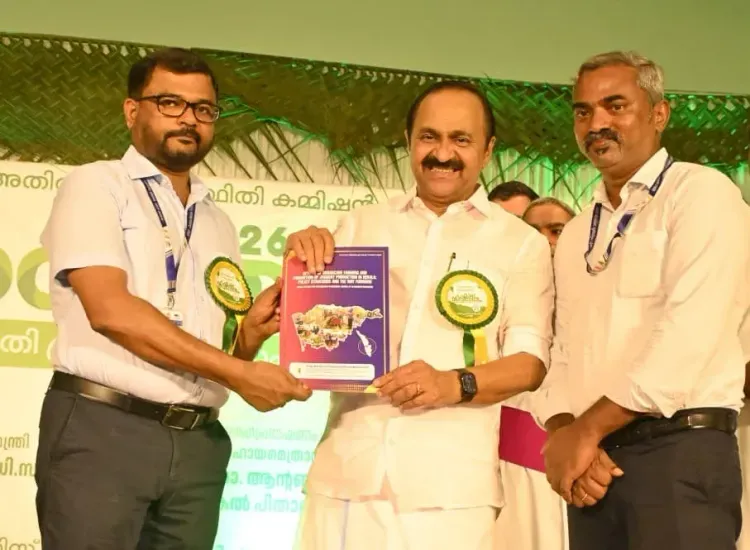
Kerala CM Satheesan receives CMFRI blueprint for statewide jaggery revival
Synopsis
CMFRI's Ernakulam KVK has handed Kerala CM Satheesan a detailed blueprint to scale the Alangad Jaggery Revival Model statewide — combining scientific sugarcane cultivation, ₹20 lakh micro-processing units, and district-level branding into a rural income model that could reshape Kerala's farm economy from the ground up.
Key Takeaways
ICAR-CMFRI's Ernakulam KVK submitted a jaggery revival policy document to Kerala CM V.D.
Satheesan in June 2025 .
The proposal is based on the Alangad Jaggery Revival Model , operational since 2022 , which has achieved 16 tonnes per acre sugarcane yield.
A one-tonne-per-day processing unit requires an investment of approximately ₹20 lakh and can be sustained by cultivation across 20 acres of fragmented holdings.
The blueprint recommends a special mission integrating government bodies, research institutions, farmer organisations, and financial institutions.
Additional proposals include district-level jaggery brands , decentralised processing facilities, scientific farmer training, and agri-tourism development.
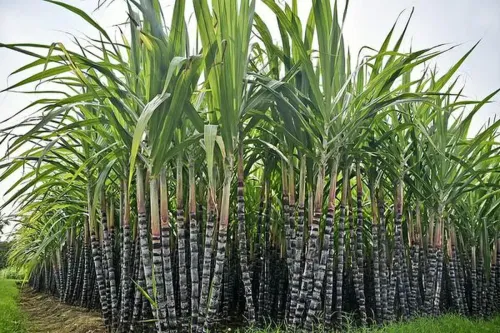
The Ernakulam Krishi Vigyan Kendra (KVK) of the ICAR-Central Marine Fisheries Research Institute (CMFRI) has submitted a comprehensive policy document to Kerala Chief Minister V.D. Satheesan, recommending a statewide programme to promote scientific sugarcane cultivation and village-level jaggery production units. The proposal, grounded in the success of the Alangad Jaggery Revival Model implemented since 2022, outlines a roadmap to deliver adulteration-free jaggery while generating new income streams for farmers and rural entrepreneurs across Kerala.
The Alangad Model: Proof of Concept
The policy blueprint draws directly from the Alangad initiative, which has recorded an average sugarcane yield of 16 tonnes per acre — a benchmark the KVK believes is replicable across suitable regions of the state. The model demonstrates that linking field-level sugarcane cultivation with micro-processing infrastructure can create a self-sustaining agricultural value chain. KVK Head Dr Shinoj Subrahmanian personally handed over the document to the Chief Minister, positioning Alangad as a template for broader rural development.
Unit Economics and Investment Requirement
According to the document, a processing unit capable of crushing one tonne of sugarcane per day can yield jaggery equivalent to roughly 10 per cent of the cane's total weight, making small-scale operations both technically viable and financially sustainable. Establishing such a unit would require an estimated investment of ₹20 lakh. The KVK calculates that a phased cultivation spread across approximately 20 acres — even through small and fragmented landholdings — would be sufficient to supply a one-tonne-per-day unit and ensure year-round production continuity.
Key Recommendations in the Blueprint
The policy document calls for the formation of a special mission that would bring together government departments, research institutions, local self-government bodies, farmer organisations, financial institutions, and entrepreneurs. This convergence body would oversee the integration of sugarcane cultivation, jaggery processing, and value-added product development, while also exploring agri-tourism as an ancillary revenue stream. Additional recommendations include identifying new regions suitable for sugarcane cultivation, providing scientific training to farmers, establishing decentralised processing facilities, and developing district-level jaggery brands backed by structured marketing networks.
Wider Significance for Kerala's Farm Sector
Kerala's agricultural economy has long grappled with fragmented landholdings, low farm incomes, and dependence on a narrow set of cash crops. The CMFRI-KVK proposal attempts to address these structural weaknesses by creating a replicable agri-processing model that works within the state's land constraints. Notably, the recommendation to build decentralised units rather than large centralised mills is a deliberate design choice — it lowers entry barriers for individual farmers and rural entrepreneurs. This comes amid growing consumer demand for chemical-free, traceable food products, which gives authentic, locally produced jaggery a distinct market advantage. How the Satheesan government responds to the blueprint — and whether it allocates budgetary support for a formal mission — will determine whether the Alangad model remains a local success story or becomes the foundation of a statewide agricultural transformation.
Point of View
It asks the state to build processing infrastructure around what farmers already have. What the blueprint does not address is the market-side risk — jaggery faces stiff price competition from cheaper, often adulterated substitutes, and district-level branding alone will not guarantee premium pricing without a credible certification and distribution mechanism. The real test will be whether the Satheesan government treats this as a budget line or a mission with teeth.
NationPress
25 Jun 2026
Frequently Asked Questions
What is the CMFRI jaggery revival blueprint submitted to Kerala CM Satheesan?
It is a policy document prepared by the Ernakulam Krishi Vigyan Kendra of ICAR-CMFRI, recommending a statewide programme for scientific sugarcane cultivation and village-level jaggery production. The blueprint is modelled on the Alangad Jaggery Revival Model, which has been operational since 2022 and has achieved yields of 16 tonnes per acre.
What is the Alangad Jaggery Revival Model?
The Alangad model is a KVK-led initiative in Kerala's Ernakulam district that links sugarcane cultivation with micro-processing units to produce adulteration-free jaggery. Running since 2022, it has demonstrated an average yield of 16 tonnes per acre and serves as the proof-of-concept for the statewide proposal.
How much does it cost to set up a jaggery processing unit under this model?
According to the KVK document, establishing a unit capable of crushing one tonne of sugarcane per day requires an investment of approximately ₹20 lakh. Such a unit can be sustained by sugarcane cultivation spread across around 20 acres, including small and fragmented holdings.
What does the blueprint recommend for scaling up jaggery production in Kerala?
The document recommends forming a special mission that integrates government departments, research bodies, local self-government, farmer organisations, and financial institutions. It also calls for district-level jaggery branding, decentralised processing facilities, scientific farmer training, and exploration of agri-tourism opportunities.
Who presented the policy document to the Chief Minister?
KVK Head Dr Shinoj Subrahmanian handed over the policy document to Chief Minister V.D. Satheesan, presenting the Alangad model as a potential template for a new rural development initiative across Kerala.