What Are the Three Key Objectives of the Upcoming ‘AI Impact Summit’ in Davos?

Synopsis
As the AI Impact Summit approaches in New Delhi, India aims to redefine its role on the global stage through a focus on impact, accessibility, and safety in AI. With significant investments and innovations, this summit promises to shape the future of AI for India and the world.
Key Takeaways
Impact: Using AI to enhance economic efficiency and productivity.
Accessibility: Ensuring AI solutions are available for India and the Global South.
Safety: Developing guidelines and safety measures to mitigate AI risks.
Investment: Anticipated announcements of significant investments in AI.
Global Collaboration: Partnerships with leading tech firms to advance AI development.
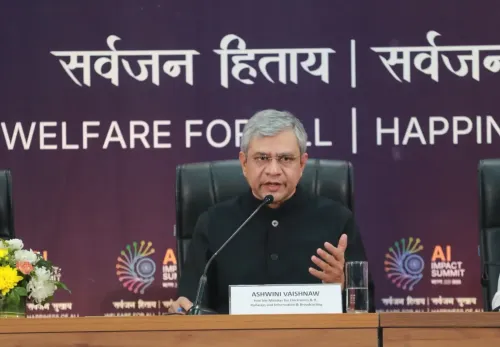
Davos, Jan 21 (NationPress) The forthcoming AI Impact Summit in New Delhi next month is set with a distinct emphasis on three main objectives, as India increasingly establishes itself as a reliable global partner through its sovereign models, safety frameworks, and robust semiconductor ecosystem, according to Union Minister Ashwini Vaishnaw.
The primary goal of the Summit is impact — examining how AI models, applications, and the entire AI ecosystem can enhance efficiency, boost productivity, and generate a multiplier effect on the economy.
Accessibility is the second key objective, particularly for India and the Global South, Vaishnaw pointed out.
He drew comparisons to India's achievements with UPI and the Digital Public Infrastructure (DPI) stack, suggesting that the world is now looking to India to determine whether a similar, scalable, and affordable framework can be established for AI.
The final objective highlighted by Vaishnaw is safety. He underscored the importance of addressing concerns surrounding AI by instituting suitable guardrails, guidelines, and safety measures. He asserted that India should also develop its regulatory and safety framework for AI.
The AI Impact Summit will attract global leaders and tech innovators, with announcements regarding investments and the launch of India’s AI models.
With nearly 200,000 startups, India ranks among the top three global startup ecosystems. The minister emphasized that 24 Indian startups are engaged in chip design, a challenging area for startups, with 18 having secured venture capital funding, demonstrating strong confidence in India's deep-tech capabilities.
Vaishnaw elaborated on India’s semiconductor strategy, stating that approximately 75% of global chip volume is within the 28nm to 90nm range, which includes applications in electric vehicles, automotive, railways, defense systems, telecom, and a significant portion of consumer electronics.
India aims to master manufacturing in this segment before moving to advanced nodes. Collaborating with industry partners like IBM, India has a well-outlined plan to progress from 28nm to 7nm by 2030, and 3nm by 2032.
Additionally, Vaishnaw met with Google Cloud CEO Thomas Kurian in Davos, where Google reaffirmed its commitment to India’s AI ecosystem, including a $15 billion AI data center in Vizag, Andhra Pradesh, and collaborations with Indian startups. He also discussed social media safety from deepfakes and AI-generated content with Joel Kaplan, Chief Global Affairs Officer at Meta.
Point of View
This summit represents a significant moment for India to assert its influence in the global AI arena. By focusing on impact, accessibility, and safety, India is not just participating in the AI race but leading it. This is a strategic move that aligns with the nation's vision of being a technological powerhouse.
NationPress
16 Sept 2026
Frequently Asked Questions
What are the main objectives of the AI Impact Summit?
The AI Impact Summit aims to focus on three key objectives: impact on the economy through AI, accessibility for India and the Global South, and safety measures to address concerns surrounding AI technologies.
Why is India focusing on AI and semiconductors?
India is enhancing its AI capabilities to position itself as a global leader in technology and innovation. The focus on semiconductors is crucial for supporting AI development and ensuring a robust tech ecosystem.
What role do startups play in India's AI strategy?
With nearly 200,000 startups, India is fostering innovation in AI and technology. Notably, 24 startups are designing chips, indicating a vibrant deep-tech sector that is gaining venture capital support.