Arunachal CM Pema Khandu pushes NE universities to become problem-solving hubs
Synopsis
At the first-ever Vice-Chancellors' Roundtable of Northeast Universities in Pasighat, Arunachal Pradesh CM Pema Khandu laid out an ambitious blueprint — a Northeast Higher Education Consortium, AI-enabled campuses, Centres of Excellence for indigenous knowledge, and university-based startup ecosystems. The pitch: stop producing degree-holders and start producing solutions to the region's real challenges.
Key Takeaways
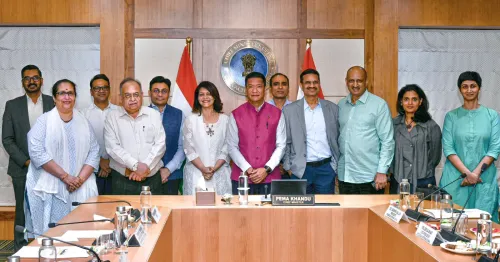
Arunachal Pradesh CM Pema Khandu addressed the first-ever Roundtable of Vice-Chancellors of Northeast Universities at RRU, Pasighat on 10 August .
He called on Northeast universities to evolve into 'problem-solving institutions' addressing developmental, social, environmental and strategic challenges.
Khandu proposed a Northeast Higher Education Consortium for joint research, faculty exchange and shared digital resources.
He advocated for AI-enabled academic ecosystems with applications in remote education, disaster prediction and biodiversity monitoring.
Universities were urged to establish Centres of Excellence for Indigenous Knowledge and Tribal Studies and become hubs for entrepreneurship and startup activity.
The roundtable, themed 'Transforming Higher Education: Innovations, Collaborations and Strategies for a Future-Ready India' , is expected to run for two days.
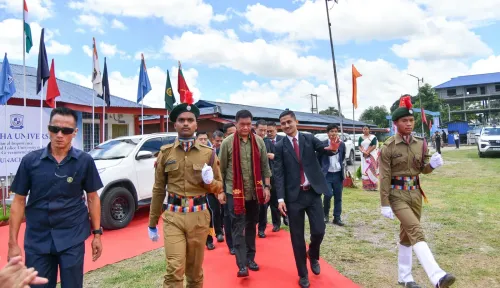
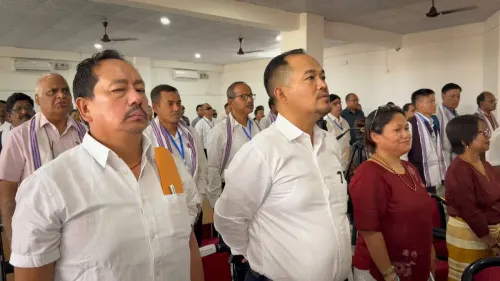
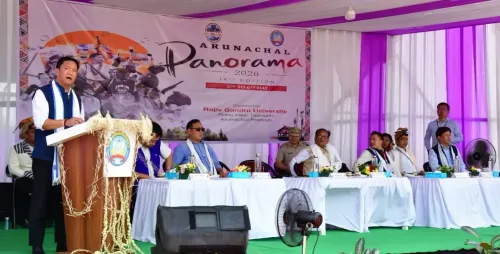
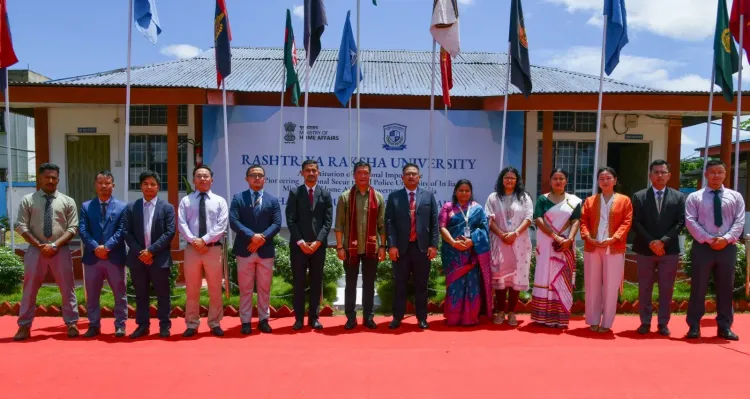
Arunachal Pradesh Chief Minister Pema Khandu on Monday, 10 August called on universities across the Northeast to shed their conventional degree-factory model and transform into 'problem-solving institutions' equipped to tackle the region's developmental, social, environmental and strategic challenges. He was speaking at the inaugural session of the first-ever Roundtable of Vice-Chancellors of Northeast Universities, held at the Rashtriya Raksha University (RRU) campus in Pasighat, Arunachal Pradesh.
Key Developments at the Pasighat Roundtable
The two-day roundtable, themed 'Transforming Higher Education: Innovations, Collaborations and Strategies for a Future-Ready India', brought together Vice-Chancellors, academicians, experts and representatives of the Association of Indian Universities (AIU) and RRU. Khandu stressed that the gathering must produce concrete institutional partnerships, actionable ideas and measurable outcomes — not merely deliberations.
He underscored that higher education in Arunachal Pradesh must respond to the state's distinctive realities: frontier and border-area development, tribal communities, biodiversity, climate change, cultural preservation, rural livelihoods, tourism, connectivity and national security.
What Khandu Said: Universities as Living Laboratories
Calling for a fundamental shift in the purpose of universities, Khandu said research must increasingly focus on real-life challenges. 'Universities should become laboratories where local challenges are converted into research questions and research outcomes are converted into practical solutions,' he said.
He encouraged institutions to forge partnerships with government departments, industries, defence and security establishments, local communities and civil society — spanning areas such as sustainable agriculture, bamboo and cane, handloom and handicrafts, border-area development, disaster management, eco-tourism, renewable energy, indigenous knowledge and public health.
Khandu also called for universities to become early adopters of artificial intelligence and digital technologies. He proposed AI-enabled academic ecosystems for personalised learning, student assessment, research assistance, language technologies and administrative efficiency. For Arunachal Pradesh specifically, he said AI could drive transformative applications in remote education, multilingual learning, disaster prediction, biodiversity monitoring and healthcare delivery.
Proposals: Consortium, Centres of Excellence and Startup Ecosystems
Among his concrete proposals, Khandu called for the creation of a Northeast Higher Education Consortium — a cross-regional body for joint research, faculty exchange, student mobility, shared laboratories and common digital resources. He also suggested establishing Centres of Excellence for Indigenous Knowledge and Tribal Studies, bringing together interdisciplinary research across anthropology, science, technology, environment and economics.
'Indigenous knowledge should not be treated merely as heritage. Wherever scientifically appropriate, it should be explored for contemporary applications and livelihood generation,' he said.
On entrepreneurship, Khandu urged institutions to become incubators of ideas rather than consumers of government employment, identifying tourism, agri-business, food processing, bamboo, handicrafts, textiles, clean energy, digital services and indigenous products as sectors with considerable entrepreneurial potential in the state.
RRU Campus and the Act East Policy Angle
Referring to RRU's presence in Pasighat, Khandu described it as a strategic opportunity for Arunachal Pradesh and the wider Northeast. He said the campus could develop into a regional centre for national security education, research and capacity building — with potential collaboration in border management, cyber security, drone technology, disaster response, forensic science, counter-terrorism studies, community policing and strategic studies.
On internationalisation, Khandu argued it should go beyond sending students abroad and instead bring global knowledge, research partnerships, faculty collaborations and international exposure to Northeast campuses. He encouraged universities to develop joint programmes with institutions in South and Southeast Asia, leveraging the region's strategic position under India's Act East policy.
What Comes Next
Khandu proposed that each technical session identify a major challenge, three practical interventions, a lead institution and a clear implementation timeline. He also recommended that the Vice-Chancellors' Roundtable be institutionalised as an annual process to ensure continuity, follow-up and measurable progress. The roundtable's second day is expected to deliberate further on innovation, institutional collaboration, research, entrepreneurship and digital transformation across the Northeast's higher education landscape.
Point of View
Annual Vice-Chancellors' roundtables, session-level implementation timelines. That granularity is rare in policy addresses and suggests a deliberate attempt to avoid the fate of similar higher-education reform rhetoric that has circulated in the region for decades without institutional follow-through. The harder question is whether the universities in attendance have the autonomy, funding and administrative capacity to act on these proposals, or whether they remain dependent on state and central allocation cycles that rarely reward academic risk-taking. The RRU-Pasighat angle is also worth watching: positioning a national security university as a regional anchor for border management and cyber research is a quiet but significant strategic signal in a state that shares sensitive frontiers with China.
NationPress
25 Sept 2026
Frequently Asked Questions
What is the Roundtable of Vice-Chancellors of Northeast Universities?
It is the first-ever gathering of Vice-Chancellors from universities across India's Northeast, held at the Rashtriya Raksha University campus in Pasighat, Arunachal Pradesh on 10 August. The two-day roundtable focuses on transforming higher education through innovation, collaboration and strategies for a future-ready India.
What did CM Pema Khandu propose for Northeast higher education?
Khandu proposed a Northeast Higher Education Consortium for joint research and faculty exchange, Centres of Excellence for Indigenous Knowledge and Tribal Studies, AI-enabled academic ecosystems, and stronger university-based startup incubators. He also called for annual Vice-Chancellors' roundtables to ensure follow-up on outcomes.
What is the significance of RRU's campus in Pasighat?
Khandu described the Rashtriya Raksha University campus in Pasighat as a strategic opportunity for the Northeast, with potential to become a regional centre for national security education, border management research, cyber security, drone technology and counter-terrorism studies.
How does the Act East policy connect to Khandu's education proposals?
Khandu urged Northeast universities to leverage the region's geographic position under India's Act East policy by developing joint academic programmes and research partnerships with institutions in South and Southeast Asia, bringing global knowledge to campuses rather than only sending students abroad.
Who attended the Pasighat Vice-Chancellors' Roundtable?
The roundtable brought together Vice-Chancellors, academicians, experts and representatives of the Association of Indian Universities (AIU) and Rashtriya Raksha University (RRU), along with Arunachal Pradesh Chief Minister Pema Khandu who delivered the inaugural address.