Khattar hails India's podium sweep in Asian Para Games High Jump

Synopsis
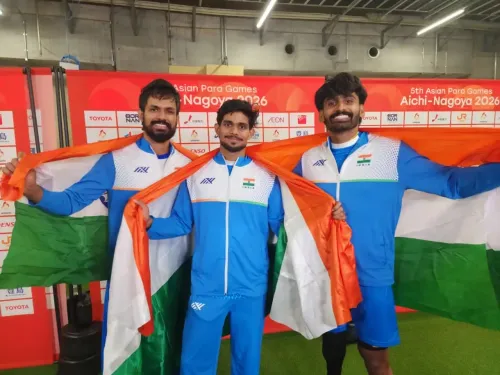
India's para-athletes Shailesh Kumar, Varun Bhati, and Rahul Saroha swept all three medals in the Men's High Jump T63 at the Asian Para Games 2026. Union Minister Manohar Lal Khattar hailed the historic clean sweep as proof of India's growing para-athletics strength.
Key Takeaways
Shailesh Kumar won gold, Varun Bhati silver, and Rahul Saroha bronze in Men's High Jump T63 at the Asian Para Games 2026 .
India achieved a complete podium clean sweep, locking out all three medals in the event.
Union Minister Manohar Lal Khattar celebrated the result on October 22, 2026 under the hashtag #Cheer4Bharat .
Varun Bhati is a seasoned para-athlete with a strong international medal record across multiple competitive cycles.
India's para-athletics has shown consistent growth at continental events over the past decade, backed by expanded training infrastructure.
The performances strengthen India's position heading into the 2028 Los Angeles Paralympics cycle.
Three athletes. One podium. Zero room for anyone else. Union Power Minister Manohar Lal Khattar celebrated a complete Indian clean sweep in the Men's High Jump T63 final at the Asian Para Games 2026 on Thursday, October 22, as Shailesh Kumar, Varun Bhati, and Rahul Saroha claimed gold, silver, and bronze respectively — locking out every step of the podium for Bharat.
Gold, silver, bronze — all three to India
The T63 category is contested by athletes with a single above-knee amputation or comparable leg impairment, making the high jump a test of explosive technique as much as raw power. Shailesh Kumar topped the field to take gold, with Varun Bhati — a para-athlete who has built a strong record of continental and global medals over the past decade — claiming silver, and Rahul Saroha completing the sweep with bronze. When a single nation fills every medal slot, it is not luck. It is depth.
Varun Bhati and the decade-long arc of Indian para-athletics
Varun Bhati is among the most recognised names in Indian para-athletics, having accumulated international hardware across multiple cycles. His presence on this podium — now as a silver medallist — signals the maturity of India's para-sports pipeline: newer names like Shailesh Kumar rise to the top while established athletes continue to deliver. That generational overlap is exactly what a healthy programme looks like.
India's gains in para-athletics at Asian and global events have been incremental but unmistakable over the past decade, backed by expanded domestic training infrastructure and sharper federation focus. The high jump, a discipline demanding both technical coaching and elite physical conditioning, has become a marker of that progress. A clean sweep at a continental championship is the kind of result that changes funding conversations and inspires the next cohort of para-athletes to step onto the track.
What the sweep signals for Paris-to-LA Paralympic cycle
With the 2028 Los Angeles Paralympics now firmly in the planning horizon, performances at the 2026 Asian Para Games serve as critical form guides for selectors and the Sports Authority of India. A medal is proof of potential; a sweep is a statement of dominance. Khattar, posting under the hashtag #Cheer4Bharat, called the achievement 'a moment of immense pride for the nation' and framed it as evidence of 'the growing strength of India's para-athletics.' The athletes — and the infrastructure behind them — have earned that framing.
India's para-sport story is no longer one of isolated breakthrough performances. It is becoming a pattern. And patterns, once established, are very hard to disrupt.
Point of View
Where veterans like Varun Bhati and emerging champions like Shailesh Kumar coexist on the same podium. For the BJP-led central government, moments like these align neatly with its broader 'Khelo India' and inclusive sports narrative, giving ministers like Khattar high-visibility moments to amplify. The real test, however, will be whether this continental dominance translates into Paralympic medals in Los Angeles 2028, where global competition is considerably stiffer. If India can sustain this depth, the para-athletics story may become one of the defining sporting chapters of the decade.
NationPress
22 Oct 2026
Frequently Asked Questions
Who won gold in Men's High Jump T63 at the Asian Para Games 2026?
Shailesh Kumar won the gold medal in Men's High Jump T63 at the Asian Para Games 2026, with Varun Bhati taking silver and Rahul Saroha claiming bronze.
What is the T63 classification in para-athletics high jump?
The T63 category is for athletes with a single above-knee amputation or comparable leg impairment who compete using a prosthetic leg in field events like high jump.
What did Manohar Lal Khattar say about India's Asian Para Games 2026 sweep?
Union Minister Manohar Lal Khattar called the clean sweep 'a moment of immense pride for the nation' and said it underscores 'the growing strength of India's para-athletics and the extraordinary talent of our para-athletes.'
Has Varun Bhati won medals at international para-athletics events before?
Varun Bhati is a well-established Indian para-athlete in the high jump T63 category with a record of international medals at continental and global events spanning multiple competitive cycles.
Where are the Asian Para Games 2026 being held?
The specific host city of the Asian Para Games 2026 was not detailed in the available information, but the event is the quadrennial multi-sport competition for Asian para-athletes organised under the Asian Paralympic Committee.