Khattar inaugurates Tower of Justice court complex in Gurugram
Synopsis
Union Minister Manohar Lal Khattar, Chief Justice of India Justice Suryakant, Union Minister Arjun Ram Meghwal, and Haryana CM Nayab Saini inaugurated the 'Tower of Justice' district court complex in Gurugram on 12 July 2026 — described as one of North India's largest, with technology-driven judicial infrastructure.
Key Takeaways
Union Minister Manohar Lal Khattar , Chief Justice of India Justice Suryakant , Union Minister Arjun Ram Meghwal , and Haryana CM Nayab Singh Saini jointly inaugurated the 'Tower of Justice' district court complex in Gurugram on 12 July 2026 .
The complex is described as one of the largest district court campuses in North India , equipped with judicial service centres, conference rooms, and technology-driven facilities.
The new infrastructure is designed to make judicial processes more transparent, secure, efficient, and citizen-friendly , in line with national court modernisation goals.
Construction workers who built the complex were publicly felicitated at the inauguration ceremony.
The project aligns with India's e-Courts Mission Mode Project (launched 2007), which drives ICT upgradation of district and subordinate courts nationwide.
Stakeholders will monitor the complex's impact on case disposal timelines in Gurugram, with potential for the model to be replicated across other Haryana districts.
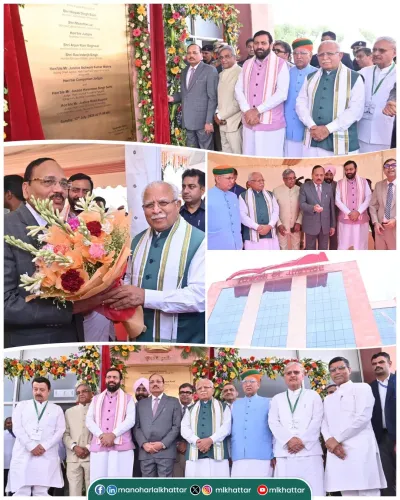
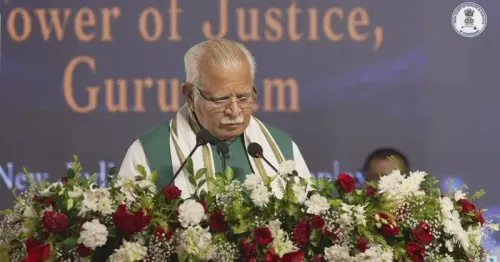
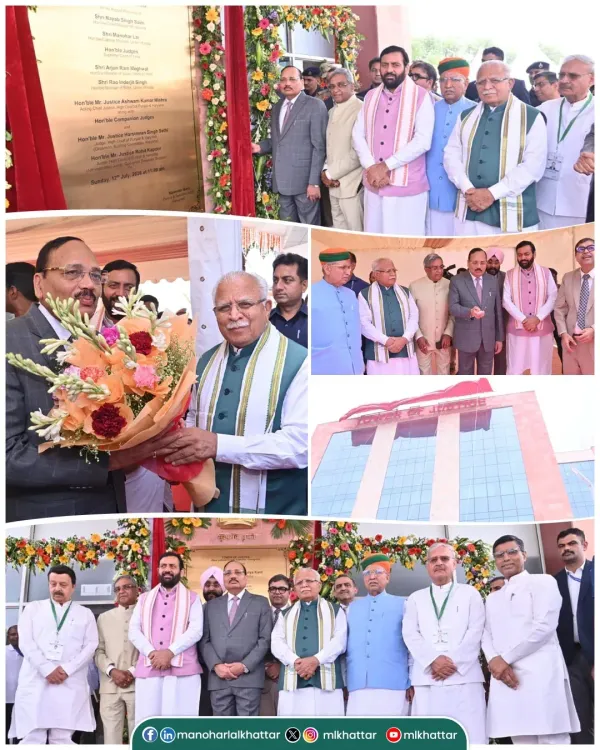
Union Power Minister Manohar Lal Khattar attended the inauguration of the newly constructed 'Tower of Justice' district court complex in Gurugram on Sunday, 12 July 2026, alongside Chief Justice of India Justice Suryakant, Union Minister Arjun Ram Meghwal, and Haryana Chief Minister Nayab Singh Saini.
Khattar shared the occasion on X, stating: 'Uttar Bharat ke sabse bade zila nyayalay parisar mein shamil yah aadhunik nyayik parisar...' — describing the complex as 'one of the largest district court campuses in North India,' equipped with state-of-the-art judicial service centres, conference halls, and technology-based facilities designed to make judicial processes 'more transparent, secure, efficient, and citizen-friendly.'
The minister also noted that workers who contributed to the construction of the complex were felicitated at the ceremony — a gesture he described as a meaningful recognition of their labour.
Context
Gurugram is one of India's fastest-growing urban centres, a major commercial and IT hub within the National Capital Region. Rapid population growth and economic activity have placed significant pressure on its judicial infrastructure, driving high volumes of litigation and demand for modern court facilities.
Khattar himself served as Chief Minister of Haryana from 2014 to 2024 before being elevated to the Union Cabinet, giving him a direct stake in the state's long-term development agenda. His presence at the inauguration underscores the political and administrative significance attached to the project.
Policy Backdrop
India's push to modernise district court infrastructure is rooted in the e-Courts Mission Mode Project, launched in 2007, which has driven the computerisation and ICT upgradation of subordinate courts across the country. The 'Tower of Justice' complex fits squarely within this national effort to reduce case pendency and improve access to justice.
Khattar described the complex as 'not merely a new building, but an important initiative towards an accessible, organised, and modern justice system.' The facility's integration of judicial service centres and technology-driven infrastructure reflects the broader national pattern of upgrading courts in high-growth urban districts.
Stakeholders and Impact
The primary beneficiaries are litigants, lawyers, and residents of Gurugram and surrounding Haryana districts who depend on district court services. A modern, technology-enabled campus is expected to reduce procedural delays and improve the experience of citizens navigating the judicial system.
The felicitation of construction workers at a high-profile government event also signals an effort to publicly acknowledge the labour force behind state infrastructure — a practice increasingly visible at government inaugurations. The presence of the Chief Justice of India at the ceremony lends the inauguration significant institutional weight, reflecting judicial branch endorsement of the upgraded infrastructure.
What's Next
Attention will now turn to whether the new complex delivers measurable improvements in case disposal timelines in Gurugram, one of the key metrics used to evaluate judicial infrastructure investments. Haryana's experience with the 'Tower of Justice' model could inform the rollout of similar modern court complexes in other districts of the state facing comparable pressures.
Khattar expressed confidence that the new campus would prove 'a milestone in delivering swift and easy justice to citizens' — a benchmark that stakeholders and the legal community will watch closely in the months ahead.
Point of View
And his attendance signals continuity of ownership over the state's development story. The presence of the Chief Justice of India elevates what could have been a routine ribbon-cutting into a statement of institutional alignment between the executive and judiciary on court modernisation. The felicitation of construction workers, while ceremonially modest, reflects a deliberate optics choice by the BJP government to associate infrastructure delivery with worker dignity. Gurugram's rapid urbanisation makes it a high-visibility test case: if the new complex demonstrably cuts case pendency, it becomes a replicable model that the party can cite ahead of future electoral cycles in Haryana.
NationPress
12 Jul 2026
Frequently Asked Questions
What is the Tower of Justice in Gurugram?
The 'Tower of Justice' is a newly inaugurated district court complex in Gurugram, described as one of the largest in North India. It features state-of-the-art judicial service centres, conference halls, and technology-based facilities aimed at making court processes more transparent, efficient, and citizen-friendly.
Who inaugurated the Tower of Justice court complex?
The complex was inaugurated on 12 July 2026 in the presence of Chief Justice of India Justice Suryakant, Union Minister Manohar Lal Khattar, Union Minister Arjun Ram Meghwal, and Haryana Chief Minister Nayab Singh Saini.
What is the e-Courts Mission Mode Project?
The e-Courts Mission Mode Project was launched in 2007 to provide ICT infrastructure and computerisation to district and subordinate courts across India. The Gurugram 'Tower of Justice' complex aligns with this national initiative to modernise judicial infrastructure.
Why is Gurugram getting a new district court complex?
Gurugram is one of India's fastest-growing urban and commercial centres within the National Capital Region. Rapid population and economic growth have increased litigation volumes significantly, creating demand for a larger, more modern judicial facility.
What role does Manohar Lal Khattar play in Haryana's development?
Manohar Lal Khattar served as Chief Minister of Haryana from 2014 to 2024 before becoming Union Minister of Power and Housing and Urban Affairs. He retains a close association with the state's infrastructure and governance agenda.