Khattar Pays Tribute on INA Foundation Day
Synopsis
Union Minister Manohar Lal Khattar marked the Azad Hind Fauj Foundation Day by honouring Netaji Subhas Chandra Bose and INA fighters, recalling their historic 1943 hoisting of the tricolour in the Andaman and Nicobar Islands as an eternal 'nation-first' inspiration.
Key Takeaways
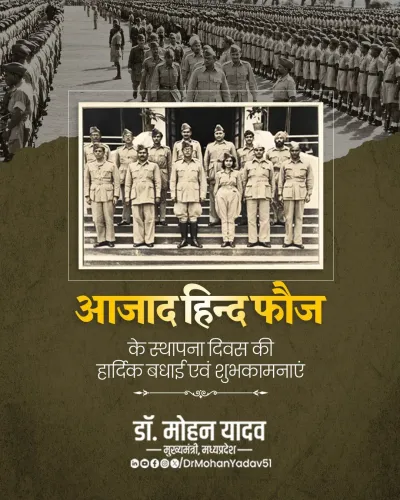
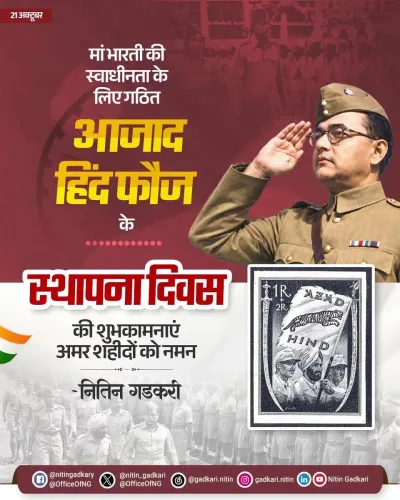
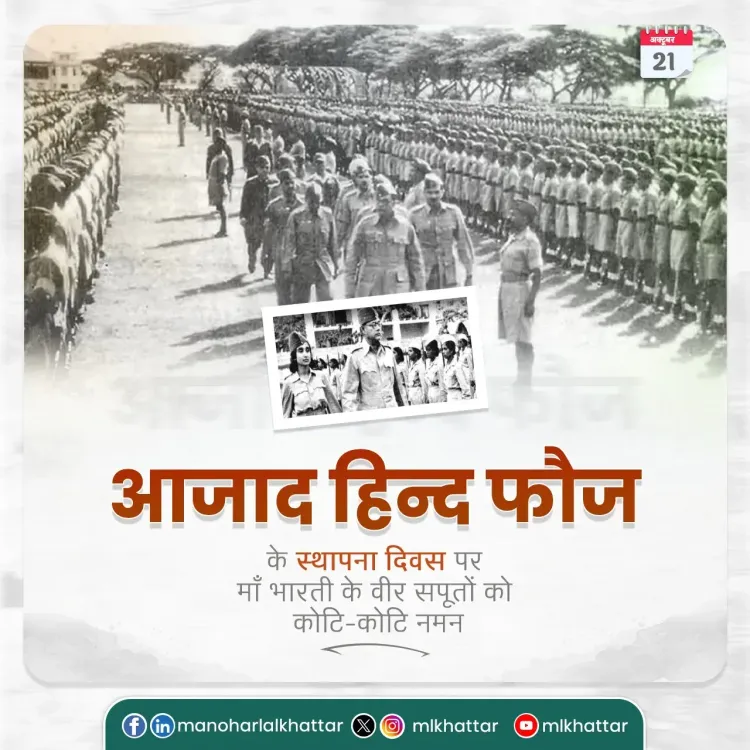
October 21 marks the Foundation Day of the Azad Hind Fauj (Indian National Army) , established in 1943 by Netaji Subhas Chandra Bose .
Union Minister Manohar Lal Khattar paid tribute to Netaji and INA soldiers on the occasion via a Hindi post on X.
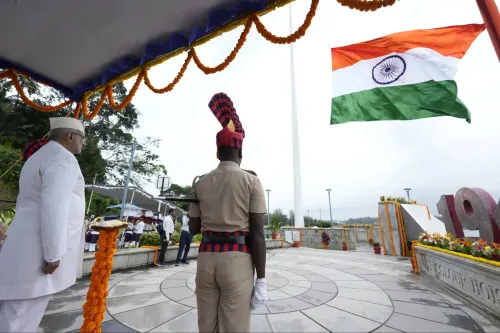
Khattar recalled the INA's hoisting of the tricolour in the Andaman and Nicobar Islands in 1943 — a symbolic declaration of Indian independence years before August 15, 1947 .
He attributed three core values to the INA legacy: sacrifice (tyaag), courage (sahas), and unbreakable love for the nation (aṭūṭ deśprem) .
The occasion, observed as Azad Hind Diwas , has gained growing institutional recognition in India, including the declassification of Netaji files and his portrait's installation at Kartavya Path .
On the Foundation Day of the Azad Hind Fauj (Indian National Army), Union Power Minister Manohar Lal Khattar on Wednesday, October 21, 2026, paid tribute to Netaji Subhas Chandra Bose and the valiant soldiers of the INA, invoking their 1943 moment of defiance that planted the tricolour on Indian soil.
Khattar's post, shared in Hindi, offered 'kotishaḥ naman evam vandan' — a salute of a hundred million folds — to Netaji and the INA's warriors. He specifically recalled how, under Netaji's leadership, INA fighters had hoisted the tricolour in the Andaman and Nicobar Islands in 1943 — years before formal Independence — declaring in that act the arrival of a free India.
The 1943 Tricolour Moment That Preceded Independence
The INA's raising of the Indian flag over the Andaman and Nicobar Islands on December 30, 1943 stands as one of the most symbolically charged moments of the freedom struggle. Netaji renamed the islands 'Shaheed (Martyr) and Swaraj (Self-Rule) Islands', signalling that the fight was not abstract but territorial — a government-in-exile exercising sovereign will. For many historians, this act made the INA not merely a military formation but the first government to physically claim Indian land under a national flag.
The Azad Hind Fauj was formally established on October 21, 1943, when Netaji Subhas Chandra Bose proclaimed the Provisional Government of Free India in Singapore. The INA was a multinational force — drawing heavily from Indian prisoners of war captured by Japan in Southeast Asia and the Indian diaspora across Malaya and Singapore. At its peak, it fielded tens of thousands of soldiers united by a single demand: 'Dilli Chalo' — 'March to Delhi.'
Sacrifice, Courage, and the 'Nation First' Legacy
Khattar's message distilled three pillars he attributed to the INA's ethos: tyaag (sacrifice), sahas (courage), and aṭūṭ deśprem (unbreakable love for the nation). He closed with an enduring call — that their stories would continue to inspire 'rashtra-seva aur ekta', national service and unity. The framing is a recurring motif in how the Indian political mainstream has sought to mainstream Netaji's legacy alongside the broader freedom movement.
For a government leader invoking this anniversary, the message carries weight beyond ceremony: the INA story, long contested in colonial historiography, has gained increasing institutional recognition — from the Netaji files declassification to his portrait being installed in Rashtrapati Bhavan and the Kartavya Path in New Delhi. October 21 is now widely observed as Azad Hind Diwas.
The INA soldiers — many of whom faced trial for treason at the Red Fort in 1945, only to become national heroes overnight — remain an enduring symbol of the proposition that patriotism requires no certificate from an empire. Their legacy, Khattar wrote, will 'remain a source of 'nation-first' inspiration for all eternity.'
Point of View
Long-running effort by the BJP-led government to fold Netaji Subhas Chandra Bose's legacy into the mainstream national narrative — alongside Mahatma Gandhi rather than in competition with it. Institutionalising October 21 as Azad Hind Diwas, declassifying Netaji files, and installing his hologram at India Gate are part of a coherent heritage-politics arc. Senior ministers amplifying the occasion on social media extends that institutional signal into the public domain, reinforcing a 'nation-first' ideological frame that the party has consistently made central to its identity. The tribute is ceremonial in form but deliberately political in its cultural resonance.
NationPress
21 Oct 2026
Frequently Asked Questions
When was the Azad Hind Fauj (INA) founded?
The Azad Hind Fauj (Indian National Army) was formally founded on October 21, 1943 , when Netaji Subhas Chandra Bose proclaimed the Provisional Government of Free India in Singapore.
Why is October 21 celebrated as Azad Hind Diwas?
October 21 is observed as Azad Hind Diwas to commemorate the founding of the Provisional Government of Free India and the Azad Hind Fauj by Netaji in 1943 — a milestone in India's armed struggle for independence.
When did the INA hoist the tricolour in the Andaman and Nicobar Islands?
The INA, under Netaji Subhas Chandra Bose's leadership, hoisted the Indian tricolour in the Andaman and Nicobar Islands on December 30, 1943 , symbolically declaring Indian sovereignty over the islands.
What did Manohar Lal Khattar say about the INA on Foundation Day 2026?
Union Power Minister Manohar Lal Khattar paid tribute to Netaji and INA soldiers, recalling the 1943 tricolour hoisting in the Andamans and calling the INA fighters an eternal source of 'nation-first' inspiration rooted in sacrifice, courage, and love for India.
What is the significance of the Andaman and Nicobar Islands in INA history?
The Andaman and Nicobar Islands were the first Indian territory where the INA physically hoisted the tricolour in 1943 . Netaji renamed the islands 'Shaheed' and 'Swaraj' Islands, making the act a declaration of practical sovereignty by the Provisional Government of Free India.