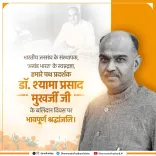
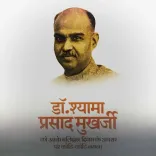
Khattar Pays Tribute to Dr. Shyama Prasad Mukherjee on Balidan Diwas

Synopsis
Union Power Minister Manohar Lal Khattar marked the death anniversary of Dr. Shyama Prasad Mukherjee on 23 June 2026, honouring the Bharatiya Jana Sangh founder who died in 1953 demanding full constitutional integration of Jammu and Kashmir under the slogan 'Ek Nishan, Ek Vidhan, Ek Pradhan.'
Key Takeaways
Manohar Lal Khattar , Union Power Minister, paid tribute to Dr.
Shyama Prasad Mukherjee on 23 June 2026 , his death anniversary.
Mukherjee founded the Bharatiya Jana Sangh in 1951 , the ideological predecessor to the BJP.
He died in detention in Srinagar on 23 June 1953 while protesting the special status of Jammu and Kashmir under Article 370 .
His slogan 'Ek Nishan, Ek Vidhan, Ek Pradhan' demanded one flag, one constitution, and one prime minister for all of India.
The demand was legislatively fulfilled when Article 370 was abrogated by Parliament in August 2019 .
The BJP observes 23 June as Balidan Diwas , with senior leaders offering annual tributes.
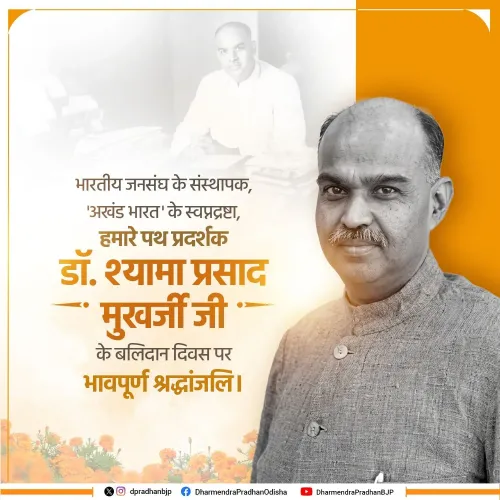
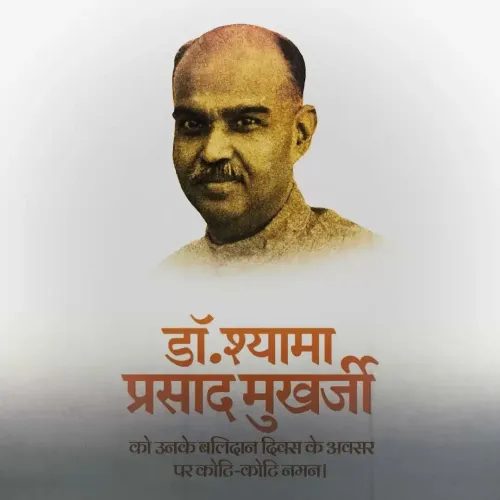
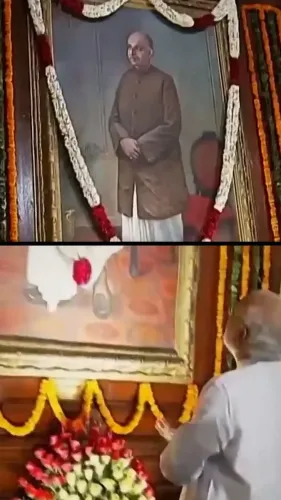
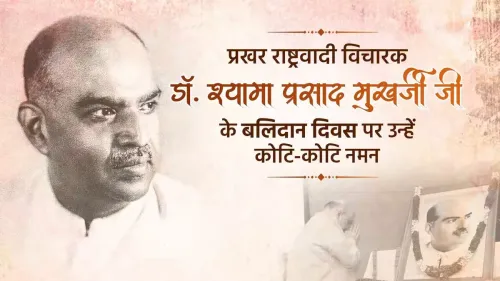
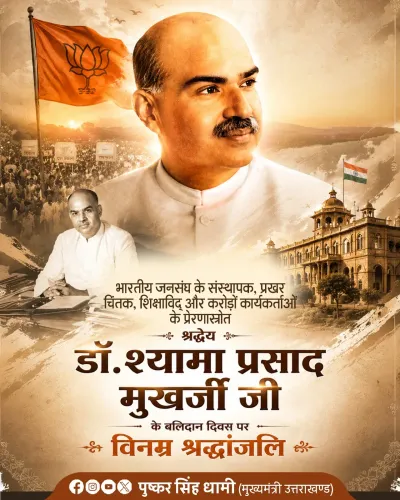
Union Power Minister Manohar Lal Khattar on Tuesday, 23 June 2026 paid homage to Dr. Shyama Prasad Mukherjee on his death anniversary, honouring the Bharatiya Jana Sangh founder as a supreme martyr who sacrificed his life for India's unity and territorial integrity.
Context
Khattar's post, written in Hindi, described Dr. Mukherjee as 'माँ भारती के महान सपूत' ('a great son of Mother India') and an 'unparalleled educationist and ardent nationalist.' He offered 'koti-koti naman' — salutations from countless Indians — on what the BJP and its ideological ecosystem observe as Balidan Diwas (Martyrdom Day). The minister recalled Mukherjee's famous slogan 'Ek Nishan, Ek Vidhan, Ek Pradhan' — 'One Flag, One Constitution, One Prime Minister' — which encapsulated his demand for full constitutional integration of Jammu and Kashmir with the rest of India.
Policy Backdrop
Dr. Shyama Prasad Mukherjee founded the Bharatiya Jana Sangh in 1951, with national integration as its foundational objective. He died in detention in Srinagar on 23 June 1953 while protesting the requirement that Indian citizens obtain a permit to enter Jammu and Kashmir — a consequence of the special status granted to the state under Article 370 of the Constitution. The Bharatiya Jana Sangh is widely regarded as the ideological and organisational predecessor to the Bharatiya Janata Party (BJP).
The demand Mukherjee gave his life for found legislative fulfilment in August 2019, when the Government of India abrogated Article 370 in Parliament and reorganised Jammu and Kashmir into two Union Territories: Jammu and Kashmir and Ladakh. The BJP has consistently framed this act as the realisation of Mukherjee's ultimate political goal.
Stakeholders and Impact
The annual commemoration on 23 June carries significance for BJP workers and affiliated organisations across the country, who observe the day with events, rallies, and tributes. For residents of Jammu and Kashmir, Mukherjee's legacy remains intertwined with the long-running debate over the region's constitutional status — a debate that was formally settled, at least legislatively, by the 2019 abrogation. Khattar's tribute, coming from a senior Union Minister and former Chief Minister of Haryana, amplifies the occasion's national visibility.
Khattar wrote that whenever the stories of struggle for India's unity and integrity are written, Mukherjee's name 'will be inscribed in golden letters.' The framing positions Mukherjee alongside freedom fighters in the nationalist canon — a characterisation that the BJP has advanced consistently since coming to power at the Centre.
What's Next
The 23 June observance is an entrenched fixture in the BJP's annual political calendar, and tributes from senior leaders including ministers, chief ministers, and the Prime Minister are customary. With Jammu and Kashmir continuing its transition as a Union Territory — including the restoration of statehood remaining a subject of political and judicial discussion — the symbolism attached to Mukherjee's martyrdom is likely to remain a live reference point in BJP political messaging. The government's posture on further administrative or symbolic measures reinforcing the constitutional integration of the region will be watched in the months ahead.
Point of View
Elevating him to the stature of a freedom fighter rather than a merely partisan figure. The invocation of the 'Ek Nishan, Ek Vidhan, Ek Pradhan' slogan serves a dual purpose: honouring a historical leader while implicitly validating the 2019 abrogation of Article 370 as the completion of an unfinished national mission. For the BJP, Balidan Diwas functions as both a moment of remembrance and a political reaffirmation of the party's ideological lineage. As Jammu and Kashmir's statehood question remains unresolved, these annual observances also carry a forward-looking political charge.
NationPress
23 Jun 2026
Frequently Asked Questions
Who was Dr. Shyama Prasad Mukherjee and why is he remembered?
Dr. Shyama Prasad Mukherjee was the founder of the Bharatiya Jana Sangh in 1951 and a prominent educationist and nationalist. He is remembered for his demand that Jammu and Kashmir be fully integrated into India under the same constitutional framework as other states, a cause for which he died in detention in Srinagar on 23 June 1953.
What is Balidan Diwas?
Balidan Diwas, meaning Martyrdom Day, is observed on 23 June each year to mark the death anniversary of Dr. Shyama Prasad Mukherjee. The BJP and affiliated organisations hold tributes and events across the country on this day.
What did the slogan 'Ek Nishan, Ek Vidhan, Ek Pradhan' mean?
'Ek Nishan, Ek Vidhan, Ek Pradhan' translates to 'One Flag, One Constitution, One Prime Minister.' Dr. Mukherjee coined this slogan to demand that Jammu and Kashmir not have a separate flag, constitution, or prime minister, and that it be governed on the same terms as other Indian states.
What happened to Article 370 that gave Jammu and Kashmir special status?
Article 370 of the Indian Constitution, which granted special autonomous status to Jammu and Kashmir, was abrogated by Parliament in August 2019. The state was simultaneously reorganised into two Union Territories: Jammu and Kashmir, and Ladakh.
What is the connection between the Bharatiya Jana Sangh and the BJP?
The Bharatiya Jana Sangh, founded by Dr. Shyama Prasad Mukherjee in 1951, is the direct ideological and organisational predecessor to the Bharatiya Janata Party. The BJP traces its political lineage and many of its core principles back to the Jana Sangh.